
A joint study by scientists from the YSU Institute of Physics and their colleagues at the National University of Singapore has been published in the international scientific journal Advanced Optical Materials. The researchers investigated the optical properties of naturally occurring muscovite and identified its potential for developing ultrathin nanophotonic devices.
The scientists found that muscovite has a low refractive index and low optical losses across the ultraviolet-to-near-infrared spectral region. These properties are important for developing all-van-der-Waals ultrathin photonic devices.
The findings are presented in the article "Dielectric Permittivity Tensor of Muscovite for Next Generation All Van Der Waals Broadband Photonic Components", co-authored by Meri Hayrapetyan, Maxim Sargsyan, Davit Karakhanyan, Ani Khachatryan, Maria Levonyan, Artsruni Margaryan, and Davit Ghazaryan, all from the YSU Institute of Physics.
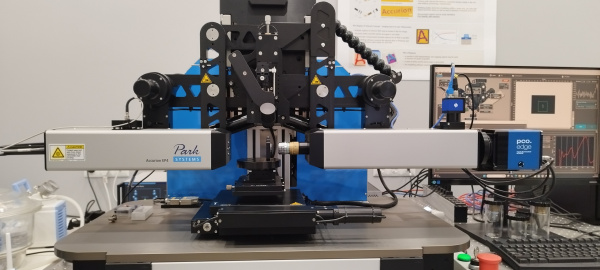
The research team determined the optical constants of muscovite across a wavelength range of 250–1,700 nm. Using spectroscopic micro-ellipsometry, the scientists characterized muscovite's anisotropic dielectric response and found that the material maintains a low refractive index and negligible absorption throughout the investigated spectral region.
The researchers also demonstrated that muscovite exhibits weak in-plane birefringence, which can be neglected in thin layers less than 250 nm thick. These findings highlight the potential of muscovite as a low-index optical layer in photonic components based on layered van der Waals materials.
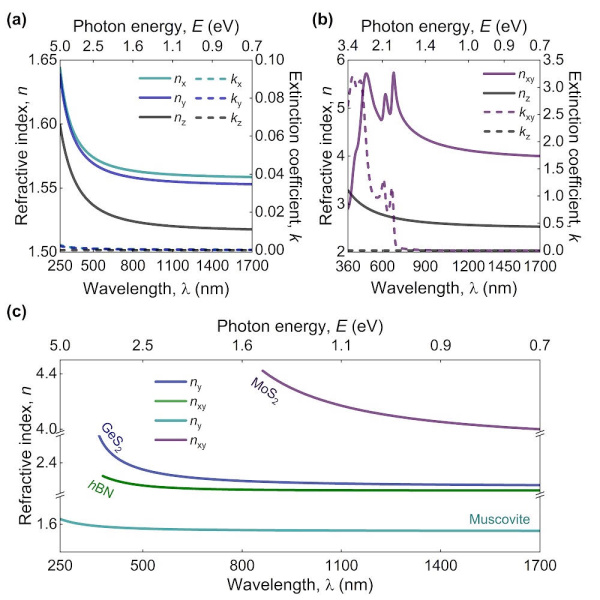
Optical properties of muscovite and MoS₂ and their refractive-index contrast
The scientists further combined muscovite with molybdenum disulfide (MoS₂), a high-index van der Waals material, to design nanophotonic components. The strong refractive-index contrast between the two materials enables efficient control of light through optical interference.
Using this combination, the researchers designed all-van-der-Waals distributed Bragg reflectors (DBRs) and short-pass dichroic beam splitters (DSBs) operating in the near-infrared (NIR) spectral region.
The five-layer DBR has a total thickness of 650 nm and achieves average reflectance exceeding 95% at wavelengths above 1,100 nm. The short-pass DSB is 690 nm thick and provides an average transmittance of 98% across the 990–1,040 nm spectral region, while maintaining high reflectance across the 1,240–1,700 nm wavelength range.
The results demonstrate the potential of combining muscovite with high-index van der Waals materials to develop thin, efficient optical components.
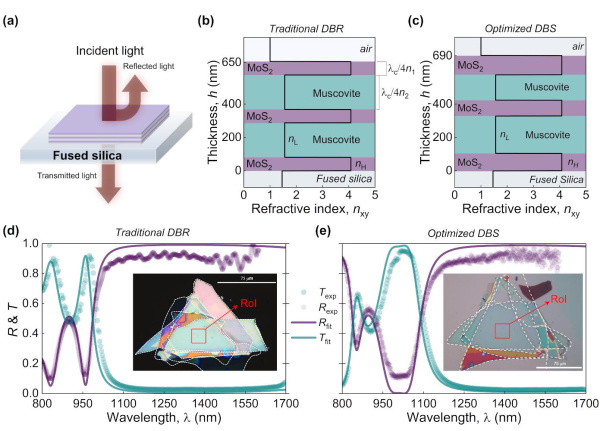
Structure and optical characteristics of all-van-der-Waals nanophotonic components made of muscovite and MoS₂
The researchers then presented schematic illustrations of the layered structures, refractive-index profiles, and measured and modeled optical responses of the components.
The findings highlight the potential of muscovite as a low-optical-loss material for developing next-generation all-van-der-Waals nanophotonic components. The joint work by YSU scientists and their international colleagues contributes to the exploration of new material solutions for designing ultrathin optical devices.