October 28, 2026 | 10:30
Science
International cooperation
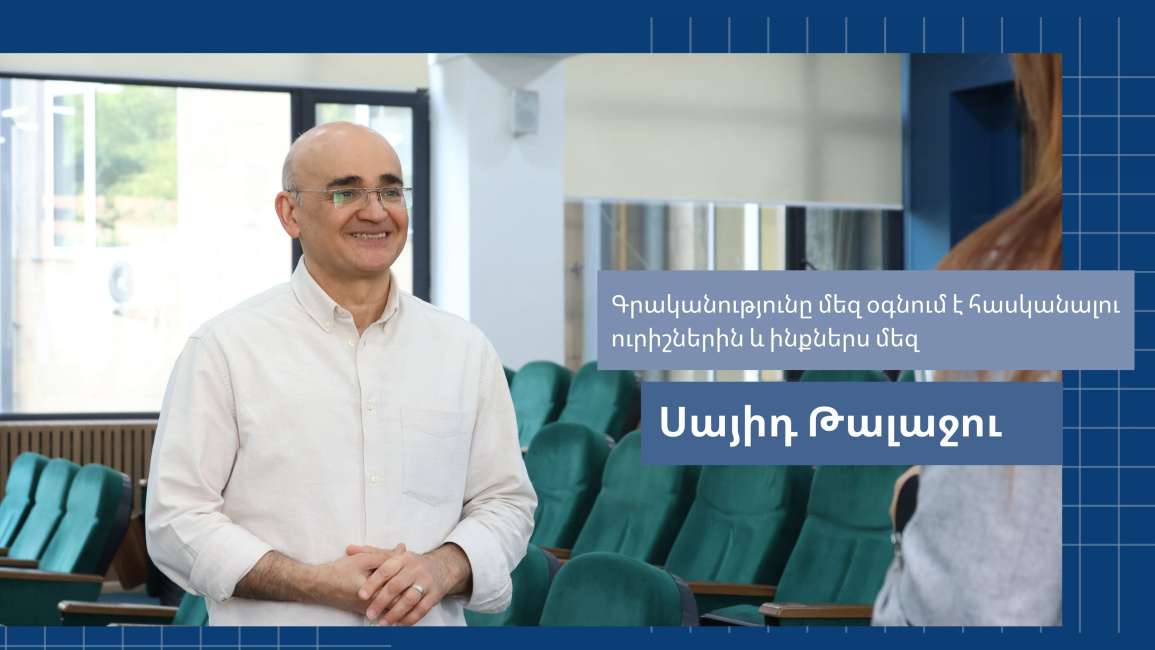
At the heart of Talajooy's research is how culture can help us understand society and human relationships.
In this interview, we discuss his academic journey, the role of literature and cinema in understanding the world, the Iranian tradition of javānmardī and its ideals of chivalry, as well as Armenian-Iranian cultural ties and opportunities for collaborative research.
- Mr Talajooy, you have spent many years studying Persian literature, Iranian cinema and theatre, and questions of cultural identity. Where did your interest begin, and how did your academic career take shape?
- My interest in literature and culture began at a very early age, when I was about seven or eight. I loved reading not only children's stories but also works about different societies and cultures, which helped me understand the world and the people around me.
The Iranian Revolution deepened that interest. I was about twelve or thirteen at the time. I began thinking about politics, but what interested me most was not the struggle between political groups, but what Iranians needed to build a better society. I was troubled by why people so often struggle to tolerate one another and why they seek to eliminate those who are different from them rather than cooperate and build a shared future.
When I was thirteen or fourteen, a few like-minded people and I set up a small library in our neighbourhood. We brought books from our homes and borrowed some from relatives. Over time, the collection grew to around 1,000 books. We made them available to readers, hoping to create a place where people could come together through ideas and literature.
However, political divisions intensified in the post-revolutionary period, and we had to close the library. That experience showed me more clearly how easily ideological conflicts can prevent people from working together.
Later, when I was unable to enter university for a period, I began studying psychology, sociology, Iranian history, literature, cinema and theatre in greater depth. What began as a desire to understand the world gradually developed into research. Over time, I also turned my attention to the history of Iranian theatre and the works of Bahram Beyzaie.
Yet the same question has always been at the heart of my work: How can we understand ourselves and others so that we can live better together? I believe literature, cinema and other forms of culture can help us find possible answers.
- What can Persian literature and Iranian cinema teach Armenian students that they might not fully learn from history textbooks or political analyses alone?
- This is a particularly interesting question for Armenian students. Armenia has a long history of contact with neighbouring peoples and cultures. Exposure to different languages and cultures can encourage creative thinking and a broader understanding of the world.
Understanding a culture takes more than gathering information about who ruled as king, what political events took place or how relations between states developed. All of that matters, but it does not always help us understand how people think and feel, what they fear or what they value.
To understand Iranians, it is important to study their literature, cinema and myths, which reveal how they see themselves, what they value and how they view their relationships with others. Similarly, Armenian folk tales, literature and cinema can reveal the values that matter to Armenians. Comparing these works allows us to identify similarities and differences between the two cultures.
I often say that knowing someone's story makes it easier to understand and accept them. When we do not know another person's story, we may see them as an adversary. But when we try to understand their experiences, worldview and cultural background, we create greater opportunities for dialogue and cooperation.
That is why literature and cinema are also important for those studying history or politics. They allow us to look more deeply into the inner life of a society and understand what sometimes remains hidden beneath the surface of political events.
I believe studying politics without an understanding of culture and literature can lead to a superficial understanding. A good diplomat must understand not only what the person they are speaking with is saying, but also the cultural context in which that person's ideas and values were formed.
- In your research, particularly your study of heroism in Bahram Beyzaie's works, you explore the tradition of javānmardī. How would you explain this concept to Armenian students, and what similarities might exist between it and Armenian cultural traditions?
- In Iranian cultural tradition, javānmardī is associated with chivalry, virtue, honour and responsibility towards others. Different societies have developed their own ideals of chivalry and heroism, many of which are linked to the strength and energy of youth. The central question is how that strength is directed: towards destruction or towards activities that benefit society.
In Persian, javān means "young", while mard is associated with the idea of a man. But understanding javānmardī in purely literal terms is not enough. It involves maturity, taking responsibility and putting one's strength to a higher purpose.
Javānmardī emphasises courage, honour, loyalty, compassion and a willingness to protect others. According to this ideal, a strong person is not simply someone who defeats others, but someone who uses their strength to protect vulnerable people and contribute to the well-being of society.
Several types of heroic figures can be distinguished within the tradition of javānmardī. The first is the pahlavan, a powerful warrior who protects people and is prepared to sacrifice his own interests when necessary. The second is the ayyar, a resourceful and agile figure who uses his skills to fight injustice and help those in need. The third is the pir, a wise person who uses knowledge, experience and new ideas to help guide society in the right direction.
These figures show that heroism is not simply about physical strength or military victory. It also encompasses wisdom, responsibility and care for others.
I believe similar ideas can be found in Armenian culture. If we examine Armenian epics and folk tales, we encounter heroes who use their strength and abilities to protect their communities or bring people together. The Armenian epic Daredevils of Sassoun also presents an ideal of heroism centred on defending the community and restoring justice. This common ground could provide a basis for comparative research into the heroic ideals of the two cultures.
The concept of javānmardī is also relevant to contemporary society. It reminds us that strength and energy should serve to protect life rather than destroy it.
- Armenia and Iran have a long history of cultural interaction. What opportunities do you see for collaboration between Armenian and Iranian researchers?
- The presence of Armenians in Iranian culture and the long history of contact between the two societies offer interesting opportunities for research.
This does not necessarily mean that one perspective is better than another. However, experiences from different cultural settings can raise new questions and help identify new solutions. That is why collaboration between Armenian and Iranian researchers could be productive.
Potential areas for joint research include comparative studies of folk epics, concepts of heroism, the history of theatre, literary traditions and the representation of cultural identity in cinema. Researchers could also explore how ideas of solidarity, honour, responsibility and coexistence are expressed in the two societies.
Collaboration does not mean agreeing on everything. What matters is ensuring that differences and disagreements do not stand in the way of dialogue and working together. We can discuss different perspectives, understand one another's interests and try to find solutions that allow us to continue our joint work.
- Why would you recommend that students interested in studying Iranian culture begin by watching Iranian films?
- If you want to begin exploring Iranian culture, I would recommend starting with cinema. Film can be an excellent introduction to another culture. Even if viewers do not fully understand the language spoken in a film, visual storytelling can help them understand the characters' relationships, emotions and circumstances.
Iranian cinema encompasses a wide range of genres and styles, and many films explore society's values, tensions and everyday life. I would recommend watching different kinds of films rather than limiting yourself to the works of internationally recognised filmmakers. This allows you to explore both deeper cultural questions and people's everyday experiences.
From there, you can move on to literature, theatre and language study. Knowing Persian opens up new possibilities because it allows you to read literary works in the original and better appreciate their linguistic and cultural nuances.
For example, the epic Shahnameh can reveal a great deal about Iranian cultural memory, ideals of heroism and historical identity. Similarly, every people can gain a deeper understanding of the fundamental layers of its culture through its own epics and folk tales.
It is important to watch films not only for entertainment but also as material for study. Try to understand what motivates the characters, what they value and how they relate to one another. Then consider what you have seen alongside historical and political studies. In this way, cultural and historical knowledge can complement each other.
- Which Armenian films, or films related to Armenian culture, stand out to you, and which Iranian film would you recommend to students?
- That is a difficult question.
I remember a film called The Spring (Cheshmeh), which is connected to an Armenian myth. It was made by Iranian-Armenian director Arby Ovanessian. I found the film interesting because it showed how a folk story could be used to convey human emotions. It is an interesting example of how certain aspects of Armenian culture can be explored through cinema.
From Iranian cinema, I would single out Bahram Beyzaie's Bashu, the Little Stranger, which explores questions of human solidarity, compassion and belonging.
The film centres on a village woman whose character brings out ideas of compassion, courage and a willingness to protect others. What matters to me is that these ideas are conveyed through the actions of real people rather than abstract arguments.
The film reminds us that a person's worth is determined not only by their origins or identity, but also by how they treat others.
- What advice would you give Armenian students who want to specialise in Iranian studies? What skills and approaches are important for success in this field?
- I would advise them to maintain an interdisciplinary approach.
If you want to understand a society, do not limit yourself to historical facts. History helps us understand the sequence of events, sociology reveals social relationships, psychology sheds light on some of the motives behind human behaviour, and literature explores deeper layers of human experience.
Each discipline offers a particular perspective. If you study only one field, you may see one aspect of an issue while overlooking others. By bringing different disciplines together, you can develop a more complete picture.
The same applies to cultural identity. When studying it, it is important to recognise that a person's sense of belonging has multiple layers, including national, linguistic, social and other dimensions.
I would also encourage students to learn as many languages as possible and explore different cultures. My grandfather used to say that every new language you learn makes you another person. I understand this to mean that learning a new language broadens the ways in which we can see the world. It allows us to understand how other people think and express themselves.
But simply gathering information about other cultures is not enough. You also need to be creative: ask new questions, draw comparisons, form your own conclusions and apply what you have learned.
In my view, one of the great values of science and education is that they allow us to discover new ways of seeing the world. A good researcher is not someone who simply repeats what is already known, but someone who can bring together different perspectives and offer new interpretations.