November 12, 2026 | 13:00
Partners
Career
Graduates
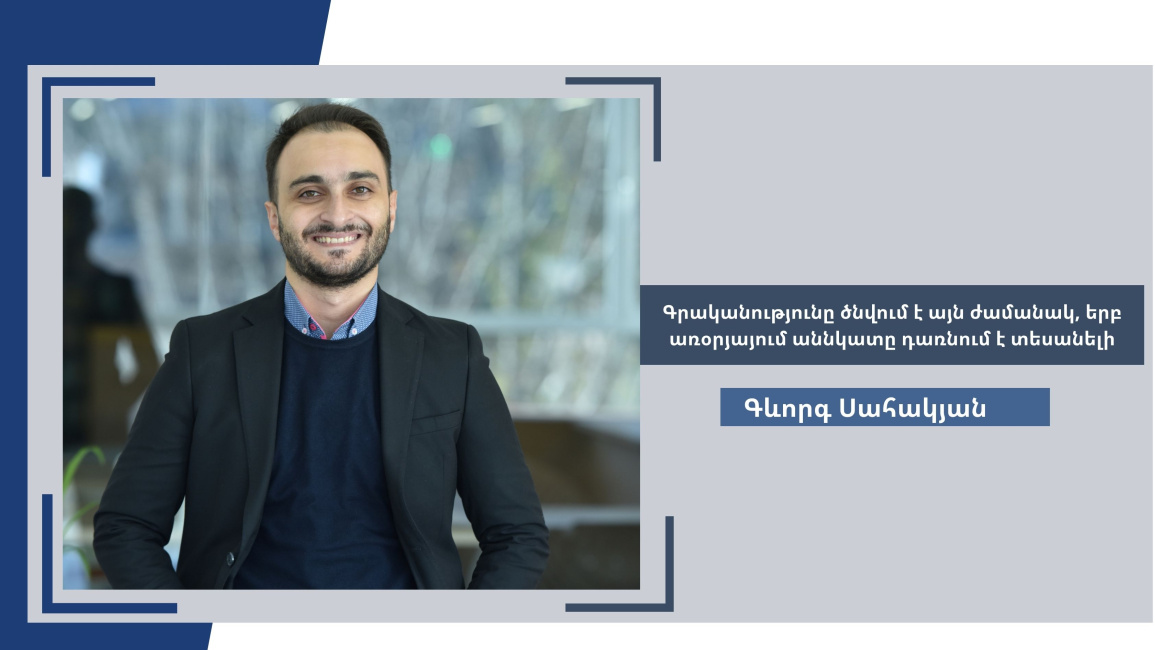
- Mr. Sahakyan, what does creativity mean to you, and how does it manifest itself in your everyday life?
- It is what I love most: writing and reading. The first thing that comes to mind is observation. You instinctively try to turn things happening to you into literary texts. That is how it works for me. A photographer might look at something and think about what an interesting photograph it could make; a musician might find inspiration in it. I try to find a text in everything.
What makes a text unique is that you do not necessarily have to see something extraordinary. It could be an inconspicuous occurrence that few people notice, but you recognize it could make an interesting text. That makes you look at everything from that perspective.
I have not written anything for two years now, and I find that a little difficult because I have no material to work with.
- Perhaps this is related to the feeling that everything has already been written about?
- Probably. It feels as though everything has already been said and written. You cannot seem to uncover anything new, and you don't know where to find new material again.
- What changes in a person when they choose a pen name?
- It helps me. When I need to, I introduce myself by that name; when I do not, I do not. For example, it would be a little unusual for people to address me by my pen name when I am teaching.
Recently, friends of mine from Vanadzor invited me to speak about literature. One of them said, "Mr. Jesah" (laughs - ed.). It was quite funny. Hearing the title "Mr." used with my pen name felt unusual.
A pen name is a good way to separate identities. Sometimes you may feel freer expressing an opinion on certain issues as a fiction writer than, for example, as a government employee or lecturer.
- Are your students interested in your literary work? Do you talk about literature during classes?
- During class, we mostly focus on the subject. Sometimes we may digress a little and talk about literature, for example, to make things more interesting and keep students from getting too tired. But I make a point not to talk about my own books.
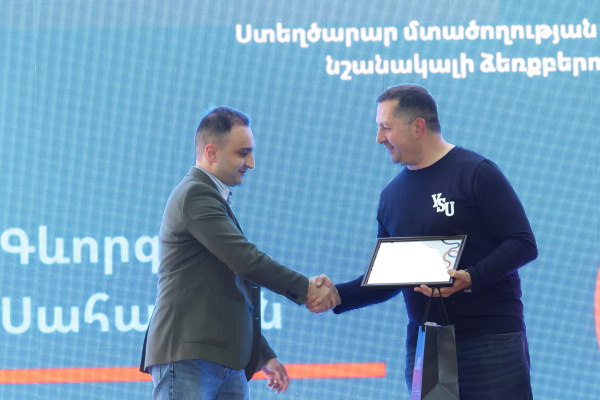
- How has the spread of artificial intelligence affected the assignments you give your students?
- When AI tools became widely available, I stopped assigning research papers to students. If I were a student myself, I would certainly use AI.
- During your years of teaching at YSU, what changes have you observed in the quality of education and the organization of the learning process?
- I am very satisfied with the quality of education at YSU. It improves year after year. I serve on examination committees every year and see that students are very well prepared. Many of them are highly intelligent, which is certainly commendable.
Quite a lot has changed. Requirements have become stricter. For example, students must now submit the methodological section of their master's thesis in advance. This means they do not wait until the last minute and then have to produce poor-quality work. It may seem like a simple procedural change, but it makes a significant difference.
- You also talk about books on your Instagram page. In your opinion, why should people read books?
- I love reading. I can get tired of almost anything, but reading is the one thing that has never tired me; it is something wonderful to me. I feel bad when I cannot explain to others what they are missing out on by choosing not to read.
The most brilliant people throughout history, both philosophers and writers, have given us their carefully refined thoughts. How can anyone turn down such a gift?
I also believe it is important to read contemporary authors because they write about the world we live in.
- Which literary works have had the greatest influence on you?
- The Picture of Dorian Gray. It is a fantastic book for people who are just beginning to read.
After that, Thus Spoke Zarathustra left a strong impression on me. It's a book I keep coming back to, and I've probably read it 10 to 15 times. I might see it differently today, but reading it back then made me think about what an author's mind can be like, what forms it can take, and what kinds of ideas it can produce.
Dostoevsky's The Brothers Karamazov came next, followed by Faulkner. Shakespeare, of course, continued to surprise me from time to time along the way.
The most recent author to impress me is Cormac McCarthy. For years, I had not read anyone whose work made me think, "What a new thing this is!" But I had that reaction when I read McCarthy.