October 20, 2026 | 11:30
Conferences
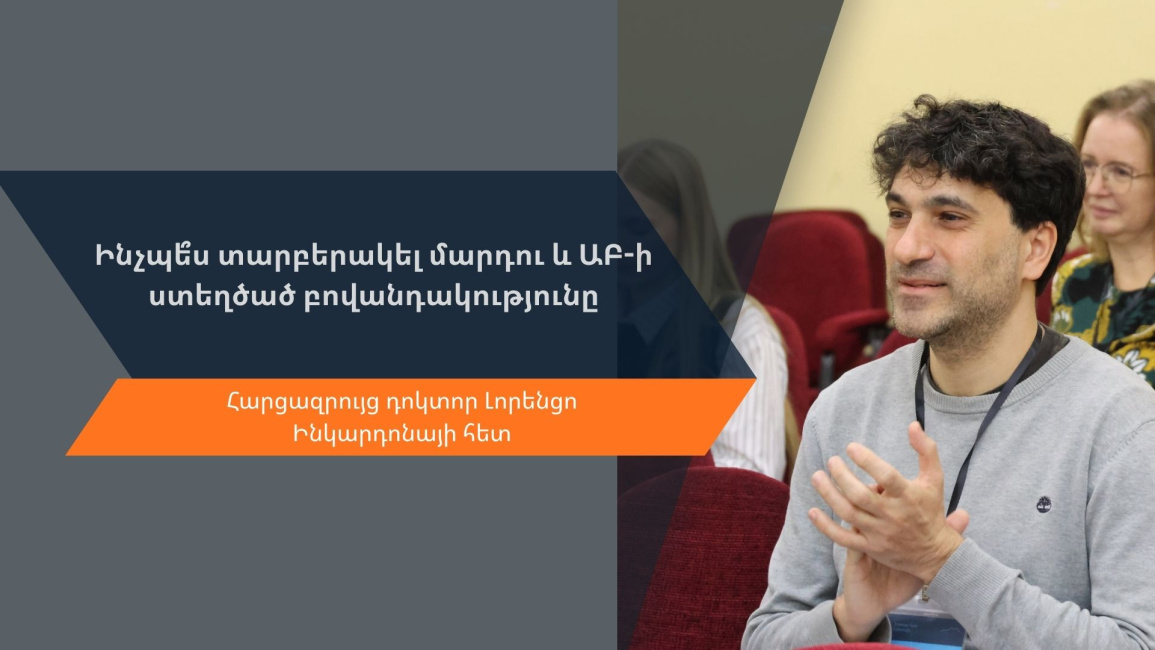
AI systems today largely rely on statistical patterns. According to Lorenzo Incardona, however, one important direction in AI development is improving systems' ability to represent knowledge of the world and make more well-founded judgments.
The researcher highlights in particular the creation of what are known as world models.
"Today, the main goal of cutting-edge research in AI is to move toward world models. The question is: Can we advance artificial intelligence further by equipping it with a reliable representation of knowledge and robust ontologies so that it can reason more deeply and logically about the world and reality itself?" Incardona says.
The idea behind this approach is to expand AI systems' capabilities by moving beyond statistical patterns toward more structured representations of knowledge and logical reasoning.
How can we tell whether a text was written by a human or by AI?
Incardona's answer may come as a surprise: "We should not make that distinction."
According to the researcher, AI-generated texts can also be studied as semiotic artifacts. From this perspective, what matters is not only who or what produced a text but also how readers interpret and evaluate its content.
"Our goal should be to foster a new culture of reading. We should focus on developing people's critical reading skills and not worry too much about whether the author is human or artificial," Incardona emphasizes.
He therefore suggests placing greater emphasis on how a text is understood and critically analyzed, rather than focusing solely on its origins.
Although Incardona gives priority to the meaning and value of content, he does not rule out the possibility that, in some cases, it may be necessary to determine how and by whom a text was produced.
Various tools are available today to detect AI-generated content by analyzing the linguistic and stylistic features of texts. Incardona, however, also suggests using philological and investigative methods. These involve examining which sources were used to produce a text, how they were processed and whether the author actually had access to them.
"Those are the factors I would look at when trying to distinguish human authors from artificial ones, although, as I said, we should not be overly concerned about this," Incardona concludes.
His observations show that advances in AI are raising new questions not only for those developing technology but also for those reading texts. In this context, the ability to verify sources, analyze information and critically evaluate content is becoming increasingly important.
Lorenzo Leucio Domenico Incardona holds a doctorate in semiotics and is a lecturer and consultant in artificial intelligence.
He earned his doctorate from the University of Bologna. His research focused on computational semiotics and the Semantic Web. He received the Enrico Manca Award in 2013.
For more than a decade, he has worked at the intersection of semiotics and technology. He has led international research teams working on knowledge graphs, data processing and AI model training.
He teaches AI fundamentals, prompt engineering, generative AI, as well as ethical and legal issues related to artificial intelligence.