October 22, 2026 | 14:00
Conferences
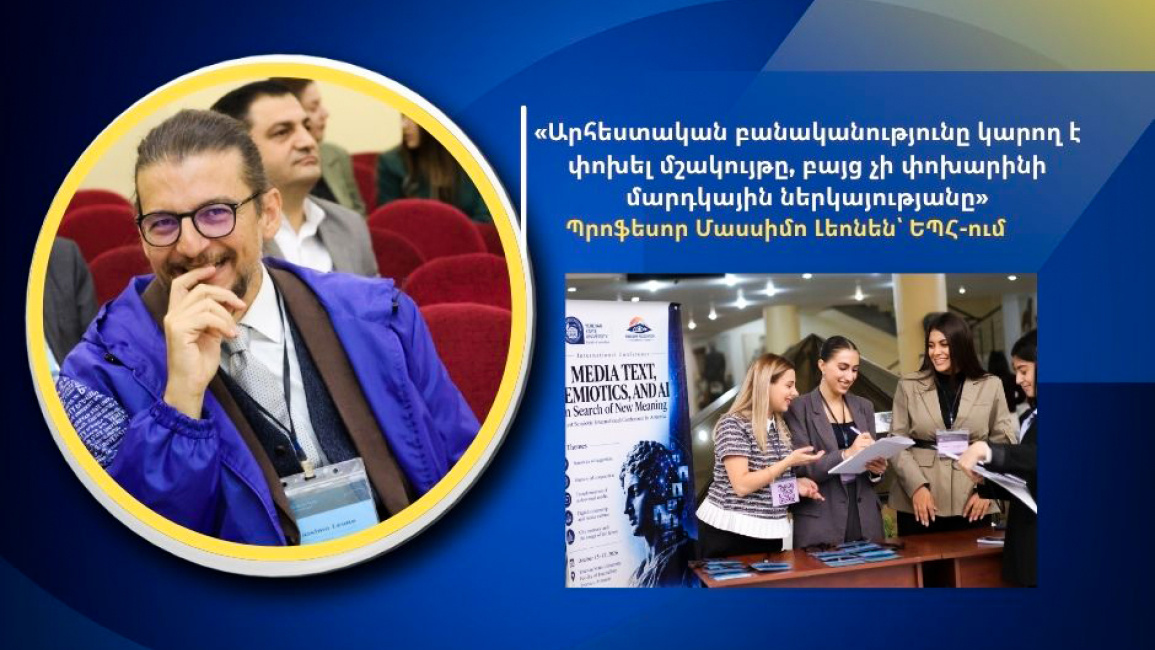
Professor Massimo Leone opened his presentation at the international conference not with a scientific observation about technological advances, but with a story about a rain poncho he had received as a gift from Yerevan State University.
He recalled receiving the poncho at the end of a previous visit to Armenia. For him, it had become more than a memorable gift; it was a symbol of his connection to Armenia and the relationships he had built with his university colleagues.
Through this story, Leone illustrated one of the central ideas of semiotics: Objects can acquire meanings that go beyond their practical purpose.
In this case, the rain poncho was more than an everyday item. It carried personal memories, emotions and human connections.
The professor also recalled another experience from his previous visit to Armenia. He described how he had rushed to buy Armenian lavash after arriving in Yerevan because it reminded him of the time he had spent there with his daughter. He also remembered how his young daughter had learned to say "thank you" in Armenian — "շնորհակալություն" — at markets in Yerevan.
"Even my daughter is a little Armenian," Leone joked.
According to Leone, as artificial intelligence and digital communication continue to develop, the importance of being physically present with others is becoming even greater.
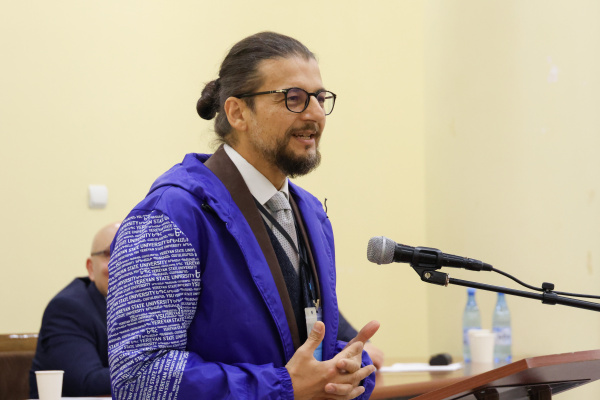
He noted that as technology makes it possible to reproduce voices, images and various forms of communication, face-to-face encounters and the physical world take on greater significance.
"It is important that I am here with you in person, and not just through my digital voice or digital presence," the researcher emphasized.
This observation offers a different perspective on one of the conference's central themes: the impact of artificial intelligence. The question is not only what technology can create, but also what human experience and direct interaction come to mean as the digital world expands.
In the final part of his presentation, Massimo Leone discussed the cultural changes expected as artificial intelligence continues to develop.
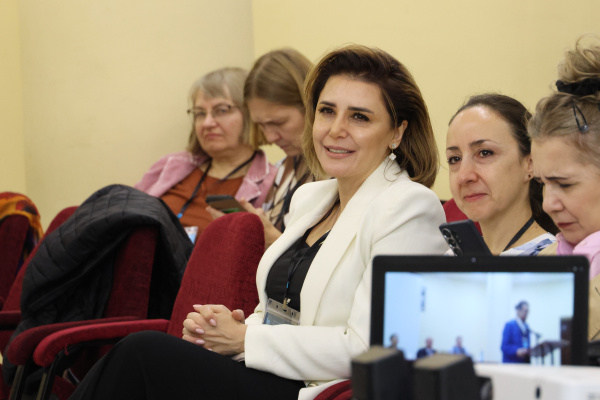
He observed that digital technologies and AI are playing an increasingly important role in the creation and dissemination of cultural content.
As a result, it may become more difficult to distinguish between cultural content created independently by humans, content produced through collaboration between humans and technology, and content generated entirely by artificial intelligence.
Leone did not rule out the possibility that AI-generated cultural content could become dominant in the future. Nevertheless, the central emphasis of his presentation was not on technological capabilities but on the value of human presence and direct experience.
Leone's presentation serves as a reminder that culture is not merely the content we create. It also encompasses the connections people forge, the memories they share and their relationship with the physical world.
Massimo Leone is an Italian semiotician and Professor of Philosophy of Communication, Cultural Semiotics and Visual Semiotics at the Department of Philosophy and Educational Sciences of the University of Turin.
He is also Professor of Semiotics at Shanghai University, Associate Member of Cambridge Digital Humanities at the University of Cambridge, and Director of the Institute for Religious Studies at the Bruno Kessler Foundation in Trento.
He has authored 15 monographs, edited more than 50 academic volumes and published over 500 research articles in semiotics, religious studies and visual studies.
He received a European Research Council (ERC) Consolidator Grant in 2018 and an ERC Proof of Concept Grant in 2022.
His research interests also include digital culture, artificial intelligence, visual communication and the impact of technology on the formation of human identity and cultural meanings.