Panel discussions are one of the key formats of the forum, bringing together professionals from various fields, alumni, and partners on a single platform to discuss the most pressing challenges and opportunities of the modern world. The discussion topics are aimed at highlighting the role of YSU as a center of intellectual, academic, and social impact, the international significance of Armenian studies, the formation of innovation ecosystems, the green development agenda, and transformations in higher education. This format creates opportunities not only for the exchange of views, but also for the development of new approaches and directions for cooperation.
The panel discussions will be held under the following themes:
1. Transformations in Education: How the Modern World Is Redefining Education
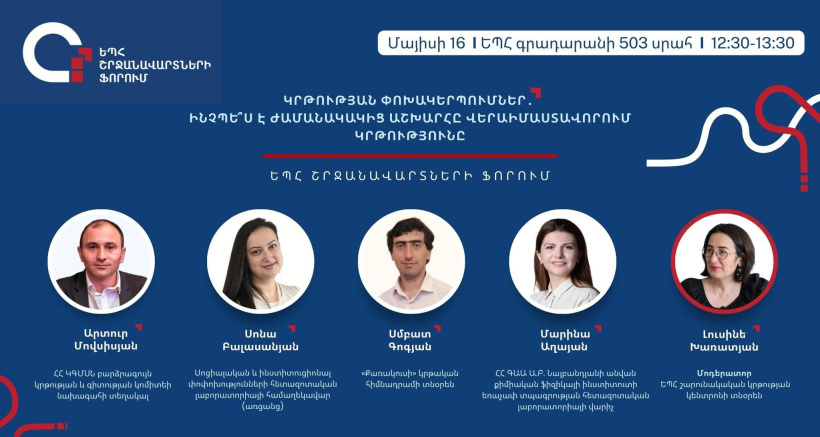
The modern world is changing rapidly, and at the center of these changes lies education—its content, formats, methods, and objectives.
Within the framework of the YSU Alumni Forum, the panel discussion titled "Transformations in Education: How the Modern World Is Redefining Education" will address the following questions:
What factors are currently influencing education, particularly higher education?
What opportunities and challenges are emerging for universities?
How can the education system be reorganized in response to present and future demands?
The discussion will not be limited to raising questions. It is intended to serve as a platform for the exchange of ideas, where conversations about the future of education may evolve into new programs, collaborations, and university initiatives.
2. COP17: Armenia at the Center of the Global Environmental Agenda — Priorities for the Academic Community
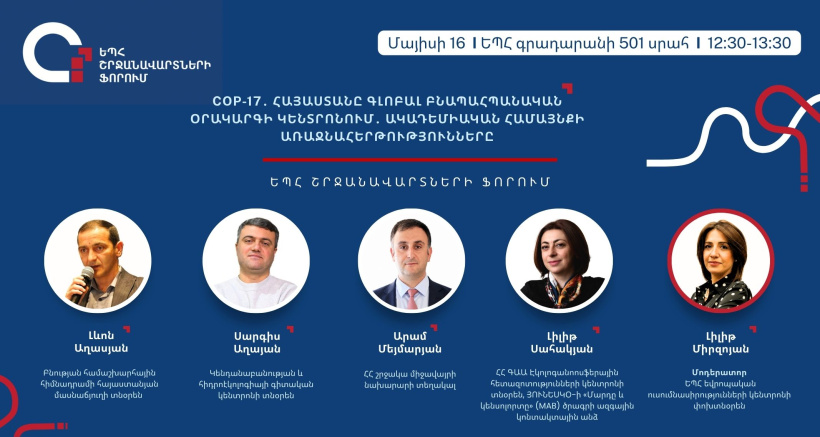
Armenia is positioned at the center of the global environmental agenda, and in this context it is important to understand the significance of COP-17 for the world, for Armenia, and especially for the academic community.
Within the framework of the YSU Alumni Forum, the panel discussion titled "COP17: Armenia at the Center of the Global Environmental Agenda — Priorities for the Academic Community" will address the following questions:
What substantive and political significance does the conference hold for Armenia and the world?
What roles can the state, the academic community, and other stakeholders play?
How can academic knowledge and expertise contribute to shaping and implementing the environmental agenda?
The discussion aims not only to identify key issues and priorities, but also to generate practical ideas that may lead to new programs, collaborations, and university initiatives.
3. Opportunities and Challenges in Developing YSU's Innovation Ecosystem
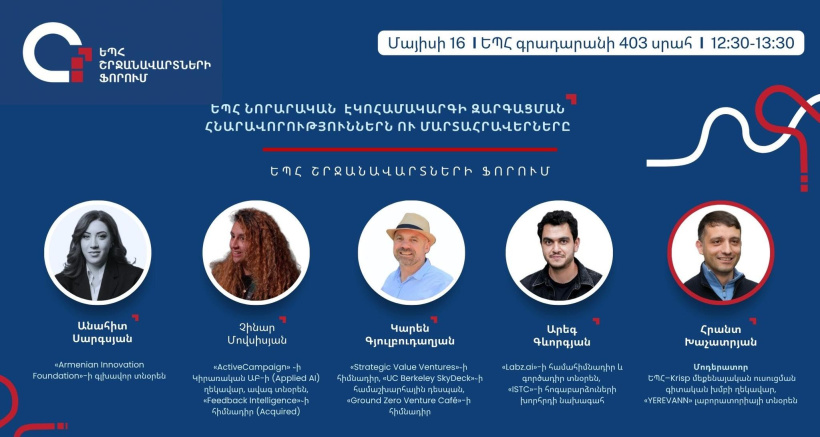
The development of an innovation ecosystem is one of YSU's key areas of development, enabling academic knowledge, research potential, and creative ideas to be transformed into practical solutions.
Within the framework of the YSU Alumni Forum, the panel discussion titled "Opportunities and Challenges in Developing YSU's Innovation Ecosystem" will address the following questions:
To what extent does YSU have the potential to develop an innovation ecosystem?
How can academic knowledge and research outputs be transformed into practical solutions?
What models can support effective university–industry collaboration?
How can YSU alumni, international partners, and the Diaspora contribute to the development of the innovative environment?
What structural, financial, and governance solutions are needed for sustainable ecosystem development?
How can students and faculty be supported in developing innovative thinking, practical skills, and the ability to transform ideas into real projects?
The discussion aims not only to identify opportunities and challenges, but also to generate practical ideas that may contribute to the development of new programs, partnerships, and innovative initiatives at YSU.
4. Development Prospects for Armenian Studies
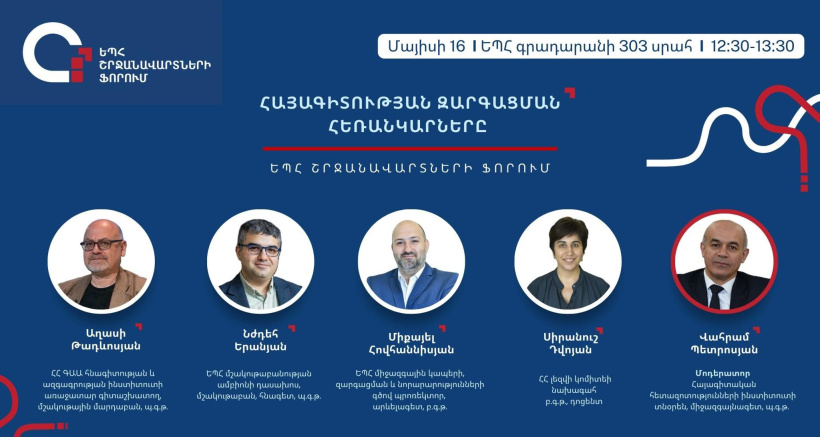
What is Armenian studies: merely the study of the past, or knowledge that shapes the present?
Within the framework of the YSU Alumni Forum 2026, the panel discussion titled "Development Prospects for Armenian Studies" will focus on questions that are important not only for the academic community, but for Armenia as a whole.
In this panel discussion, we will seek to explore the boundaries of Armenian studies, its key actors, and its prospects.
Where is Armenian studies oriented today—towards the internal or the external sphere? To what extent do these two perspectives complement one another?
What is expected from Armenian studies: academic knowledge, a basis for policy-making, or a rethinking of identity?
Armenian studies, as an interdisciplinary field—from history to politics, from culture to technology—where do its boundaries lie?
And finally, how has the field changed within a spatio-temporal context?
If you are interested in who produces knowledge about Armenia and why its audience should not be limited to the academic community, we invite you to join the discussion.