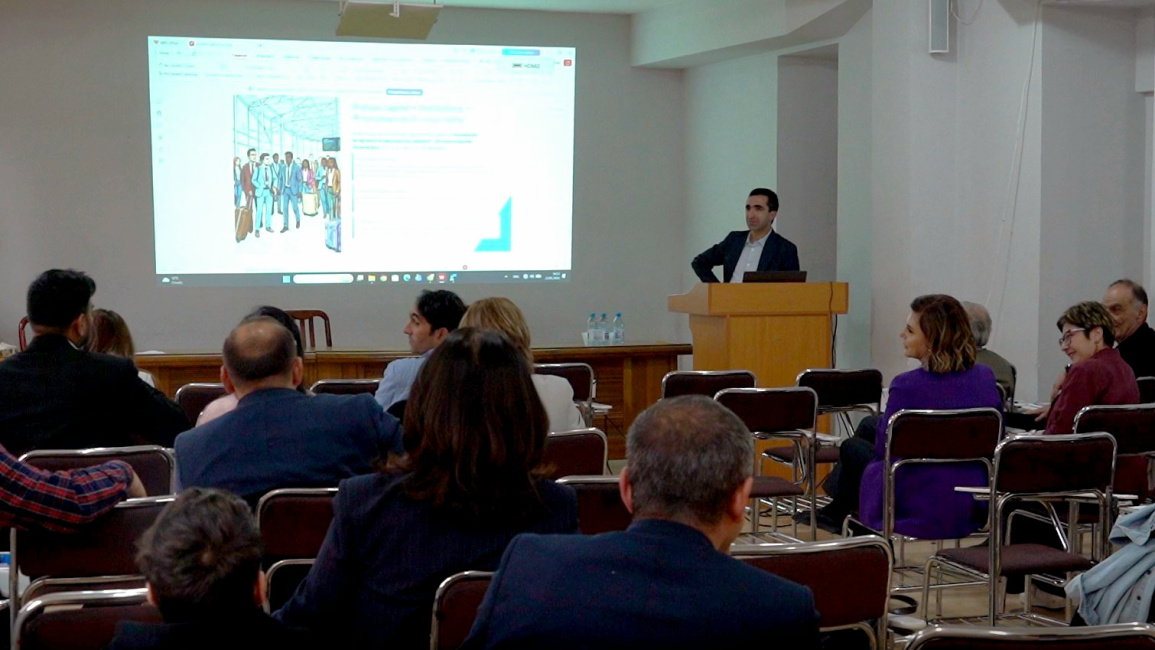
Within the framework of the YSU Annual Review Conference, Dean of the Faculty of Economics and Management, Associate Professor Karlen Khachatryan, delivered a presentation titled "The Impact of Human Capital and Institutions on Economic Development in the Context of State Development."
Now in its third consecutive year, the conference brought together members of the university's academic community to summarize research conducted over the year, present scientific achievements, and discuss priorities in education, science, and strategic development.
The conference aimed to serve as a unified platform for the exchange of scholarly ideas, interdisciplinary cooperation, and the presentation of the university's research potential, while also addressing challenges facing contemporary science and higher education.
Khachatryan's report focused on the interconnection between human capital, institutional quality, and economic development. He presented the main theoretical and empirical findings of his research, based on a comparative analysis of data from 120 countries, with particular attention to differences between high- and low-development states.
He emphasized that modern economic thought no longer views development solely through the accumulation of human capital. While education, knowledge, and professional skills remain key drivers of economic growth, their effectiveness largely depends on the institutional environment in which human capital is formed and utilized. Weak governance systems, corruption, political instability, and inefficient legal frameworks often limit the full economic realization of human potential.
The report also highlighted the mutual influence of human capital and institutions. Khachatryan noted that weak institutions hinder the effective development of education, research, and innovation, often trapping countries in cycles of low productivity, economic stagnation, and brain drain. At the same time, insufficient human capital constrains institutional capacity and the effectiveness of public governance, creating interconnected structural challenges.

One of the key findings of the study was that institutional quality has a more significant impact on economic outcomes than the direct effect of human capital alone. The analysis showed that in countries with strong and effective institutions, investment in education, research, and innovation translates into sustained economic growth, higher productivity, and increased competitiveness, whereas in countries with weak institutional environments, the impact of human capital is substantially diminished.
Khachatryan also stated that for Armenia and similar developing economies, a key prerequisite for economic progress is not only the development of education and science but also the establishment of effective, accountable, and stable institutions. He noted that only the combination of strong human capital and a high-quality institutional environment can ensure long-term economic development, realization of innovative potential, and enhanced national competitiveness.
The report generated significant interest among attendees, sparking discussion on modern models of economic development, institutional reforms, and the importance of evidence-based governance.