January 09, 2026 | 10:36
Research
Publications and scientific journals
Culture

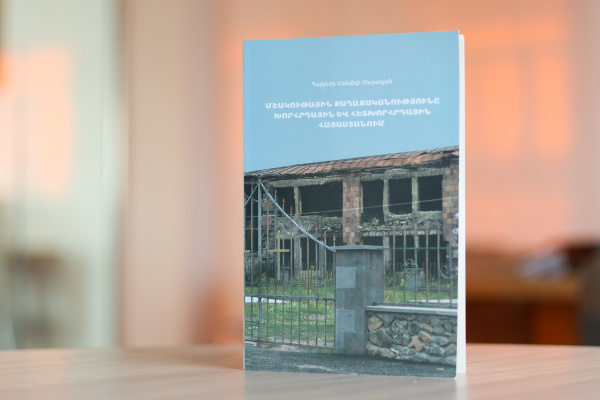
The monograph "Cultural Policy in Soviet and Post-Soviet Armenia" by Haykuhi Muradyan has recently been published. The book examines the formation and development of cultural policy in Armenia from 1920 to 2025, the ideological foundations of cultural policy during the Soviet period, and their influence on the post-Soviet cultural governance system. We spoke with the author about her research.
– Could you present the structure of the book and the topics it addresses?
– The book is composed of four chapters. The first chapter presents the theoretical foundations of cultural policy, explaining what cultural policy is, how it emerged as an academic discipline, and the main theories and models in the field. It also discusses classical models of cultural policy, including the American, British, and French frameworks, along with their policy toolkits. Building on this theoretical foundation, the second chapter addresses the formation and development stages of cultural policy in Soviet Armenia.
Soviet cultural policy is often perceived in a one-sided way—either nostalgically or entirely negatively. In this book, I took a phased approach to highlight the complex and multifaceted developments of the 1920s and 1930s.
– How would you describe cultural policy in the 1920s and 1930s?
– The 1920s were marked by Soviet modernization, campaigns against illiteracy, the promotion of women's roles, and the formation of educational and cultural systems. During this period, the basic formula of Soviet culture was established: national in form, proletarian in content.
In the 1930s, with the establishment of Stalin's regime, cultural policy became highly centralized. Control mechanisms and censorship were implemented, and a new class of Soviet intellectuals emerged. This period was also marked by persecutions of cultural figures. Thus, Stalinist repressions represent some of the darkest chapters of Soviet history, particularly affecting cultural figures.
– What changes occurred later?
– The Khrushchev Thaw, following the Stalinist period, brought certain liberalizations to cultural policy. In the 1960s, there was a notable strengthening of national content in cultural production. While the form of culture remained Soviet, national motifs became more pronounced in architecture, literature, visual arts, and music.
During this period, discussions of the Armenian Genocide memory also began to emerge, representing a significant turning point in Soviet cultural policy. The book pays particular attention to cultural institutions, creative unions, and their transformations in the post-Soviet era.

– How has cultural policy changed after independence?
– The third chapter addresses the post-Soviet period and the formation of a new cultural policy framework. After the collapse of the Soviet system, some governance structures were retained, but names and approaches changed. Specific subsections of the book also focus on regulatory and legislative issues.
In the research, I applied Max Weber's theory of leadership to examine how leaders have projected their cultural visions onto state policy. The book analyzes the cultural governance models under the presidencies of Levon Ter-Petrosyan, Robert Kocharyan, and Serzh Sargsyan, and also addresses the reforms in the cultural sector during Nikol Pashinyan's administration, noting that this latter section requires further detailed study.
– What is the main theme of the final chapter?
– The fourth chapter analyzes the formation and amendments of the law on the preservation of historical and cultural monuments in Armenia. I aimed to show why legislative changes are frequent, the problems they attempt to solve, and the challenges faced in implementation.
Haykuhi Muradyan's "Cultural Policy in Soviet and Post-Soviet Armenia" has been published under the auspices of the Academic Council of the YSU Faculty of History.