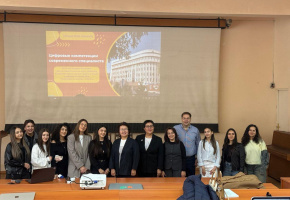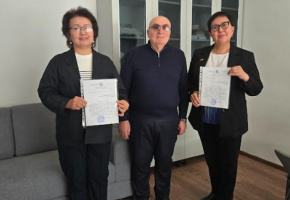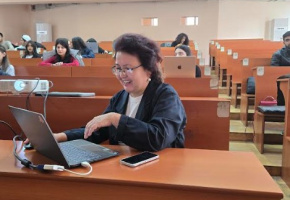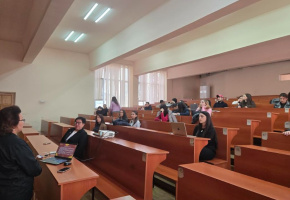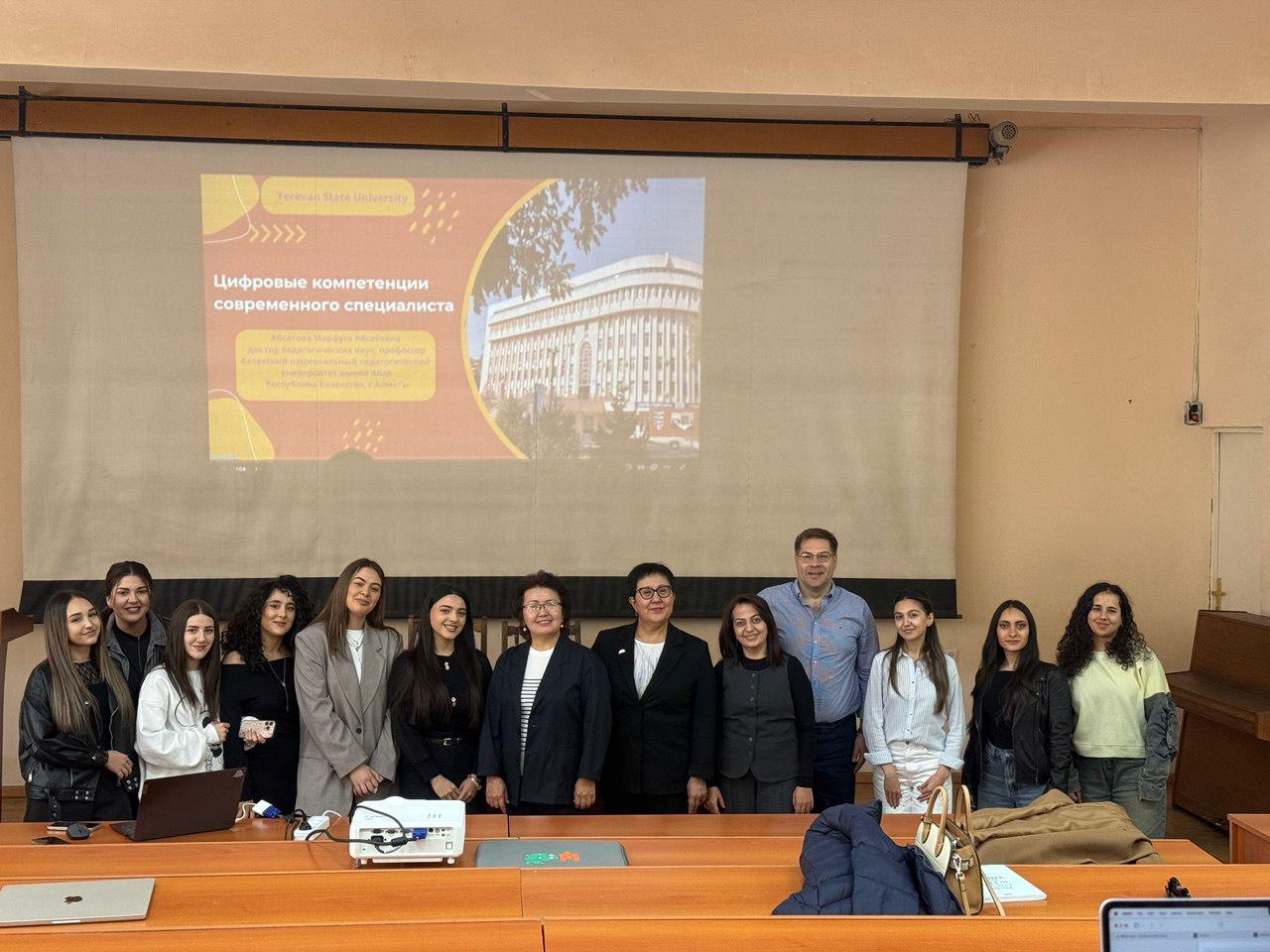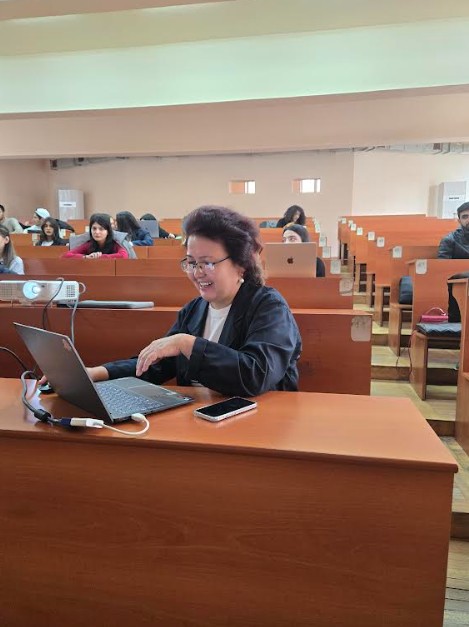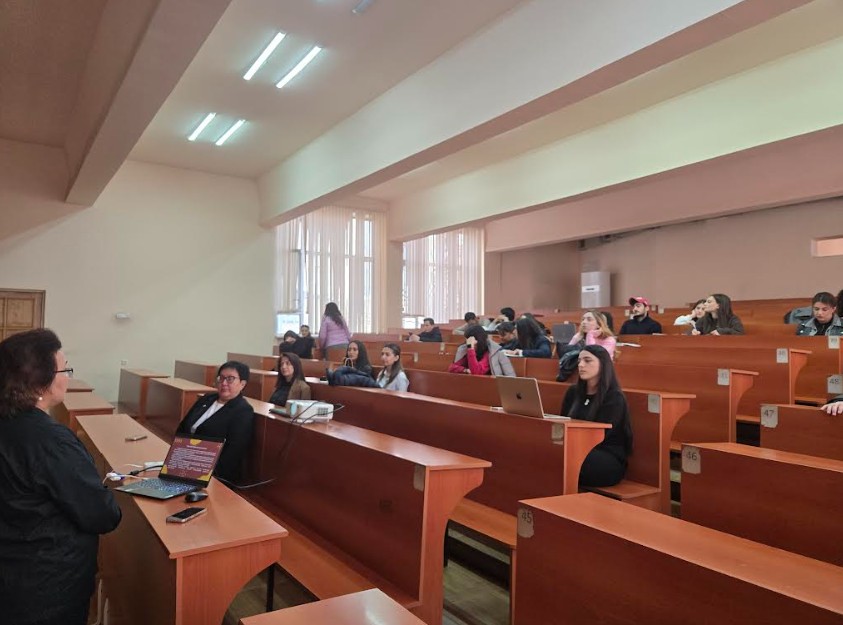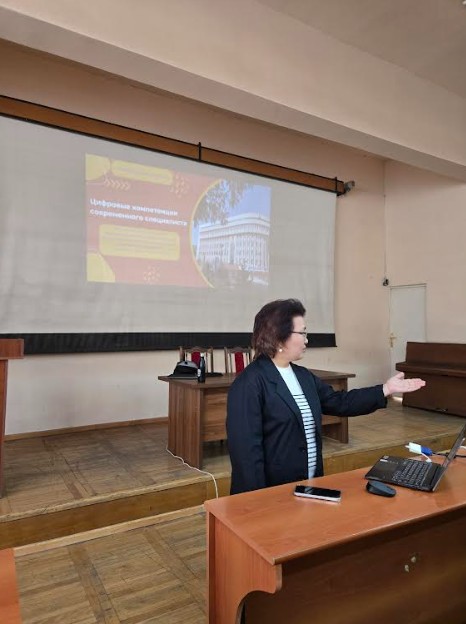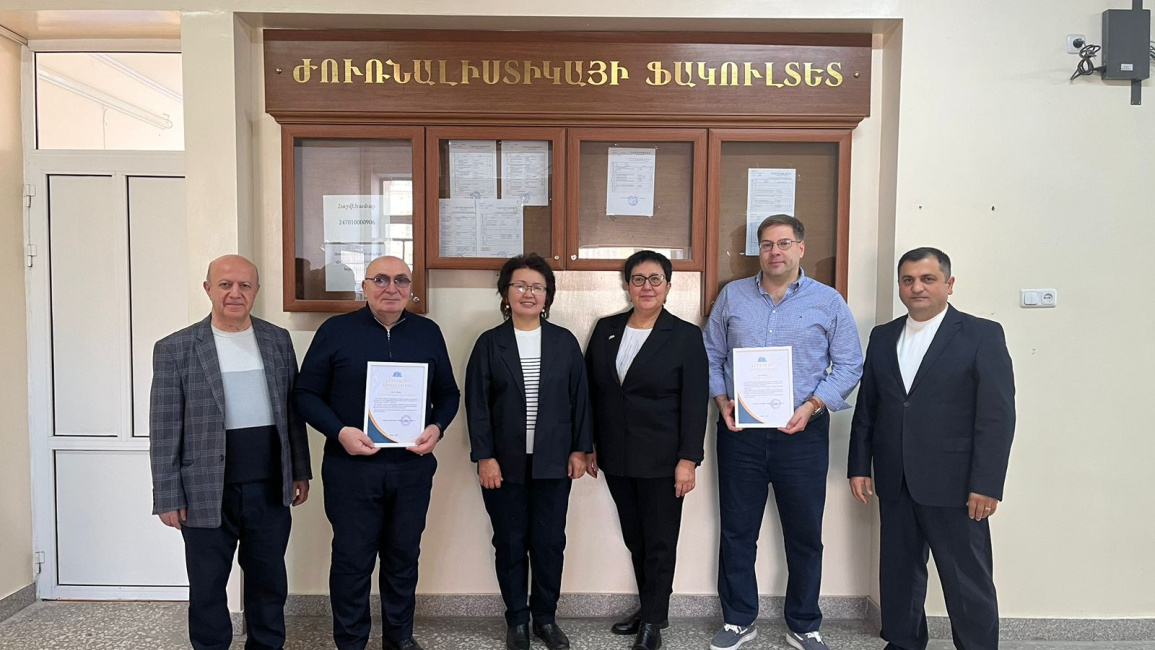
During the visit to Yerevan State University, scientists of the Kazakh National Pedagogical University named after Abai (Almaty, Kazakhstan): Marfuga Absatova, Doctor of Pedagogical Sciences, Professor, Director of the Department of Science, and Sholpan Columbayeva, Candidate of Pedagogical Sciences, Professor, Head of the Department of Pedagogy, held an open lecture for students on the topic «Digital competencies of a modern specialist».
At the meeting, introductory information about Abai University was provided, which ranks No. 628 in the QS World University Rankings 2025.
The structural components of a specialist’s digital competence, such as information literacy, digital communication and collaboration, cybersecurity and digital hygiene, and digital creativity, were considered. The capabilities of the Google server, such as document storage, were also revealed.google, google.forms, google.presentation, sites.google.com, and the capabilities of the Padlet virtual whiteboard; resources for evaluating onlinetestpad, simpoll, tools for developing specialized tasks, learningapps, and others. The digital services presented form a tool ecosystem.
The use of platforms such as Google Docs, Google Forms, Google Presentations, and websites facilitates the transition from a reproductive learning model to a constructivist one, thereby enabling students to synthesize knowledge coming from students who reflexively absorb information. The Padlet virtual whiteboard and LearningApps-type tools allow us to organize training in the format of micro-projects, interactive tasks, and visual scenarios, which increases motivation and supports multimodal learning (visual, verbal, kinesthetic).
The OnlineTestPad and Simpoll platforms provide formative assessment, allowing us to monitor learning dynamics and quickly adjust the educational process. From a semiotic point of view, digital educational platforms function as multilevel sign systems in which knowledge is represented using visual, iconographic, spatial, and interactive codes, rather than just texts.
The interfaces of Google services, Padlet, and LearningApps form a special type of “visual grammar” where meaning is created by combining text, images, hyperlinks, and colors. The use of these tools contributes to the development of multimodal literacy, as students learn to interpret and create messages in various symbolic forms. Semiotically, it is also important that digital platforms form a new educational discourse in which learning is understood as the interaction among signs, interfaces, and social practices, rather than as a linear transmission of information. At the end of the meeting, the participants noted the practice-oriented orientation of the lecture and expressed their gratitude to the organizers and university scientists.