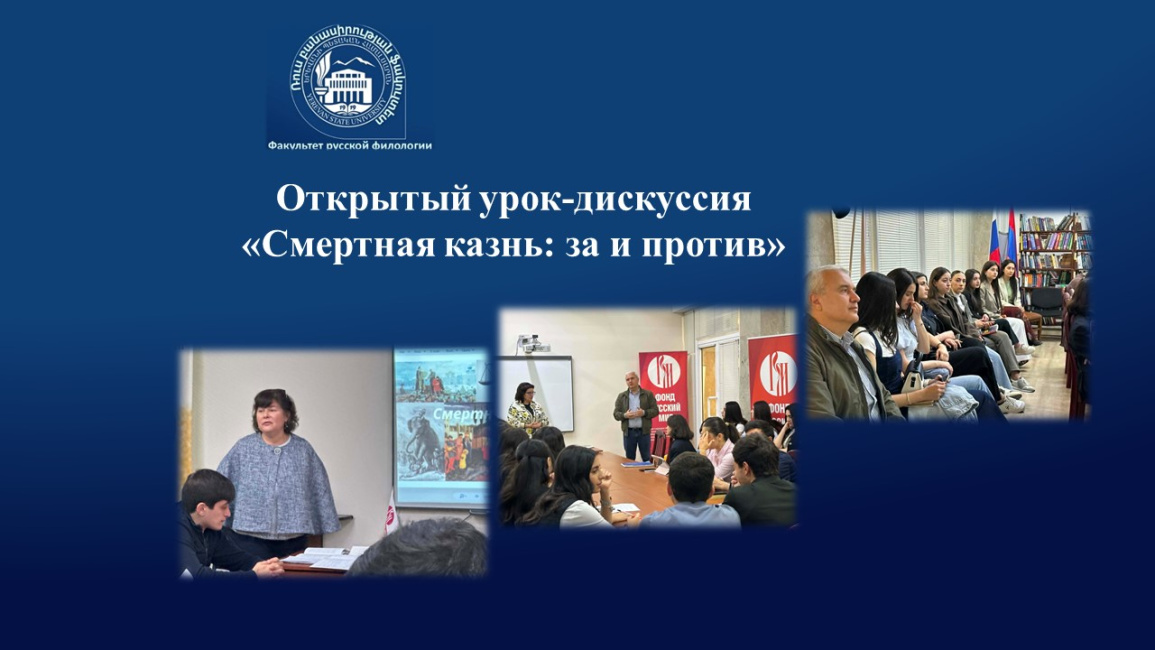
An open class titled "Death Penalty: For and Against" was held at the YSU Russian Center, organized by the university's Chair of Russian Language. The event brought together lecturers and students, serving as a platform for debate on one of the most complex and widely discussed issues in modern law and society.
Director of the YSU Russian Center Arusyak Nersesyan emphasized the importance of such educational events, noting that they promote a culture of debate, critical thinking, and the development of students' communication skills.
Deputy Dean and Head of Office of the YSU Faculty of Law Ashot Petrosyan highlighted the importance of foreign language study for future lawyers, stating that language proficiency is a key component of a modern specialist's professional development.
First-year students of the YSU Faculty of Law, under the guidance of Russian language lecturers, PhD in Philology, Associate Professor Lilit Zolyan, as well as Arusyak Nersesyan, Gayane Hovhannisyan, and Mariam Arshakyan, prepared content-rich presentations on different viewpoints regarding the topic under discussion.
The presentations were accompanied by engaging visual materials addressing the history of capital punishment, contemporary approaches to the death penalty, as well as the experience of countries where it is still applied or where a moratorium is in place.
The interactive segment of the event drew particular interest. A symbolic vote was held before and after the discussion, with results showing that the number of supporters of the death penalty significantly decreased following the debate.
The presentations were followed by active discussions, questions from the audience, and comments from participants. Despite the complexity of the topic, the event took place in an open and creative atmosphere, allowing each participant to express their views.
At the conclusion of the open class, Head of the YSU Chair of Russian Language, PhD, Associate Professor N. Martiryan thanked the lecturers and students for their work. He further emphasized the importance of Russian language proficiency for future lawyers.
The holding of such events contributes not only to the development of students' linguistic and communication skills, but also to their professional thinking, ability to justify their positions, and capacity to engage in academic debate.