November 06, 2026 | 14:45
Science
Society
International cooperation
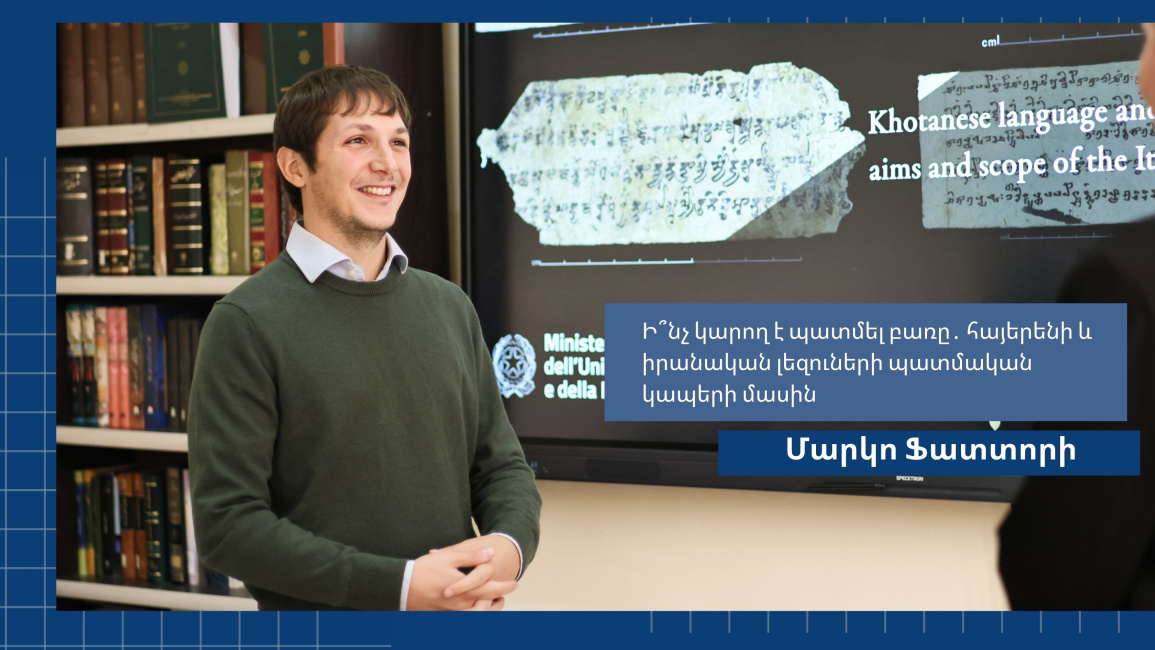
– Mr. Fattori, you started out studying Latin and Ancient Greek. What led you to Iranian languages?
– In Italy, I studied classical languages: Latin and Greek. I have always been interested in Indo-European linguistics, so I was open to studying other Indo-European languages as well. I studied Armenian, Sanskrit, and other languages. I became interested in Iranian languages through Ancient Greek. Greek literature contains Iranian words, names, and various references to the Iranian world. I became interested in the origins of those words and names. I began studying Iranian languages and realized that one of their most interesting features is their connection with other linguistic traditions. Armenian, Greek, and Aramaic all have Iranian loanwords. These linguistic connections are what make the subject particularly interesting to me.
– What can the connections between Old Armenian and Middle Iranian languages tell us about the historical relationship between Armenia and Iranian-speaking peoples?
– This is a very important question, particularly for the history of Middle Iranian languages and Parthian. We know more about Armenian than about Parthian for the period in question. The two languages were in contact from roughly the first to the third centuries AD.
During that period, as I point out in my research, the Parthians held a dominant position in Armenia. The linguistic evidence points to very close contact between the two languages.
I believe bilingualism was widespread at all levels of society. As a result, Parthian had a significant influence on Armenian, both on its vocabulary and on its morphological and syntactic structures. Studying these languages therefore offers insight into the nature of contact during that period.
– How can one language influence another, and what does this tell us about the interactions between their speakers?
– This is quite a complex phenomenon, but I can explain the general principle.
One of the simplest forms of language contact is word borrowing. We all use words borrowed from languages such as English, French, Turkish, Russian, and others. This is the most basic form of language contact. However, when contact between languages is deeper, not only words but also the structures of expressions can be borrowed. One such phenomenon in linguistics is known as calquing, in which an expression is formed using the words of one's own language while following the structure of an expression in another language. For example, a bilingual Armenian speaker who knows Russian well may use an Armenian expression modeled on Russian. In this case, the words are Armenian, but the structure of the expression comes from Russian.
Such phenomena can arise when speakers of different languages interact over a long period and bilingualism is widespread. This is a more complex level of language contact than the borrowing of individual words.

– When studying ancient inscriptions, how can a new or more accurate reading of a text change our understanding of historical events?
– That, of course, depends on the importance of the document in question. I often work with fragmentary texts. In some cases, a change in the reading of such documents does not significantly alter our overall understanding of the past. However, I have also had the opportunity to work on a very important inscription written in Old Persian: the Behistun Inscription. It is associated with King Darius I and recounts his conquests and how he came to the throne. In the case of an inscription like this, changing the reading of a passage or using higher-quality photographs to reconstruct the text more accurately can alter our understanding, to some extent, of the events that took place during those years. That is why such work can be very important.
Thus, this is primarily a philological problem rather than a purely linguistic one.
– What subjects could specialists working on Armenian and Iranian languages explore together?
– There are many possible topics. In my view, one of the first important steps should be to strengthen cooperation between specialists in Armenian philology and manuscript studies and Iranologists working on Armenian. So far, there has not been enough communication between these groups. This applies to me as well: I am not a specialist in Old Armenian, except in matters related to its contact with Iranian languages and to old manuscripts.
Sometimes, a deeper understanding of the manuscript tradition can help resolve linguistic problems. For example, Armenian manuscripts are often from a later period, and there are relatively few texts that preserve the old orthography. Features of the old orthography that have been preserved can sometimes provide clues to the original form of a word. I therefore believe that closer collaboration between Armenian philologists and linguists working on Iranian languages could improve our research. Specialists who can work in both fields would be particularly valuable.
– Drawing on your experience, what can help young researchers move beyond the scholarly literature available in their own language and develop a broader understanding of their field?
– One piece of advice I always give is: try not to limit yourselves to scholarly works written in your own language. This applies to researchers in Armenia, Italy, Iran, Russia, and other countries. Sometimes people prefer to read in their own language, but these works are not always the main or authoritative studies on a given subject.
First and foremost, it is important to learn to read scholarly literature in English, French, and especially German. German plays an important role in European linguistics, particularly in the historical study of Iranian languages and Armenian. For example, there are several very important works on the historical grammar of Armenian written in German. They are among the field's principal reference works and, as far as I know, have not been translated into other languages. I studied German at university myself so that I could consult these books.
Of course, to study Armenian, you also need to know at least some Armenian. I myself do not have a full command of Armenian and use Google Translate for some things, but I know which books and studies I need for my research.
– As a linguist, is there an Armenian word you particularly like because of its history or etymology?
– I know several words, of course, and I have studied a few of them. For example, one of my lectures focused on the Armenian word ognel ("to help"; ognut’yun, "help"). I don't know whether its older form is still used in modern Armenian, but it is a word that has interested me.
I wouldn't say it is my favorite word, but it is one of the words I have studied and whose etymology I have helped explain in the context of its connections with Iranian languages.