December 09, 2025 | 16:12
Society
Student

Mark Aren is the author of numerous acclaimed books, including "Anatolian Story: Where wild roses bloom", "The Christmas Angel", "Ville Evrard", among others. At the event, he spoke about the creative process behind his works, the development of their characters, and the themes that resonate with contemporary readers.
Having achieved significant success in the field of economics, Mark Aren began dedicating himself to literature in 2000. Since then, he has authored more than a dozen books, many of which have been republished multiple times, and several adapted into films.
During the event, Mark Aren spoke about his literary path and how his career as an economist eventually "transferred" him into the world of literature.

"When I was in school, my teacher often said, 'I know you excel in physics, mathematics, and chemistry, but language and literature have passed you by...' Now, my teacher would probably be very surprised to see that I started writing. I myself am surprised as well," he remarked.
His first novel, "Requiem for Judas", was published in Russian in 2006. The book's presentation took place at an international book festival in Moscow and received positive feedback. The novel tells the story of Judas, who returns to the world seeking redemption after suffering for nearly two thousand years. The narrative reinterprets Judas not as a betrayer, but as a servant of God's will in the crucifixion of Christ, exploring his quest for justification before the Supreme Council in Ejmiatsin. The story spans from the time of Christ to the present day, unfolding across cities including Moscow, Cairo, Ohio, Jerusalem, Amsterdam, and Paris.
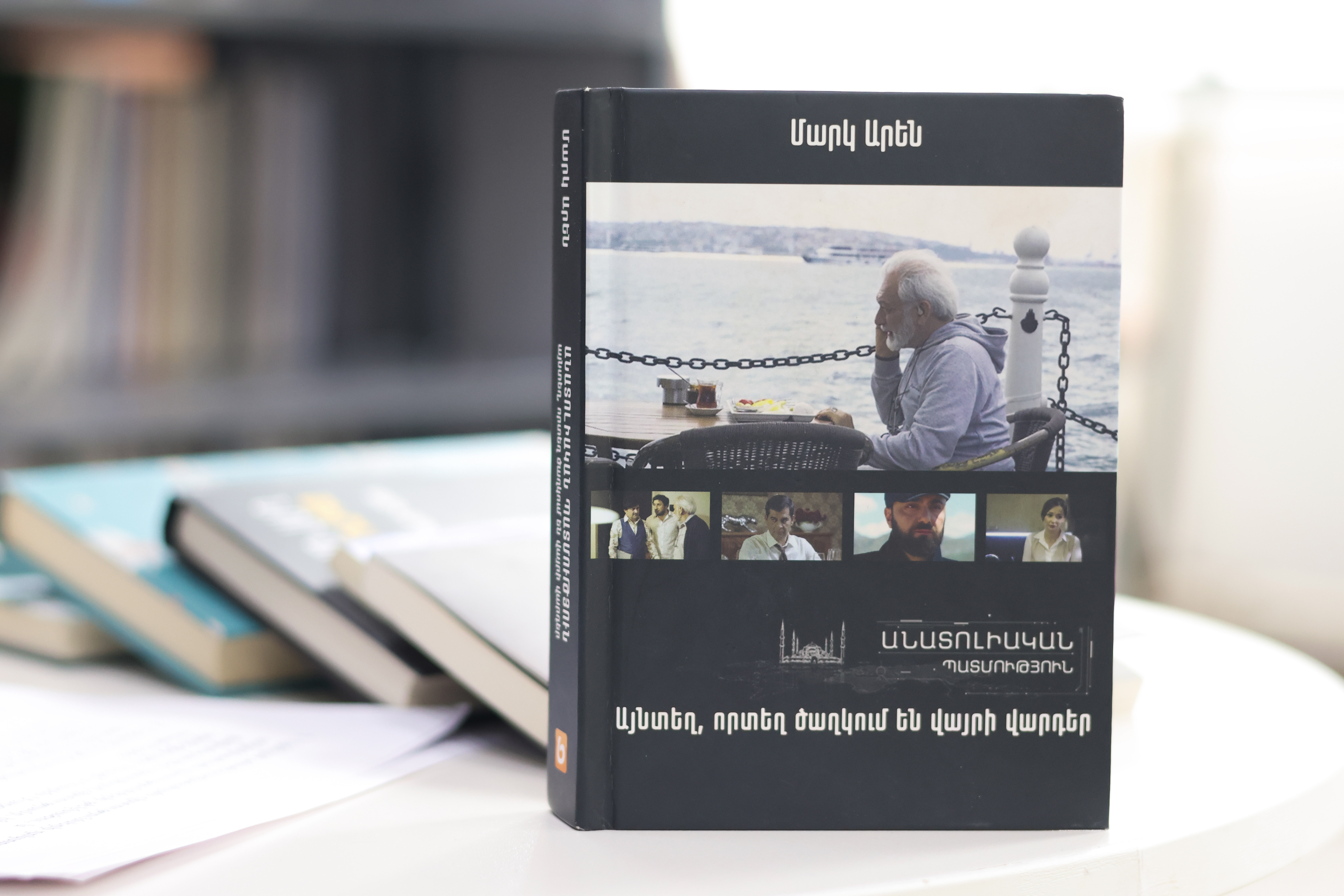
Mark Aren also discussed his second novel, "Anatolian Story: Where wild roses bloom", which has become particularly beloved by readers. Published in both Armenian and Russian in 2008, the book quickly became a bestseller in Yerevan. It narrates the story of a Turkish man who, in his old age, discovers that his parents were Armenian, realizing that his life has been lived under a misconception, and that nothing can be changed anymore.
The novel intertwines personal destinies with historical events such as the Armenian Genocide, the Sumgait massacres, and the actions of various terrorist organizations, while maintaining a focus on human experiences—the sorrow, loneliness, and search for support that could affect anyone. The book also inspired a television series adaptation.

"I wish it had been my first book, but I was probably too afraid—afraid that it wouldn't succeed. 'Requiem for Judas' was an experiment for me. In the end, it turned out very well. My second book, 'Anatolian Story', became my most famous work. It has already been published sixteen times in Armenia, which is a record, and continues to be republished every year. The book has also been published in Russian, twice in Persian, in English, and even in Turkish," Mark Aren said.
According to the author, the novel's main character symbolizes all individuals unaware of their true roots—a theme that resonates not only with Armenians but also with people from other nations, including Indians, Pakistanis, Jews, Palestinians, Irish, English, Ukrainians, and Russians.
"The problem is that a person, not knowing their roots, becomes an enemy of those roots and lives someone else’s life. I believe there is nothing more tragic than that; living someone else’s life is a tragic thing," Mark Aren emphasized.
The author also discussed broader literary themes, including the idea that "love knows no borders; borders exist only on maps," as well as his book "The New Adventures of Sherlock Holmes".
The event concluded with a Q&A session, during which readers engaged with Mark Aren, sought literary advice, and discussed the impact of his works on both Armenian and international audiences.