March 14, 2026 | 11:48
Science
Society
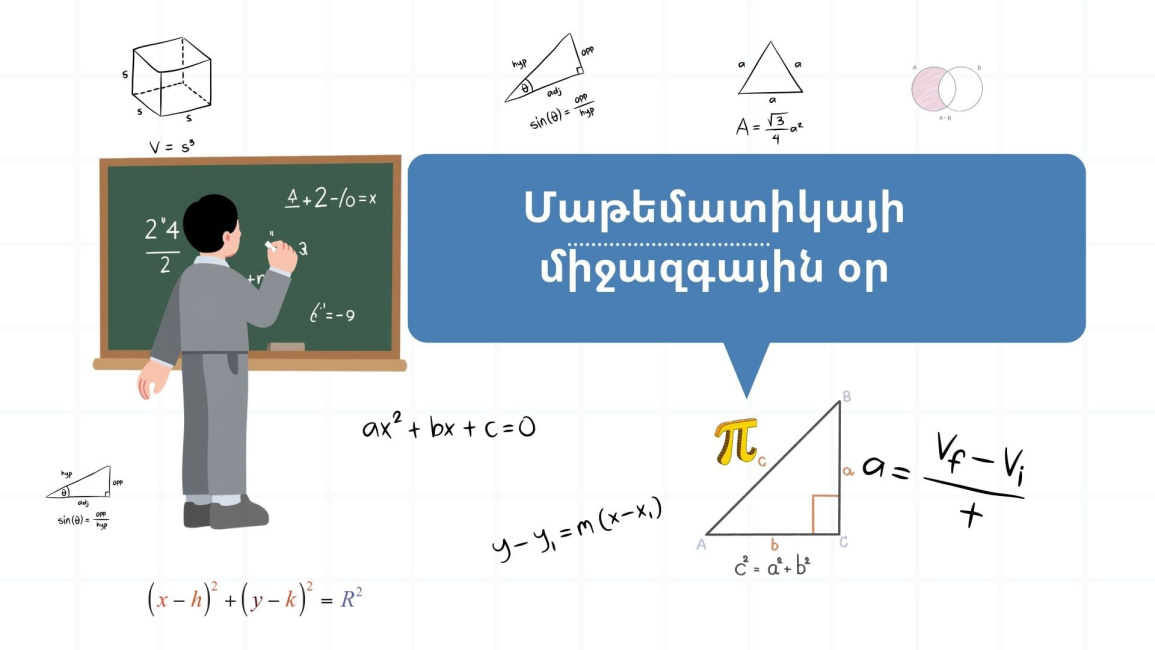
This date is also widely known as Pi Day, since the numerical form of the date—3.14—coincides with the first digits of one of mathematics' most significant constants, the number π (pi). The number π is widely used in geometry, physics, engineering, and many other scientific fields, particularly in calculations involving circles, waves, and complex mathematical models.
The International Day of Mathematics is also marked in educational and scientific institutions. On this day, universities around the world organize conferences, lectures, educational programs, intellectual games, and competitions with a view to fostering young people's interest in mathematics. Universities and educational institutions frequently host thematic events, open classes, and discussions to delve into the practical applications of mathematics.
Mathematics also plays a key role in the scientific and educational processes of Yerevan State University. At the university's Faculty of Mathematics and Mechanics, scientific research is conducted and highly qualified specialists are trained. Mathematical knowledge is also applied in other fields, including physics, computer science, economics, and data science.
This day once again highlights the important role of universities in the development of scientific thought. In higher education institutions, mathematics is not only studied as a theoretical discipline but is also actively applied in various fields, working in close cooperation with physics, computer science, economics, and other academic disciplines.
The International Day of Mathematics reminds us that numbers and formulas are not merely theoretical concepts; they are the language through which the structure of the world can be explained, and the technologies of the future can be created. For this reason, the development of mathematical knowledge continues to remain one of the key priorities of education and science.