April 29, 2026 | 12:30
Education
Society

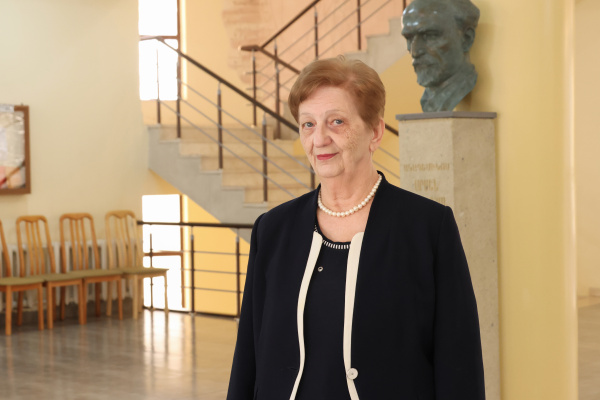
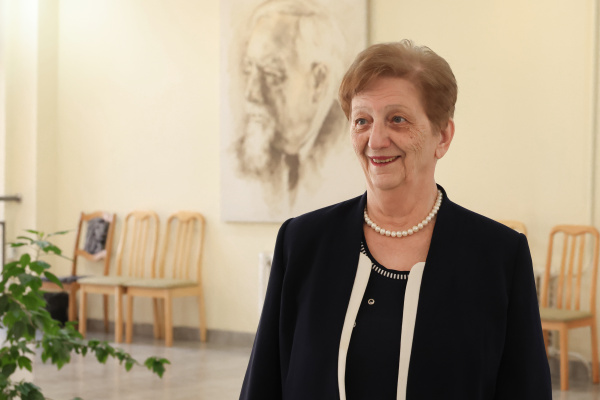
In today's media environment—where everyone has the freedom to express an opinion—the role and value of literary criticism are sometimes pushed into the background and are not always perceived as a form of scientific or professional discourse. In an interview with Professor Zhenya Kalantaryan, we sought to understand whether the significance of scholarly criticism is still preserved today.
Q: Professor Kalantaryan, can we say that real literary criticism still exists today, or has it been gradually replaced by personal reactions?
A: Actually, the role of criticism has declined for a variety of reasons. First of all, the journals that once had dedicated sections for criticism—publishing extensive and, more importantly, methodologically rigorous and scientifically grounded articles—have significantly decreased in number. Although such articles and studies are still being published, they mostly appear in authors' books, which are not widely read and often remain in the shadows. Articles published in the press today are largely superficial, often taking the form of retellings of literary works, since the press is intended for a broad audience and therefore cannot engage in in-depth professional analysis.
Hrant Matevosyan was right to propose the creation of a critical journal. In the 1980s and 1990s, several collections titled Critical Yearbook, edited by D. Gasparyan, were published and played an important role in bringing criticism into the public sphere.
Q: In your view, where does literary criticism begin and where does opinion begin?
A: Everyone can have an opinion, but not a viewpoint. The distinction between criticism and opinion was formulated as early as the first half of the 19th century by Ed. Hurmuz, a member of the Mekhitarist Congregation. In his view, everyone has their own opinion, but the difference between opinion and viewpoint is significant. A person with a viewpoint substantiates it scientifically, which is not required of someone merely expressing an opinion.
Q: Is there today in Armenia a critical discourse capable of guiding readers and influencing the literary process?
A: I believe there is. Although not frequently, there are still a small number of articles based on certain methodologies and scientific criteria, drawing on gender studies, genre theory, and contemporary terminology, bringing criticism closer to theory and science. Criticism becomes valuable when it interprets literary texts through scientific standards; otherwise, the critic risks becoming merely a reteller of what has been read.
Q: Are we currently experiencing a crisis of literary criticism? Is there a danger that it will lose its professional identity and dissolve into a general flow of opinions?
A: To some extent, yes. Naturally, opinions are not regulated. Criticism, however, must be guided by certain principles and standards. The danger lies in the fact that opinions dominate while scientific discourse diminishes.
Q: What can you say about the relevance of classical critical methods today?
A: Today, it appears that all methods coexist in parallel. During the Soviet period, the dominant method was socialist realism, which limited the application of other approaches. Today, contemporary literature itself provides the basis for using diverse methods; it is no longer strictly realist or romantic but can incorporate mythological elements, romanticism, and classicism. As one Russian critic noted, there was once only one method in the literary "market"—socialist realism—whereas now the market is diverse, and writers can choose. Not only choose, but also combine methods.
Q: What are the limits of freedom in literary criticism? Is there a point beyond which interpretation becomes arbitrariness?
A: Where criticism turns into arbitrariness, it becomes subjective and loses its scientific foundation. At the same time, it should not be forgotten that criticism is closely connected to real life and may acquire certain public characteristics. In this respect, criticism differs not only from literary history but also from theory, while simultaneously drawing on both history and theory.
Q: Professor Kalantaryan, as a result of the 2025 annual awards of the Writers' Union of Armenia, you received the Nikol Aghbalyan Prize (for literary studies and criticism) for your bookYeghishe Charents at the Target of Literary Censorship of His Time, which brings together views on Charents expressed, written, and published during his lifetime in Armenia and the Diaspora. In the case of Yeghishe Charents, to what extent were the assessments of his contemporaries shaped by the political and ideological environment?
A: The assessments of Charents's contemporaries were largely conditioned by the ideology of the time. This applied not only to his opponents, but also to those who highly valued Charents and defended him from sharp criticism, because, with few exceptions, he was evaluated not so much for his art as for his ideological position.
Q: As a lecturer, how do you cultivate critical thinking among students? Can literary criticism be "taught," or is it more of an individual ability?
A: If it can be put this way, students learn to "tell chalk from cheese," in the sense that they learn what to evaluate, for what reasons, and how. It cannot be said that everyone manages to distinguish the main from the secondary, since mastering this subject requires a strong knowledge of literature, which a significant number of students lack. A person with average reasoning ability can, if they are willing, overcome this difficulty. It may sound surprising, but I believe that a philologist also needs mathematical and logical skills.
Q: What boundary should a literary critic possess in order not to harm the creative environment?
A: Criticism should be measured and respectful in its assessments. The person should not be the target of criticism, but rather their work. The critic should reach conclusions by comparing theoretical criteria with the literary text; only then can their argument become indisputable.
Q: How do you view cases where authors do not accept criticism?
A: Many authors do not accept critical remarks. They can also be understood, because they write what they believe to be correct and are convinced of what they say. Some accept their mistakes and justify themselves, others do not. A critic's word, if balanced, should not provoke strong emotions—provided that the writer is also a balanced individual. And if the author is overly self-regarding, they may reject or ignore the critic's words.
Q: What should 21st-century Armenian literary criticism be like?
A: It is very positive that today's younger generation of writers can read foreign literature and learn much more than was previously possible. Knowledge is more necessary than ever, but our people also have their own traditions and a rich literary heritage, where the Armenian spirit, thought, and life remain alive. Twenty-first-century literary criticism should contribute to establishing a balance between universal and national values in literature.