April 22, 2026 | 11:00
Research
Publications and scientific journals
Policy

The 80th anniversary of the Great Patriotic War has provided an opportunity for researchers to revisit history and present to the international scholarly community the heroic episodes of the Armenian national divisions.
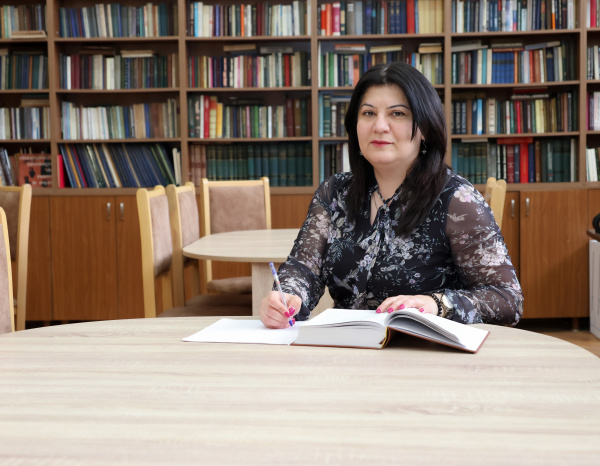
We spoke with Associate Professor Lilit Makaryan of the Chair of Armenian History at Yerevan State University about the key emphases of the article titled "Armenian National Divisions on the Stalingrad and Caucasian Fronts."
– Ms. Makaryan, how many Armenian national divisions were formed during the years of the Great Patriotic War, and beyond combat operations, what missions did they undertake?
– There were six Armenian national divisions in the USSR. The first, the 76th Division, was established as early as the 1920s, while the others were formed during the years of the Great Patriotic War. Armenians made up an overwhelming majority within these divisions—around 99 percent—and their commanders were predominantly Armenian as well. Their primary mission was the defense of the homeland, as the USSR was considered our homeland at the time.
In addition to participating in combat operations, the divisions carried out extensive propaganda activities and published their own newspapers. For example, the 409th Division issued the Armenian-language newspaper "Battle Banner" (Martakan Droshy), while the 261st published "Fight for the Homeland" (Mart hanun Hayreniki). These publications aimed to present the heroic struggle of our forces and an accurate picture of events to the public, preventing panic among the population.
– Why did you focus specifically on the defense of Stalingrad and the Caucasus?
– We addressed these fronts because historiography had not sufficiently examined the heroic struggle of the Armenian people in these contexts. It is worth noting that around 30,000 Armenians participated in the Battle of Stalingrad alone. Armenian national divisions operated across various fronts, and the 89th Tamanyan Division advanced all the way to Berlin.
– Historical accounts mention that the Tamanyan Division danced kochari in Berlin. Is this true?
– Yes, it is indeed true.
– Why was the defense of Stalingrad and the Caucasus particularly important for the Armenian people?
– Had Soviet forces been defeated on those fronts, Turkish–Nazi forces would have immediately invaded our country. Turkey had amassed 26 divisions along the border of Soviet Armenia, awaiting the outcome of the war. It pursued its own pan-Turkic ambitions, while Germany viewed the Caucasus as a strategic eastern crossroads and sought to bring the Armenian Highland under its control to secure routes from Iran to India.
Thanks to the Armenian divisions, one of Germany's key military campaigns—the so-called Edelweiss operation, aimed at capturing the Caucasus—was thwarted. Our country was among the rare exceptions that avoided territorial devastation during the Great Patriotic War.
– However, Turkey did not officially participate in the war.
– Although Turkey did not formally enter the war, it maintained what could be described as "active neutrality" and made preparations accordingly. Its generals were trained by German officers, and the country supported Germany both diplomatically and politically. Turkey's conduct during the war was so overt that in 1945 the USSR annulled the 1925 treaty of friendship and brotherhood, and Stalin raised the issue of reclaiming Armenian territories at the Potsdam Conference.
– Your article aims to present Armenians from a heroic perspective. Could you provide some examples of Armenian heroes' feats?
– One of the key contributions of our article is that the international scholarly community now has the opportunity, for the first time, to become acquainted with the names and exploits of numerous Armenian heroes. For instance, Sergeant Hunan Avetisyan, during the liberation of Novorossiysk, covered the firing embrasure of a fascist machine-gun nest near Mountain Dolgaya with his body, clearing the way for his comrades, who subsequently liberated the mountain and several settlements. Captain Samson Mkrtumyan carried out 27 combat sorties, destroying significant enemy military equipment and manpower. Lieutenant Suren Tashchiev distinguished himself by shooting down seven aircraft. Senior Lieutenant Ghukas Madoyan, during the battles for Rostov-on-Don, captured a railway station and held it for six days, repelling 43 enemy assaults. The article also highlights many other heroes and their extraordinary acts.
– What conclusions did you reach as a result of your research?
– In our conclusions, we emphasize the importance of the Armenian people's contribution to the struggle against Nazism. Our people understood that they were not only fighting for the USSR but also preventing the threat of a second genocide. It can be stated that the victory at Stalingrad prevented the invasion of Soviet Armenia by Turkish forces.
I should also note that in preparing the article, we relied on archival materials, the press of Armenian national divisions—sources we have cited for the first time—as well as contemporary scholarly literature. Our objective was to once again promote awareness of our history, as it represents the heroic past of the Armenian people. Our ancestors fought for survival so that today we might live safely in our homeland.