Home
envelope
ՀայերենРусскийEnglish

Main Navigation (Eng)

  • Admission
    • Undergraduate admission
    • Master’s degree admission
    • Postgraduate admission
    • Foreign Students
    • Preparatory courses
    • Work Carried out with Applicants
    • YSU STEM High School
  • Education
    • Guide Book for First Year Students
    • Educational programs
    • Granting qualification of a pedagogue
    • Center for Academic Writing
    • Continuing education
    • Academic Calendar
    • Olympiad
  • Science
    • Open science
    • Conferences
    • Library
    • Grants
    • Publishing House
    • Doctoral Thesis Defence Councils
    • HRS4R
  • News and events
    • Events
    • Activities
    • News
    • Newsletter
    • Announcement
    • Photo gallery
    • Video gallery

Secondary Navigation (Eng)

  • About YSU
    • YSU Management
    • YSU Symbols
    • YSU International Cooperation
    • Quality assurance
    • YSU History Museum
    • Vacancies
    • FAQ
  • Structure
    • YSU Faculties and Educational Centers
      • Faculty of Geography and Geology
      • Faculty of Theology
      • Faculty of Oriental Studies
      • Faculty of European Languages and Communication
      • Faculty of Journalism
      • Faculty of Informatics and Applied Mathematics
      • Faculty of Law
      • Faculty of Biology
      • Faculty of Armenian Philology
      • Faculty of International Relations
      • Faculty of History
      • Institute of Physics
      • Faculty of Russian Philology
      • Faculty of Sociology
      • Faculty of Economics and Management
      • Faculty of Philosophy and Psychology
      • Faculty of Chemistry
      • Faculty of Mathematics and Mechanics
      • Pedagogy and Education Development Center
      • Center for European Studies
      • Institute of Pharmacy
      • Information Technologies Educational and Research Center
      • Chair of Civil Defense
      • Chair of Physical Education and Sports
    • Column Wrapper
      • YSU STEM High School
      • YSU Ijevan Branch
    • Scientific Centers and Laboratories
      • American Studies Center
      • Psychology Research Center
      • Research Laboratory of Applied Sociology
      • Center for Mathematical and Applied Research
      • Institute for Armenian Studies
      • Institute for Social and Humanitarian Studies
      • Research Center for Chemistry
      • Research Institute of Biology
      • Research Institute of Physics
      • Research Center for the Institute of Pharmacy
    • Scientific and Educational Centers
      • Observatory
      • Scientific and Educational Center for Control and Monitoring of the Quality of Medicines
      • Specialized cabinet-laboratory for the Design of Very Large Integrated Circuits (Synopsis)
      • Legal Clinic
      • Center for Applied Psychology
      • Research Center-Library of Greek Studies
      • Innovation Center for Microbial Biotechnology and Biofuels
      • Russian Center
      • Center for Russian Studies
      • Distance Learning Laboratory of Sociology
    • Column Wrapper
      • Banner
    • Administrative Divisions of YSU
      • Academic Secretary
      • Center for Doctoral Education
      • General Division
      • YSU History Museum
      • Department of Energy System Operation
      • Financial Analysis Department
      • Human Resources Department
      • Center for Admissions and Affairs with Applicants
      • Vehicle Fleet
      • Business Incubator
      • Byurakan Industrial Practice Base
      • Medical Center
      • Science Policy Department
      • Procurement Planning Department
      • Dilijan Sports and Health Center
      • YSU Archive
      • Publishing House
      • Legal Service
      • Marketing Department
      • International Cooperation Office
      • Tsaghkadzor training and production base
      • Cultural Center
      • Fire Safety Service
      • Alumni and Career Center
      • Hankavan Industrial Practice Base
      • Accounting Department
      • Center for Quality Assurance
      • Department for Special Affairs
      • Guest House
      • Student Dormitory
      • Educational-Methodological Department
      • Marie and Sarkis Izmirlian Library
      • Center for Strategic Planning
      • Rectorate
      • Rector's Office
      • Department of Territory Improvement and Landscape Design
      • Information Technology Department
      • Department of Organization and Control of Economic Activities
  • Structure
  • Alumni and Career
    • Alumni Community
    • Career Center
    • Friends of YSU
  • Student life
    • YSU Student Scientific Society
    • YSU Student Council
    • Art and Culture
ՀայերենРусскийEnglish
envelope

Main Navigation (Eng)

  • Admission
    • Undergraduate admission
    • Master’s degree admission
    • Postgraduate admission
    • Foreign Students
    • Preparatory courses
    • Work Carried out with Applicants
    • YSU STEM High School
  • Education
    • Guide Book for First Year Students
    • Educational programs
    • Granting qualification of a pedagogue
    • Center for Academic Writing
    • Continuing education
    • Academic Calendar
    • Olympiad
  • Science
    • Open science
    • Conferences
    • Library
    • Grants
    • Publishing House
    • Doctoral Thesis Defence Councils
    • HRS4R
  • News and events
    • Events
    • Activities
    • News
    • Newsletter
    • Announcement
    • Photo gallery
    • Video gallery

Secondary Navigation (Eng)

  • About YSU
    • YSU Management
    • YSU Symbols
    • YSU International Cooperation
    • Quality assurance
    • YSU History Museum
    • Vacancies
    • FAQ
  • Structure
    • YSU Faculties and Educational Centers
      • Faculty of Geography and Geology
      • Faculty of Theology
      • Faculty of Oriental Studies
      • Faculty of European Languages and Communication
      • Faculty of Journalism
      • Faculty of Informatics and Applied Mathematics
      • Faculty of Law
      • Faculty of Biology
      • Faculty of Armenian Philology
      • Faculty of International Relations
      • Faculty of History
      • Institute of Physics
      • Faculty of Russian Philology
      • Faculty of Sociology
      • Faculty of Economics and Management
      • Faculty of Philosophy and Psychology
      • Faculty of Chemistry
      • Faculty of Mathematics and Mechanics
      • Pedagogy and Education Development Center
      • Center for European Studies
      • Institute of Pharmacy
      • Information Technologies Educational and Research Center
      • Chair of Civil Defense
      • Chair of Physical Education and Sports
    • Column Wrapper
      • YSU STEM High School
      • YSU Ijevan Branch
    • Scientific Centers and Laboratories
      • American Studies Center
      • Psychology Research Center
      • Research Laboratory of Applied Sociology
      • Center for Mathematical and Applied Research
      • Institute for Armenian Studies
      • Institute for Social and Humanitarian Studies
      • Research Center for Chemistry
      • Research Institute of Biology
      • Research Institute of Physics
      • Research Center for the Institute of Pharmacy
    • Scientific and Educational Centers
      • Observatory
      • Scientific and Educational Center for Control and Monitoring of the Quality of Medicines
      • Specialized cabinet-laboratory for the Design of Very Large Integrated Circuits (Synopsis)
      • Legal Clinic
      • Center for Applied Psychology
      • Research Center-Library of Greek Studies
      • Innovation Center for Microbial Biotechnology and Biofuels
      • Russian Center
      • Center for Russian Studies
      • Distance Learning Laboratory of Sociology
    • Column Wrapper
      • Banner
    • Administrative Divisions of YSU
      • Academic Secretary
      • Center for Doctoral Education
      • General Division
      • YSU History Museum
      • Department of Energy System Operation
      • Financial Analysis Department
      • Human Resources Department
      • Center for Admissions and Affairs with Applicants
      • Vehicle Fleet
      • Business Incubator
      • Byurakan Industrial Practice Base
      • Medical Center
      • Science Policy Department
      • Procurement Planning Department
      • Dilijan Sports and Health Center
      • YSU Archive
      • Publishing House
      • Legal Service
      • Marketing Department
      • International Cooperation Office
      • Tsaghkadzor training and production base
      • Cultural Center
      • Fire Safety Service
      • Alumni and Career Center
      • Hankavan Industrial Practice Base
      • Accounting Department
      • Center for Quality Assurance
      • Department for Special Affairs
      • Guest House
      • Student Dormitory
      • Educational-Methodological Department
      • Marie and Sarkis Izmirlian Library
      • Center for Strategic Planning
      • Rectorate
      • Rector's Office
      • Department of Territory Improvement and Landscape Design
      • Information Technology Department
      • Department of Organization and Control of Economic Activities
  • Structure
  • Alumni and Career
    • Alumni Community
    • Career Center
    • Friends of YSU
  • Student life
    • YSU Student Scientific Society
    • YSU Student Council
    • Art and Culture
  1. Main
  2. News
  3. Perceptron founder Armen Aghajanyan on the key to success in artificial intelligence
May 07, 2026 | 10:00
Education
Research
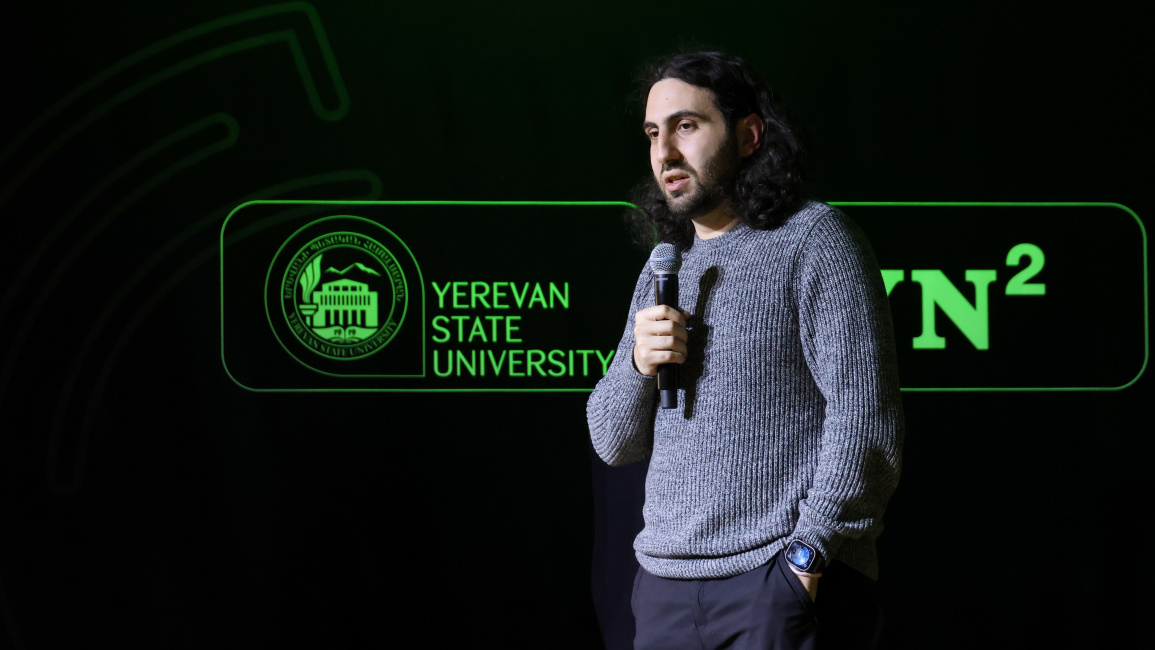
Perceptron founder Armen Aghajanyan on the key to success in artificial intelligence

Artificial intelligence is advancing at an unprecedented pace, raising pressing questions for young people seeking to enter the field, particularly what to study and how to build a career in the industry. In an interview with Armen Aghajanyan, founder of Perceptron and former head of research groups at Meta AI, key skills for today’s market and the readiness of universities to meet industry demands were discussed.

Speaking at the AI Conf 2026 as a keynote speaker, Perceptron founder Armen Aghajanyan emphasized that success in AI does not depend on learning specific tools or technologies, as these quickly become obsolete. Instead, he stressed the importance of a deep understanding of the fundamental principles of machine learning and deep learning. 

– Mr. Aghajanyan, as an experienced expert in the field, what skills do you consider most important today for young people who want to start a career in artificial intelligence? What advice would you give Armenian students and young professionals entering AI and high-tech fields? 

– The key characteristic of the field is that it is evolving very quickly, so learning very specific things is not that useful. What really matters is learning the fundamental principles of machine learning and deep learning. Once you understand the fundamentals, you can combine ideas very quickly and navigate new concepts with ease. For example, you can read just the abstract of a research paper and understand its essence without going into the full details. This is a characteristic we do not see very often.  

Aghajanyan also noted that during recruitment processes, he often encounters candidates who can write code but do not understand foundational principles. In his view, such an approach can't lead to a long-term career, so focusing on foundational knowledge is crucial. 

Another important point is that there are many open-source resources in machine learning. Create interesting projects, make them open source, publish them on X or other platforms, and you will be noticed. People are now often hired through social networks. Employers often choose someone who may not have an established reputation, but has, for example, published interesting projects on X.

– How prepared are universities today for the rapidly evolving demands of AI?

– They are not prepared at all—or perhaps only three or four universities are, such as the University of Washington, Stanford University, and UC Berkeley.

Actually, I think traditional education systems are not well suited for machine learning. The field changes every month. This means that if you have a two-year program that is not regularly updated, it becomes almost useless, and you end up wasting time.

What I have seen in successful programs is that they focus on principles and fundamentals, and complement them with high-quality lectures. That is likely the only way universities can remain competitive. Another significant challenge, however, is that many universities lack sufficient computational resources. You might be surprised, but Yerevan State University, for example, likely provides GPU resources per student on a level comparable to Stanford. Wherever students have access to computational resources, opportunities for internships, part-time or full-time jobs, they gain a major advantage.

You cannot develop intuition without access to computational resources. 

Nevertheless, according to Aghajanyan, successful educational programs share one common feature: they focus on foundational knowledge and complement it with high-quality lectures.

– You mentioned computational resources in universities. How can YSU's supercomputer change academic science and technological innovation? What role can it play in Armenia's AI ecosystem?

– I actually co-wrote the proposal for that supercomputer together with Hrant Khachatryan, Head of the YSU Machine Learning Laboratory and Director of the YerevaNN Scientific Educational Foundation, about three years ago. Its implementation was therefore also important for us. I think the biggest value of this initiative is that it creates a baseline computational infrastructure. This allows students not only to learn theory but also to work with models in practice, train them, and develop real technological intuition.

At the same time, the system has enough capacity to support team-based and research projects that produce measurable, applied results. In that sense, it was an important and correct step by both the government and the university. 

To be honest, the process took a long time and could have been implemented faster. But the most important thing is that the foundation is now in place. 

According to the industry expert, this is not an endpoint, but a starting point. If investments in computational resources continue, it will be possible to significantly expand these capabilities and build much larger-scale infrastructure in the future. 


At AI Conf 2026, Aghajanyan also presented the activities and vision of Perceptron. The company was founded around 14 months ago with a clear goal: to build a foundational technology platform focused on hardware systems and interaction with the physical world.

The core idea is that wherever technology directly interacts with real environments—such as robotics, manufacturing, automation, or complex analytical systems—models should be specifically designed for those domains. 

Perceptron's scope ranges from relatively simple robotics tasks, such as making coffee or sorting books, to more complex systems requiring advanced perception and decision-making capabilities, including systems that analyze large-scale visual data and identify key objects in complex environments. 

The company's broader vision is not only to develop innovative solutions, but also to establish a foundational framework that can guide the development of artificial intelligence in the South Caucasus in the coming years.

In his presentation on "The Armenian AI Doctrine," Aghajanyan addressed Armenia's positioning in the global AI landscape, along with its main limitations and opportunities. He emphasized the importance of building internal capacity as a long-term strategy.
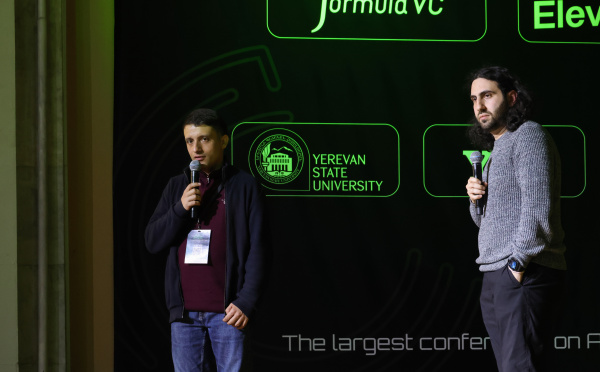
He noted that for small countries, including Armenia, the primary strategy cannot be based on training large-scale models independently. Instead, he said, a more realistic direction lies in developing applied services, systems, and the integration of AI across both public and private sectors. 

He also discussed the future of open-source models, noting that while they were once seen as a strong alternative, recent developments show leading closed models continuing to advance rapidly—particularly in benchmarks assessing complex autonomous agent performance. 

From a geopolitical perspective, he said AI has become a strategic resource whose accessibility is shaped by various global power centers. In this context, countries should not aim for full technological sovereignty but instead build flexible systems that integrate local infrastructure with global AI services.

He highlighted the efficient use of GPUs and computational resources, as well as the development of AI workflows based on them. For countries like Armenia, he stressed the importance of building systems that enable AI applications in public administration, healthcare, legal, and technical sectors.

In closing, Aghajanyan pointed to physical AI—systems in which artificial intelligence directly interacts with the physical environment, ranging from security systems to robotics—as a potential strategic direction for the future.


Sona Shahverdyan
ShareFacebookTelegram

Latest News

Գիտելիք, մրցակցություն և նոր հնարավորություններ․ ամփոփվեցին ԵՊՀ աշակերտական օլիմպիադայի արդյունքները

29.05.2026

ԵՊՀ և ֆրանսահայ գիտնականների համագործակցությամբ մեկնարկեց ակադեմիական նոր նախաձեռնություն ուսանողների համար

29.05.2026

YSU hosts annual teachers' conference on technological innovation in education

27.05.2026
Show All

Announcement

Invitation to Online Conference: American Research Institute of the South Caucasus

09.17.2026 - 09.19.2026

Invitation to Participate in International Conference "Armenia: Crossroads of Centuries and Worlds"

06.18.2026 - 06.19.2026

Ժողովրդավարության միջազգային փորձ ԵՊՀ երիտասարդների համար․ մեկնարկում է Բունդեսթագի կրթաթոշակային ծրագիրը

05.29.2026 - 07.31.2026
Show All

Արագ հասանելիություն

  • Intranet
  • E-learning
  • Mulberry
  • Online applications
  • Phone book
  • Registrar
  • Documentation

Footer(ENG)

  • Main pages
    • Admission
    • Education
    • Science
    • News
  • Information
    • Frequently asked Questions
    • Vacancies
    • Search for educational programs
    • For the applicants
    • For the students
  • About YSU
    • YSU management
    • YSU symbols
© Yerevan state university 2026
Address: Republic of Armenia, Yerevan, 0025, 1 Alex Manoogian (+37460) 710000 info@ysu.am