May 05, 2026 | 13:13
Education
International cooperation
Student

At the University of Colorado Boulder, Mikhail's field of study is international relations, with an emphasis on political philosophy, language, and culture.
"I began studying at the YSU Faculty of Russian Philology in September 2025. My choice of university was driven by the fact that it is well known for its Faculty of Russian Philology, and YSU also has partner relations both with American Councils and the University of Colorado Boulder," Mikhail said.
For the international student, Russian is not only an academic subject but also a cultural bridge.
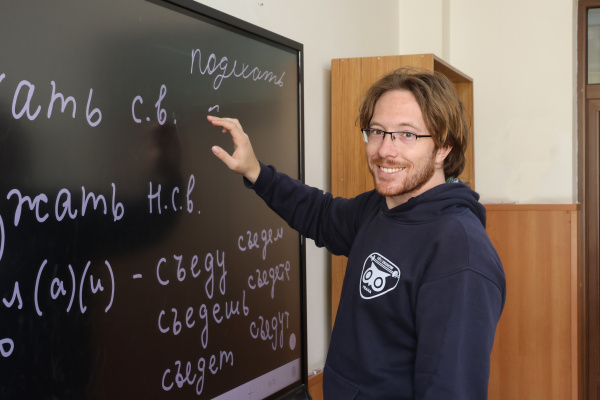
"Russian is a beautiful language with a strong culture and rich history. It is unique as an imperial language that has served as a bridge between East and West. It has naturally become part of a wider region and plays an important role in the cultures of many countries across Asia and Europe," he noted.
In Mikhail's view, teaching methods at YSU are not only modern but also have deep scientific roots. He believes many of the approaches used at the university are inherited from the Soviet education system, which he considers one of the most effective and advanced in history.
"The Soviet education system was built upon the education system of Tsarist Russia, which was quite advanced in fields such as science, arts, mathematics, and humanities. Russia also inherited intellectual traditions from the Eastern Roman Empire. After the fall of Constantinople, it came to be regarded as the 'Third Rome,' reinforcing a strong emphasis on education and cultural continuity," the student said.

According to him, although the USSR was ideologically opposed to imperial rule, its leaders recognized the importance of strong education in state-building. "Eastern Armenia has historical ties both with the Russian Empire and the USSR, so it is valuable to see elements of these educational methods still in use today."
Mikhail added that the Soviet educational approach enables deep mastery of the subject, ensuring a high level of Russian language proficiency. "This is achieved through strict discipline in the study of grammar, phonetics, and methodology," he said.
Looking ahead to his next visit from the United States, the student said he hopes to see a large garden on the YSU campus.
"YSU is a very welcoming host, which reflects the attitude of the people of Armenia toward foreigners and people in general — hospitality. However, I would like to make a suggestion: it would be nice if the university considered having a large garden where students could sit outside, spend time with peers, or study in the open air."
The foreign student will remember Armenia as his second home.
"This is my first visit to Armenia. I have spent seven months here and I will remember this country as my second home for the rest of my life," he said. "What impressed me most is the hospitality and warmth of the people. I hope that younger generations will preserve the traditions for which their ancestors fought and sacrificed. This is a unique country with a very bright future. I am grateful to Armenia for a wonderful study experience."