Home
envelope
ՀայերենРусскийEnglish

Main Navigation (Eng)

  • Admission
    • Undergraduate admission
    • Master’s degree admission
    • Postgraduate admission
    • Foreign Students
    • Preparatory courses
    • Work Carried out with Applicants
    • YSU STEM High School
  • Education
    • Guide Book for First Year Students
    • Educational programs
    • Granting qualification of a pedagogue
    • Center for Academic Writing
    • Continuing education
    • Academic Calendar
    • Olympiad
  • Science
    • Open science
    • Conferences
    • Library
    • Grants
    • Publishing House
    • Doctoral Thesis Defence Councils
    • HRS4R
  • News and events
    • Events
    • Activities
    • News
    • Newsletter
    • Announcement
    • Photo gallery
    • Video gallery

Secondary Navigation (Eng)

  • About YSU
    • YSU Management
    • YSU Symbols
    • YSU International Cooperation
    • Quality assurance
    • YSU History Museum
    • Vacancies
    • FAQ
  • Structure
    • YSU Faculties and Educational Centers
      • Faculty of Geography and Geology
      • Faculty of Theology
      • Faculty of Oriental Studies
      • Faculty of European Languages and Communication
      • Faculty of Journalism
      • Faculty of Informatics and Applied Mathematics
      • Faculty of Law
      • Faculty of Biology
      • Faculty of Armenian Philology
      • Faculty of International Relations
      • Faculty of History
      • Institute of Physics
      • Faculty of Russian Philology
      • Faculty of Sociology
      • Faculty of Economics and Management
      • Faculty of Philosophy and Psychology
      • Faculty of Chemistry
      • Faculty of Mathematics and Mechanics
      • Pedagogy and Education Development Center
      • Center for European Studies
      • Institute of Pharmacy
      • Chair of Civil Defense
      • Chair of Physical Education and Sports
      • Information Technologies Educational and Research Center
    • Column Wrapper
      • YSU STEM High School
      • YSU Ijevan Branch
    • Scientific Centers and Laboratories
      • American Studies Center
      • Psychology Research Center
      • Research Laboratory of Applied Sociology
      • Center for Mathematical and Applied Research
      • Institute for Armenian Studies
      • Research Center for Chemistry
      • Research Institute of Biology
      • Research Institute of Physics
      • Research Center for the Institute of Pharmacy
    • Scientific and Educational Centers
      • Scientific and Educational Center for Control and Monitoring of the Quality of Medicines
      • Legal Clinic
      • Research Center-Library of Greek Studies
      • Russian Center
      • Center for Russian Studies
      • Distance Learning Laboratory of Sociology
    • Column Wrapper
      • Banner
    • Administrative Divisions of YSU
      • Academic Secretary
      • Center for Doctoral Education
      • General Division
      • YSU History Museum
      • Department of Energy System Operation
      • Financial Analysis Department
      • Human Resources Department
      • Center for Admissions and Affairs with Applicants
      • Vehicle Fleet
      • Business Incubator
      • Byurakan Industrial Practice Base
      • Medical Center
      • Science Policy Department
      • Procurement Planning Department
      • Dilijan Sports and Health Center
      • YSU Archive
      • Publishing House
      • Legal Service
      • Marketing Department
      • International Cooperation Office
      • Tsaghkadzor training and production base
      • Cultural Center
      • Fire Safety Service
      • Alumni and Career Center
      • Hankavan Industrial Practice Base
      • Accounting Department
      • Center for Quality Assurance
      • Department for Special Affairs
      • Guest House
      • Student Dormitory
      • Educational-Methodological Department
      • Marie and Sarkis Izmirlian Library
      • Center for Strategic Planning
      • Rectorate
      • Rector's Office
      • Department of Territory Improvement and Landscape Design
      • Information Technology Department
      • Department of Organization and Control of Economic Activities
  • Structure
  • Alumni and Career
    • Alumni Community
    • Career Center
    • Friends of YSU
  • Student life
    • YSU Student Scientific Society
    • YSU Student Council
    • Art and Culture
ՀայերենРусскийEnglish
envelope

Main Navigation (Eng)

  • Admission
    • Undergraduate admission
    • Master’s degree admission
    • Postgraduate admission
    • Foreign Students
    • Preparatory courses
    • Work Carried out with Applicants
    • YSU STEM High School
  • Education
    • Guide Book for First Year Students
    • Educational programs
    • Granting qualification of a pedagogue
    • Center for Academic Writing
    • Continuing education
    • Academic Calendar
    • Olympiad
  • Science
    • Open science
    • Conferences
    • Library
    • Grants
    • Publishing House
    • Doctoral Thesis Defence Councils
    • HRS4R
  • News and events
    • Events
    • Activities
    • News
    • Newsletter
    • Announcement
    • Photo gallery
    • Video gallery

Secondary Navigation (Eng)

  • About YSU
    • YSU Management
    • YSU Symbols
    • YSU International Cooperation
    • Quality assurance
    • YSU History Museum
    • Vacancies
    • FAQ
  • Structure
    • YSU Faculties and Educational Centers
      • Faculty of Geography and Geology
      • Faculty of Theology
      • Faculty of Oriental Studies
      • Faculty of European Languages and Communication
      • Faculty of Journalism
      • Faculty of Informatics and Applied Mathematics
      • Faculty of Law
      • Faculty of Biology
      • Faculty of Armenian Philology
      • Faculty of International Relations
      • Faculty of History
      • Institute of Physics
      • Faculty of Russian Philology
      • Faculty of Sociology
      • Faculty of Economics and Management
      • Faculty of Philosophy and Psychology
      • Faculty of Chemistry
      • Faculty of Mathematics and Mechanics
      • Pedagogy and Education Development Center
      • Center for European Studies
      • Institute of Pharmacy
      • Chair of Civil Defense
      • Chair of Physical Education and Sports
      • Information Technologies Educational and Research Center
    • Column Wrapper
      • YSU STEM High School
      • YSU Ijevan Branch
    • Scientific Centers and Laboratories
      • American Studies Center
      • Psychology Research Center
      • Research Laboratory of Applied Sociology
      • Center for Mathematical and Applied Research
      • Institute for Armenian Studies
      • Research Center for Chemistry
      • Research Institute of Biology
      • Research Institute of Physics
      • Research Center for the Institute of Pharmacy
    • Scientific and Educational Centers
      • Scientific and Educational Center for Control and Monitoring of the Quality of Medicines
      • Legal Clinic
      • Research Center-Library of Greek Studies
      • Russian Center
      • Center for Russian Studies
      • Distance Learning Laboratory of Sociology
    • Column Wrapper
      • Banner
    • Administrative Divisions of YSU
      • Academic Secretary
      • Center for Doctoral Education
      • General Division
      • YSU History Museum
      • Department of Energy System Operation
      • Financial Analysis Department
      • Human Resources Department
      • Center for Admissions and Affairs with Applicants
      • Vehicle Fleet
      • Business Incubator
      • Byurakan Industrial Practice Base
      • Medical Center
      • Science Policy Department
      • Procurement Planning Department
      • Dilijan Sports and Health Center
      • YSU Archive
      • Publishing House
      • Legal Service
      • Marketing Department
      • International Cooperation Office
      • Tsaghkadzor training and production base
      • Cultural Center
      • Fire Safety Service
      • Alumni and Career Center
      • Hankavan Industrial Practice Base
      • Accounting Department
      • Center for Quality Assurance
      • Department for Special Affairs
      • Guest House
      • Student Dormitory
      • Educational-Methodological Department
      • Marie and Sarkis Izmirlian Library
      • Center for Strategic Planning
      • Rectorate
      • Rector's Office
      • Department of Territory Improvement and Landscape Design
      • Information Technology Department
      • Department of Organization and Control of Economic Activities
  • Structure
  • Alumni and Career
    • Alumni Community
    • Career Center
    • Friends of YSU
  • Student life
    • YSU Student Scientific Society
    • YSU Student Council
    • Art and Culture
  1. Main
  2. News
  3. "Producing quality journalism today is becoming increasingly difficult," says YSU visiting professor Kristian Bankov
November 03, 2026 | 10:00
Education
Society
International cooperation
"Producing quality journalism today is becoming increasingly difficult," says YSU visiting professor Kristian Bankov

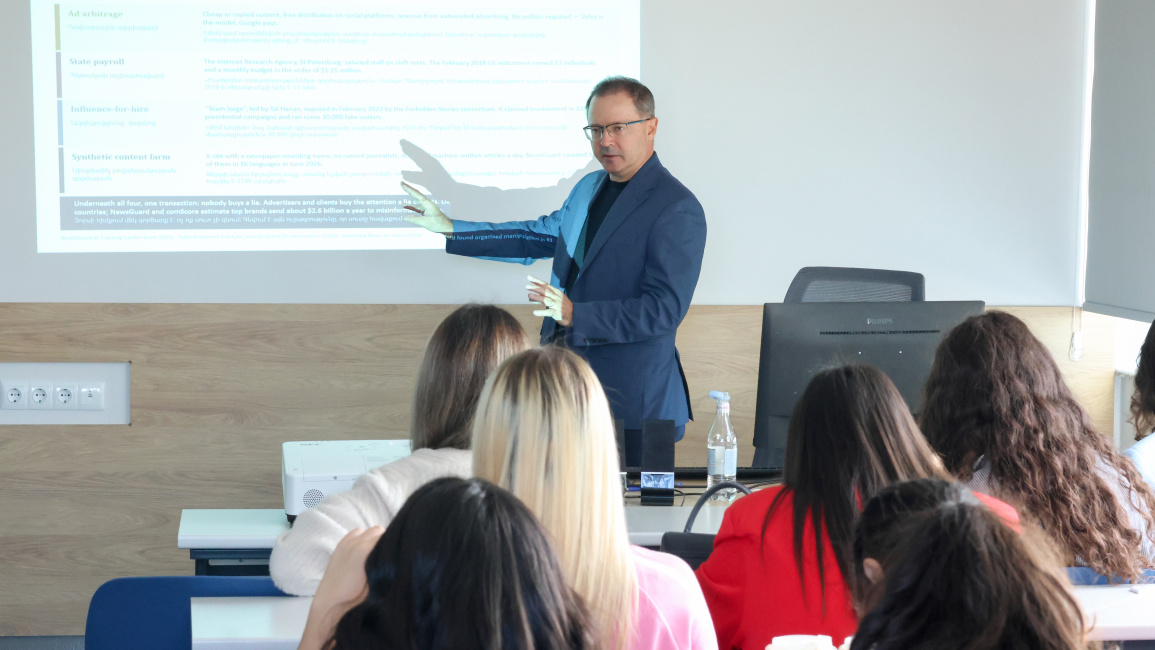
Kristian Bankov, professor of semiotics at New Bulgarian University, is teaching at Yerevan State University's Faculty of Journalism as part of YSU's Visiting Professor Grant Program. He teaches in the bachelor's degree program "Journalism" and the master's degree program "TV Journalism," introducing students to semiotic approaches to the study of digital culture and encouraging them to develop an entrepreneurial mindset.

Kristian Bankov is a professor of semiotics at New Bulgarian University in Sofia, head of the Southeast European Center for Semiotic Studies and editor-in-chief of the academic journal Digital Age in Semiotics & Communication.

We spoke with Professor Bankov about his teaching experience at YSU, the impact of digital culture and artificial intelligence on journalism, and prospects for cooperation between the two universities.

Q: Mr Bankov, what motivated you to accept the invitation to teach at YSU, and what activities are you carrying out as part of the program?

A: I have long been fascinated by Armenia, by its ancient history, cultural life, cuisine and many other distinctive features. But the main reason I accepted this invitation so eagerly was the fact that semiotics is developing here. I have a colleague, Professor Tigran Simyan, one of the main reference points for semiotics in Armenia, and thanks to this visiting professorship, our collaboration has entered a very important new phase. 
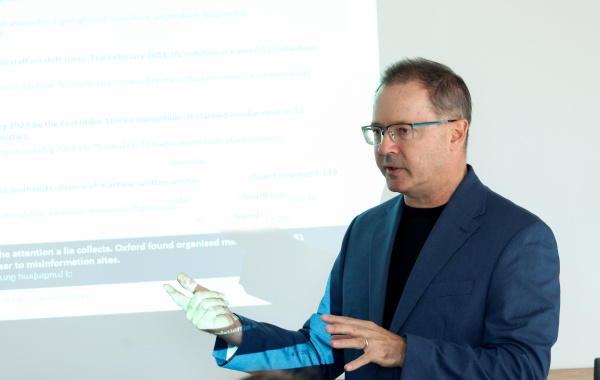
I am teaching a course and also supervising master's theses in journalism. One interesting professional challenge for me is that applying semiotics directly to journalism and media studies has not been a central focus of my previous research, although in recent years I have worked extensively on new media, digital culture and artificial intelligence.

This course helps me explore new professional territory. At the same time, I see this visit as an opportunity to strengthen ties between our universities and develop long-term cooperation.

Q: What is the main focus of your course, and what knowledge and skills do you consider important for students?

A: What I bring is my particular perspective on digital culture from semiotics. A central topic in my research is the commercialization of practically every aspect of contemporary social interaction. The digital environment gives us enormous opportunities, but at the same time, the algorithms operating within it generate profits for the owners of the platforms.

From this point of view, one of the basic ideas of my course is that producing quality journalism today is becoming increasingly difficult. Media have always faced commercial pressures, of course, but digital culture has brought something new: practically every cultural act, every interaction, every click and every moment of attention can be monetized.

One of the important practical elements of my course is encouraging students, especially master's students, to think entrepreneurially. They have knowledge, skills and practical journalistic expertise. The question is: how can they transform these into a startup or a new business venture? How can they sell their journalistic expertise in new and innovative ways?

We have a theoretical part in the course, but we will soon try to turn this theory into concrete startup ideas. Students will develop possible journalistic ventures and think about how to brand them, how to position them, what research they need, who their target audiences are and what kind of business model could make their projects sustainable.

I think this way of thinking is becoming increasingly important to almost every profession today. When pursuing a professional activity, it is also necessary to consider how to present it visually and digitally and how to make it visible and influential in the public sphere.

Q: How would you assess your experience working with YSU colleagues and students?
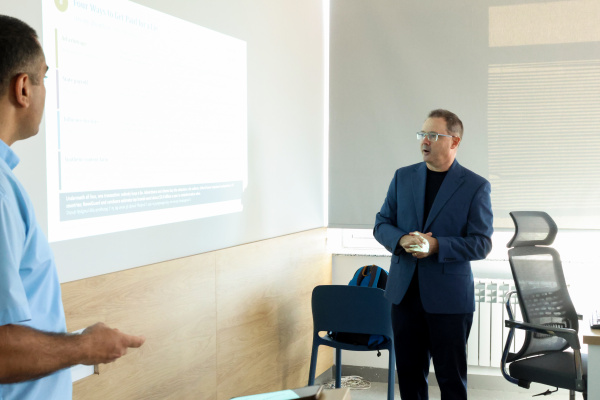
A: My experience of working with YSU colleagues has been very positive. I have found an extremely friendly environment and highly professional people who are eager to introduce innovative approaches into academic programs.

The students I work with are members of Generation Z. They are active, open, demanding, have a good command of English and are interested in high-quality learning materials. I am absolutely certain that the best of our collaboration is still to come. 

Q: What similarities and differences do you see between the academic environments at YSU and New Bulgarian University?

A: To me, Yerevan State University is a European university. Honestly, I do not see any significant differences between our academic environments.

Of course, New Bulgarian University is a private university, so our managerial structure is different from that of a state university. In this respect, YSU is probably much closer to Sofia University.

Having taught and worked in many Asian countries, I would say that the educational approaches here and the interactions between faculty and students remind me more of a European academic environment.

Since a university usually reflects something of the general climate of a society, I also perceive here a democratic academic environment and an approach to education as something that should contribute to social justice and equal opportunities. Maybe I am particularly attentive to this aspect, but it is one of the important impressions I have formed of Armenia and YSU.

Q: How do you involve students and young researchers in research activities at New Bulgarian University?

A: At my home university, I head a laboratory for social semiotic research, where we involve master's students, PhD students and early-career researchers in concrete applications of semiotic theory.

Our particular specialization is brand research. Students study brands across different sectors using semiotic methods. PhD students work more deeply on methodology, while early-career researchers further develop the theoretical approaches.

I attach great importance to the practical value of academic research and its benefits for society. We also study the impact of artificial intelligence on creative fields, seeking to promote more aware and ethical approaches to cultural life.

Q: What long-term outcomes do you expect from this visit?

A: My expectations are quite high. I very much hope that we will establish new cooperation with YSU, including exchange programs for professors and students. 
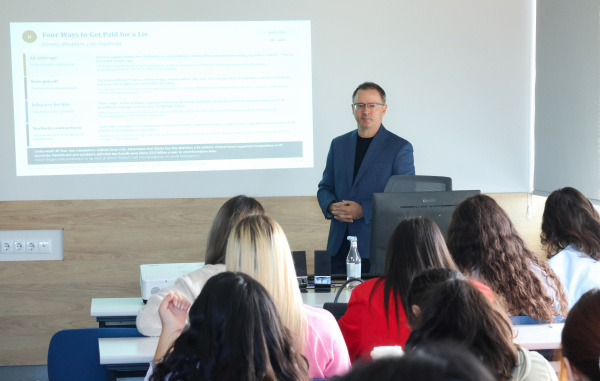
If the amount of work required and the willingness of colleagues on both sides allow it, I would also very much like us to develop a joint academic program. The affinity between what our students study at New Bulgarian University and what students study here at the Faculty of Journalism makes me optimistic.

Regarding publications, we are already discussing contributions from YSU scholars, particularly colleagues interested in semiotics, to our journal Digital Age in Semiotics & Communication.

I think further possibilities for joint research will emerge. Ideally, we could design and carry out a joint research project together. For me, it is important that this visit marks the beginning of a long-term collaboration.

Q: What advice would you give to YSU students and young researchers looking to advance in today's changing professional landscape?

A: This is probably the most difficult question. We are living through a major cultural transformation, with artificial intelligence as one of its main driving forces. My advice would be to study this new reality, keep an eye on its developments and learn to use technology to achieve your professional, creative and social goals.

Young people are more open to developing new ways of thinking and new skills. However, it is important to approach technological innovations thoughtfully and critically while maintaining the ability to think independently.

Sona Shahverdyan
ShareFacebookTelegram

Latest News

"Producing quality journalism today is becoming increasingly difficult," says YSU visiting professor Kristian Bankov

03.11.2026

How to measure university performance and improve education quality: KPI4HE project results presented at YSU

02.11.2026

Մեկ դար անց՝ Զապել Եսայանի գաղափարից դեպի նրա հիշատակը հավերժացնող արձան․ ԵՊՀ-ում ամփոփվել է մրցույթը

02.11.2026
Show All

Announcement

Cooperation with the University of Koblenz, Germany

11.02.2026 - 11.11.2026

ՅՈՒՆԵՍԿՕ–Ալ Ֆոզանի երիտասարդ գիտնականների միջազգային մրցանակի թեկնածուների առաջադրման հայտերի ընդունելություն

10.29.2026 - 11.30.2026

«Էրազմուս+» ծրագրի միջազգային կրեդիտային շարժունություն. Բոլոնիայի համալսարան, Իտալիա

10.29.2026 - 11.11.2026
Show All

Արագ հասանելիություն

  • Intranet
  • E-learning
  • Mulberry
  • Online applications
  • Phone book
  • Registrar
  • Documentation

Footer(ENG)

  • Main pages
    • Admission
    • Education
    • Science
    • News
  • Information
    • Frequently asked Questions
    • Vacancies
    • Search for educational programs
    • For the applicants
    • For the students
  • About YSU
    • YSU management
    • YSU symbols
© Yerevan state university 2026
Address: Republic of Armenia, Yerevan, 0025, 1 Alex Manoogian (+37460) 710000 info@ysu.am