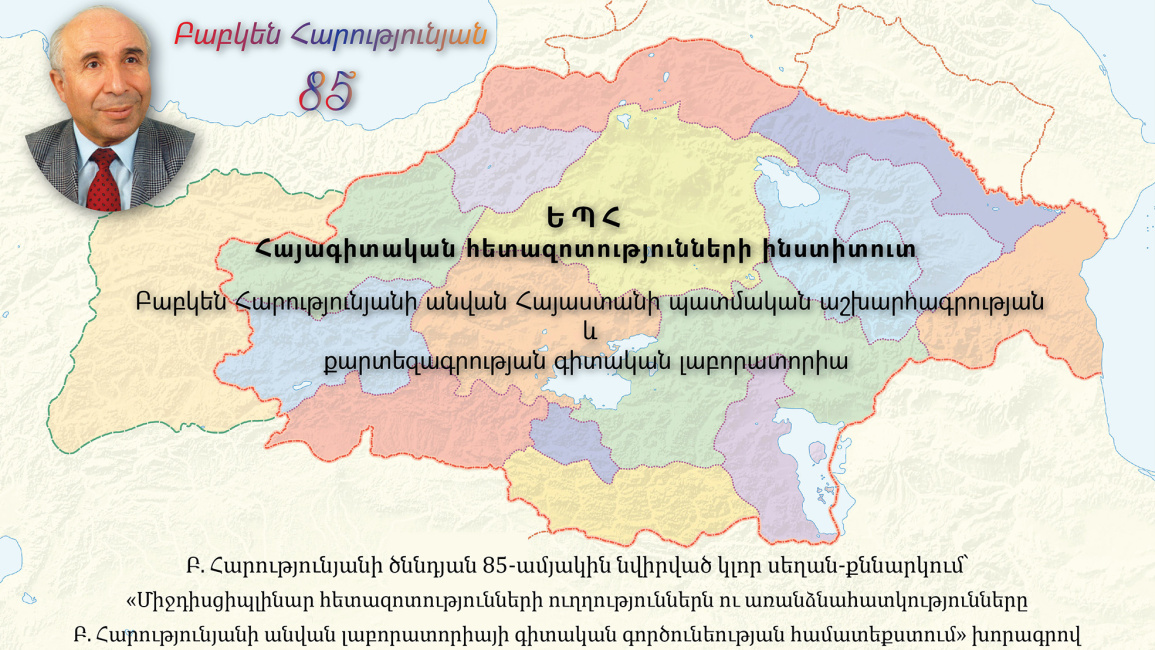
A roundtable discussion titled "Directions and Features of Interdisciplinary Research in the Context of the Scientific Activities of the Babken Harutyunyan Laboratory" was held at the YSU Institute for Armenian Studies on July 10 to mark the 85th anniversary of the birth of renowned scholar Babken Harutyunyan.
The event, organized at the initiative of the Babken Harutyunyan Research Laboratory of Historical Geography and Cartography of Armenia, opened with remarks by Vahram Petrosyan, Director of the YSU Institute for Armenian Studies, Doctor of Historical Sciences and Associate Professor. He invited Vardan Mkhitaryan, Head of the laboratory, a student and colleague of Harutyunyan, and Doctor of Historical Sciences, to deliver the first presentation.
Mkhitaryan presented the biography and extensive scientific legacy of Babken Harutyunyan, a renowned scholar, Corresponding Member of the National Academy of Sciences of Armenia, Honored Scientist, Doctor of Historical Sciences and Professor. He emphasized Harutyunyan's undeniable contribution to the establishment and development of the scientific school of historical geography and cartography in Armenia. The significance of the laboratory founded by the distinguished scholar, which is a unique research center in Armenia, was also highlighted.
Edik Minasyan, a senior researcher at the laboratory, Doctor of Historical Sciences, Professor and Head of the YSU Chair of Armenian History, as well as laboratory researchers Alik Gharibyan, Gohar Ghambaryan and Vardan Aleksanyan, delivered presentations and shared observations on the laboratory's scientific legacy, principal areas of activity and prospects for development.
The discussion also addressed the interdisciplinary research conducted at the laboratory. It was noted that combining history, geography, cartography and information technology makes it possible to examine historical phenomena and processes comprehensively and produce more substantiated scientific findings.
The results of this research are presented not only in individual monographs and articles, but also in the form of historical atlases, thematic maps and educational and research posters, which are widely used in scientific, educational and cultural fields. Particular emphasis was placed on the fact that the laboratory's work is of not only scientific and theoretical significance for Armenia, but also practical, strategic importance for the state and political significance.
During the professional discussion that followed the presentations, heads of the institute's divisions addressed scientific achievements in the field, existing challenges and future priorities.
Concluding the event, Petrosyan emphasized the exceptional importance of ensuring the continuity of the scientific school established by Harutyunyan and linking its work with research conducted at the current stage of the development of Armenian studies.