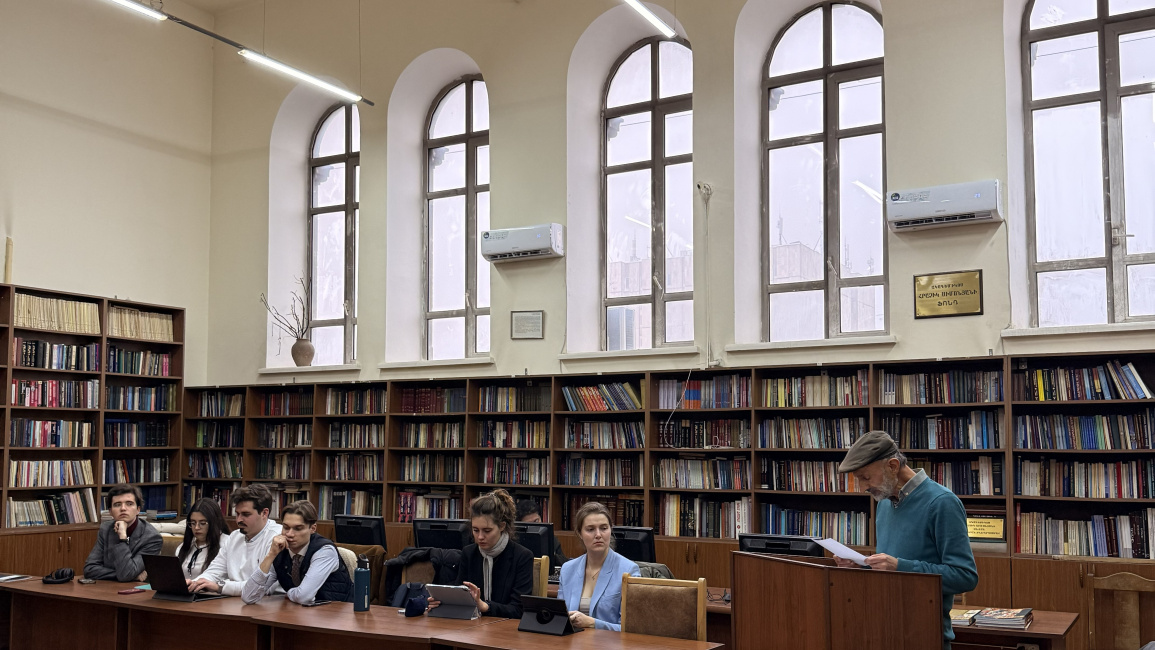
On December 2 of this year, a scholarly and educational meeting was held at the Faculty of History with the participation of scholarship recipients of the Konrad Adenauer Foundation. As part of the meeting, Hrach Bayadyan, a lecturer in the Chair of World History at Yerevan State University, delivered a lecture on the role of the Russian imperial legacy and its multifaceted manifestations within the historical and cultural context of Armenia.
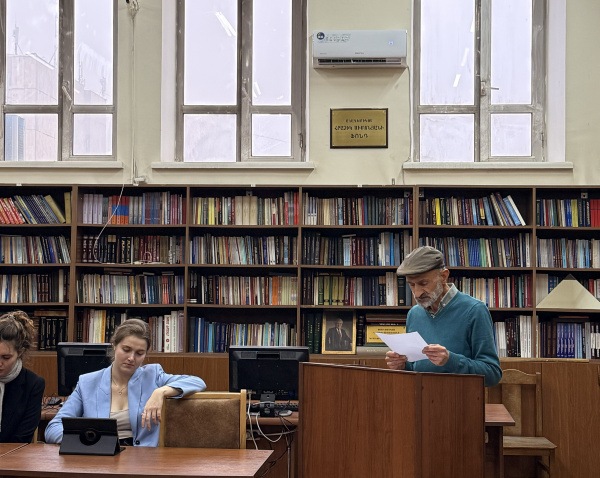
The speaker addressed the peculiarities of Russian and Soviet colonial policies, emphasizing that over the past 200 years, these policies has not been uniform across different regions. They varied significantly from Eastern Europe and the Baltic countries to the South Caucasus and Central Asia, with dynamics dependent on the political, ideological, and geopolitical orientations of each era.
Hrach Bayadyan highlighted that in recent years, Russia, citing its Soviet imperial past, has attempted to restore its great power status and reaffirm its influence over former Soviet republics. At the same time, particularly in the context of Armenia, a new situation has emerged: while maintaining significant political and economic influence, Russia has substantially lost its cultural authority and the traditional perceptions associated with its "civilizational mission". The speaker noted that the ongoing war in Ukraine and the resulting international sanctions against Russia have considerably limited its influence over several countries in the region, including Armenia.
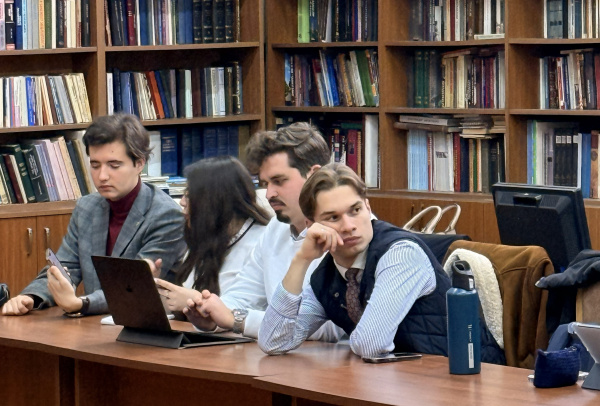
One of the key points of the lecture concerned the issue of cultural colonization. According to Bayadyan, Armenia's current cultural dependence is not a result of contemporary Russian influence. Rather, it primarily stems from the Soviet-Armenian cultural legacy, which was formed within the framework of Soviet ideology and deeply incorporated elements of Russian culture.
The event provided an important opportunity for the scholarship recipients to deepen their understanding of historical processes in the region and their contemporary manifestations.