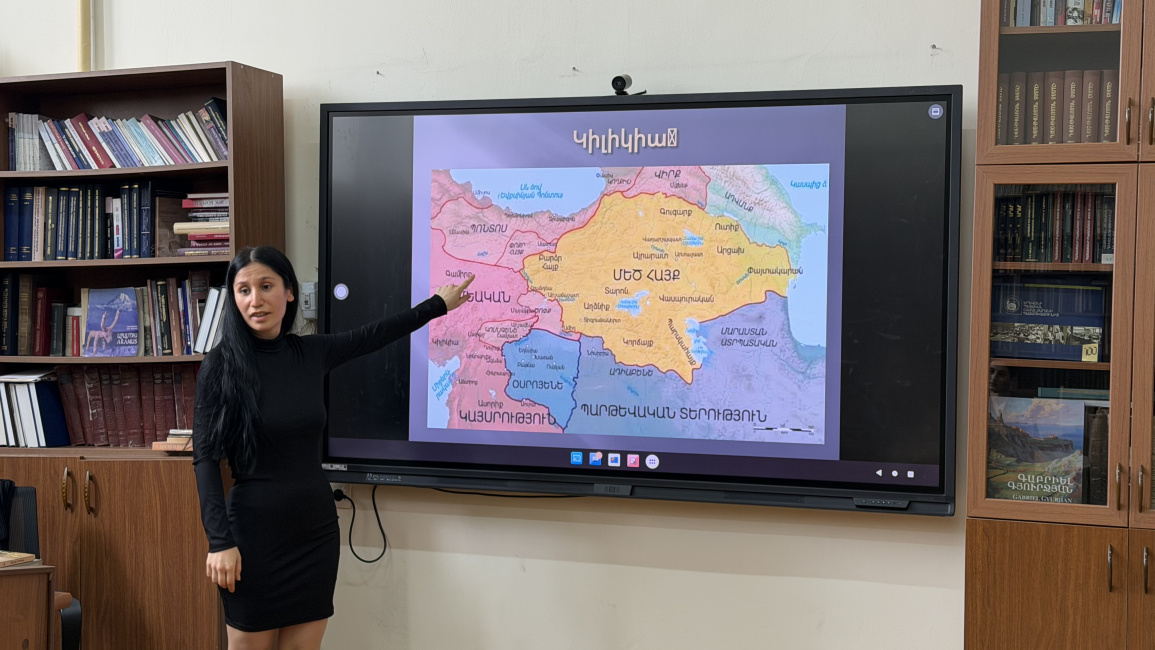
As part of the theoretical seminar series for PhD students and researchers at the YSU Faculty of History, PhD candidate Lianna Avetisyan from the Chair of Armenian History delivered a presentation titled "Cilicia According to Vardan Areveltsi's Ashkharhatsuyts". The report examined the historical and geographical profile of the medieval Armenian state of Cilicia in the 13th century, as well as the administrative and political transformations that took place during that period.
In the 13th century, the Armenian Kingdom of Cilicia, while shaping its internal life and external relations across military-political, economic, and diplomatic spheres, continued to enrich the Armenian civilizational value system with foundational principles in state-building, culture, and international relations.
According to Lianna Avetisyan, the foreign policy of the Armenian state often unfolded within a shifting geopolitical environment marked by the expansionist ambitions and conflicts of both Western and Eastern powers.
"These conditions had a direct impact on the historical and geographical profile of Cilician Armenia. In this context, the study of Cilicia's historical geography becomes particularly important. A valuable primary source for such research is Vardan Areveltsi's Ashkharhatsuyts, which makes it possible to examine the administrative and political changes that took place in Cilicia during the 1270s and the preceding period," Avetisyan noted.
The Ashkharhatsuyts is also significant because, whereas earlier Armenian historiography has primarily approached Cilician Armenia from a political perspective—focusing on royal dynasties, culture, and related topics—this work allows it to be examined as a geographical unit.
Avetisyan emphasized that Cilicia, located along the Mediterranean coast and functioning as a transit trade zone, was situated at the crossroads of East–West conflict. This position directly influenced its historical and geographical configuration, in some cases even reshaping its administrative-territorial structure.
In conclusion, it was stressed that Vardan Areveltsi's Ashkharhatsuyts is a key primary source that enables scholars to identify major administrative and territorial changes in Cilicia during this complex historical period. It also allows researchers to view Cilician Armenia from a multidimensional perspective—as both a dynamically developing political entity and a distinct and coherent geographical unit.
For participants, the presentation was valuable both in terms of content and methodology. It offered students an opportunity to approach primary sources through a historical-geographical lens and to better understand the nuances of working with medieval texts.