September 25, 2026 | 12:00
Research
Publications and scientific journals
Culture
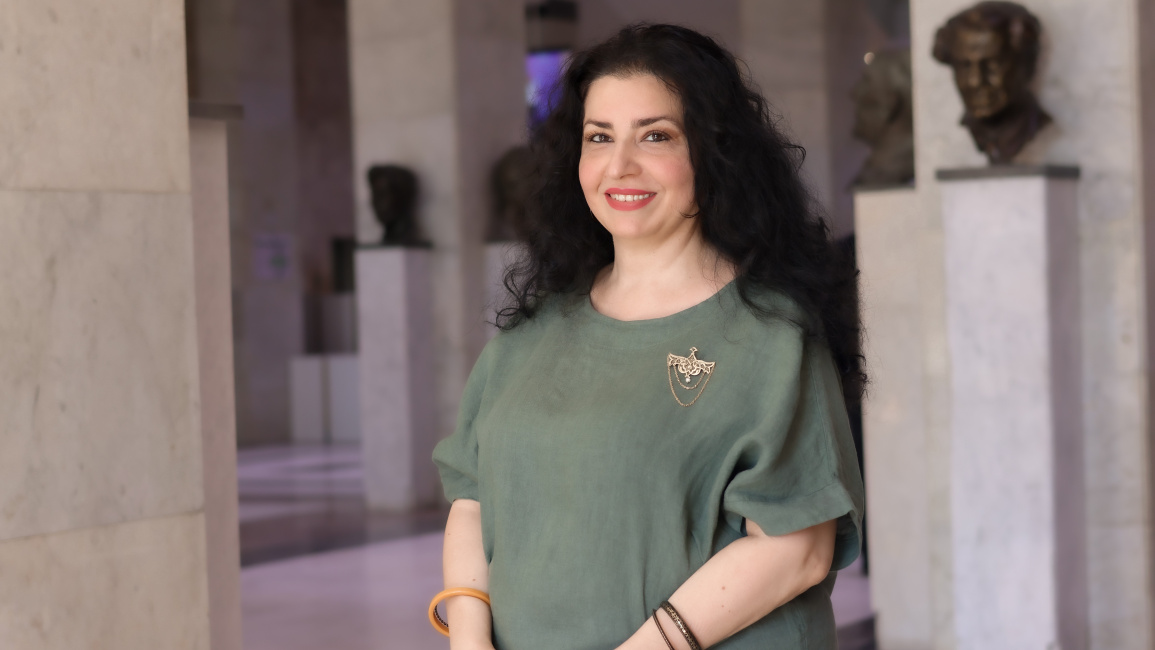
Mariam Vardanyan has concluded that the silver ark held in the collection of the Armenian Diocese of Romania may not only represent an iconographic interpretation of the Heavenly Jerusalem but may also be a unique Armenian liturgical object.
In our conversation with her, we discussed the history of the silver ark, its iconography and the mysteries that remain unresolved.
Mariam Vardanyan has spent years studying the silver ark in the collection of the Armenian Diocese of Romania in an effort to understand its meaning.
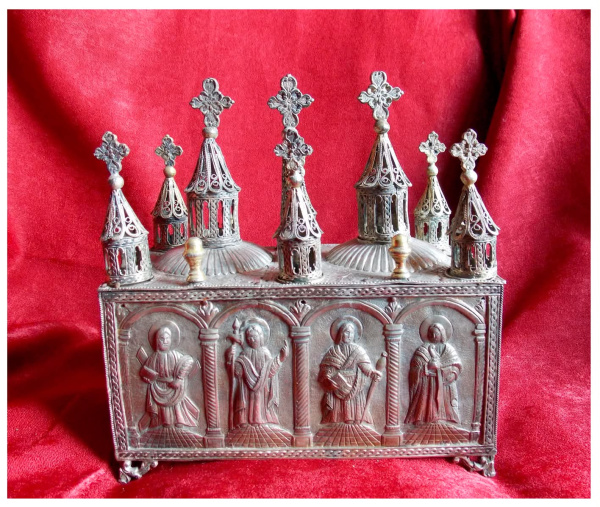
"This liturgical object depicts the 12 apostles of Jesus Christ and a number of domes. However, its practical function remains unclear to this day. There is no opening anywhere on the object, and the silver plates are firmly attached to it with small nails. It has also never undergone an X-ray examination, so we do not know what is inside," Vardanyan said.
The historical significance of the ark is further enhanced by an Armenian inscription on its underside.
"There is an inscription on the underside stating that in 1799 Mahtesi Asfatur of Focșani donated it to the Holy Mother of God Church in Focșani. This inscription points to a noteworthy phenomenon — pilgrimage to Jerusalem — since the title mahtesi was given to people who had traveled to Jerusalem on pilgrimage. There was also a custom whereby pilgrims were expected to bring gifts for the church and school in their home community, choosing the finest items they could obtain. The gift was intended to reflect their experiences, the pilgrimage they had made, the fact that they had seen the Tomb of the Lord, and so on," the YSU researcher said.
She added that Focșani, Romania, has an Armenian community and three Armenian churches.
In deciphering the symbolism of the silver ark, Vardanyan drew on biblical texts, particularly the Book of Revelation, in which the Heavenly Jerusalem is described as a four-sided city founded upon the 12 apostles. Unlike the biblical text, which mentions three apostles on each side of the four-sided city, the ark is rectangular.
"During my research, I found a similar object which, of course, is not Armenian and dates from the ninth to 13th centuries. It depicts the apostles, and researchers have concluded that it represents the Heavenly Jerusalem. This object, which is of Carolingian origin, has the same proportions as the silver ark in the collection of the Armenian Diocese of Romania," she said.
Vardanyan added that the silver ark depicts all 12 apostles: two on each of the narrow sides and four on each of the long sides. Its upper section features nine church domes — six resembling one another, another two resembling each other, and one differing from the others.
According to Vardanyan, on the Carolingian object the symbolism of light is conveyed through crystal in the Bible, whereas the maker of the silver ark chose a different solution.
"Our object has no crystal, but the idea of light entering the structure is conveyed through domes made using the filigree technique. Filigree is openwork and transparent, allowing light to refract, shimmer and shine, effectively enabling light to interact with the appearance of the object. My conclusion is that, in making this object, the craftsman replaced crystal with filigree," she explained.
According to the researcher, it is precisely the domes made using this delicate filigree technique that give the object its distinctly Armenian character, while the images of the apostles alone follow Western iconographic models.
"After the 17th century, major global cultural changes took place, and Western iconographic models became widespread throughout the Christian East. But when the apostles are viewed together with the domes, the object creates an entirely Armenian artistic impression," she said.
Vardanyan explained that the domes not only evoke Armenian architecture but also resemble the small pavilion-like structures, or tempiettos, depicted in the margins of Armenian illuminated manuscripts, which likewise symbolize the Heavenly Jerusalem.
"There is also an inscription beneath the ark indicating where it was made: 'Made in Istanbul.' Constantinople was particularly renowned for its Armenian craftsmen. They played an important role in the Ottoman Empire, including serving as chief goldsmiths to the imperial court," the YSU lecturer said.
According to the researcher, accounts of pilgrims' journeys have also survived, showing that they traveled by sea from Romania to Constantinople and obtained their pilgrimage gifts there.
According to Vardanyan, Armenian liturgical objects in general remain very poorly studied, despite the vast Armenian heritage preserved around the world.
"Today, this ark is kept at the Dudian Museum of the Armenian Diocese of Romania in Bucharest. On feast days, it is placed on the Holy Altar, regarded as the most sacred space in the church," she said.
The researcher hopes an X-ray examination can be carried out in the future to determine what is inside the centuries-old sacred ark. According to Vardanyan, similar boxes were known particularly in Byzantine culture as containers for the Eucharist. However, the object she studied has no opening or door that would allow its interior to be accessed or used, and therefore it cannot be regarded as a Eucharistic container. In addition, in reliquaries, the section containing the relic is usually made of crystal, while the silver ark has no such section either. Determining the ark's precise function and internal structure therefore remains a subject for further research.