September 24, 2026 | 16:16
Society
Culture
Policy

University of Pennsylvania Professor Lynn Meskell's research spans archaeology, heritage studies, social and political anthropology, and postcolonial theory.
During the workshop, Professor Meskell shared her view that cultural heritage in the modern world is no longer merely soft power but has become hard power/one, around which military conflicts and political confrontations unfold.
"You've probably heard about the idea of cultural heritage as soft power. I would argue, however, that it is no longer quite so 'soft'; it has become considerably harder. People fight over it, wage wars over it, ultimately destroy it or sometimes reconstruct it. In other words, heritage is very closely tied to conflict," the professor said.

According to Meskell, the destruction of archaeological sites and historical monuments has also entered the UN Security Council's agenda in recent years. She noted that diplomats at the body who previously dealt primarily with nuclear weapons issues are now also addressing the loss of historical and cultural heritage. In her assessment, actions by non-state armed groups are the main focus of international condemnation or legal proceedings, while mechanisms for holding major states accountable for their actions remain limited.
According to the professor, UNESCO's 1954 (Convention for the Protection of Cultural Property in the Event of Armed Conflict) and 1972 (Convention Concerning the Protection of the World Cultural and Natural Heritage) conventions have, in practice, failed to provide the expected level of protection for cultural heritage.
"These conventions fail to provide genuine protection or justice in cases involving the loss of historical and cultural heritage. The blue shield protective emblem used under UNESCO auspices has also been placed on some monuments in Armenia, including Geghard Monastery. The same emblem was displayed on the Mostar Bridge before it was bombed, as well as on some monuments in Iran, but it did not prevent them from being targeted or destroyed," she said.

According to the professor, being on the UNESCO list gives monuments international visibility, although that visibility in itself does not amount to protection or justice. However, such status, Meskell said, can be significant in raising questions of accountability in international legal proceedings.
"International visibility is mainly given to monuments that are not simply sites of national significance but are included on international registers. At the same time, that visibility in itself does not mean justice. Being included on the UNESCO list can be highly significant. That is what can bring a case before a court, because in such cases it concerns a violation of international law," she emphasized.
Professor Meskell visited an Armenian border village opposite the ruins of Ani and viewed the archaeological site through binoculars.
The workshop also addressed the process through which the historic Armenian city of Ani was inscribed on UNESCO's World Heritage List. It was noted that the nomination had been submitted by Turkey, where the site is located, and that Ani's inscription was approved in 2016 at a session of the UNESCO World Heritage Committee held in Istanbul.
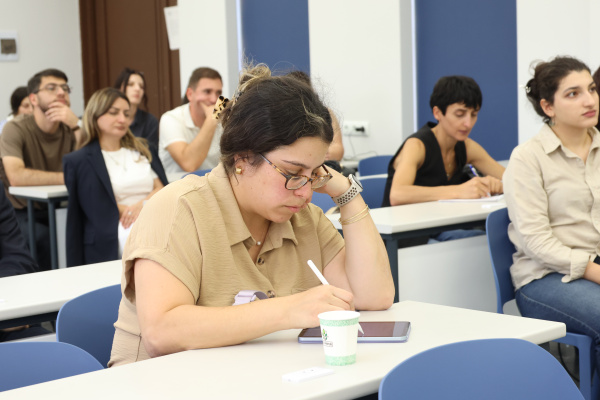
Participants also discussed the preservation of Artsakh's cultural heritage, presenting their observations on Azerbaijan's actions and the response of the international community.
According to Professor Meskell, given the limitations faced by international organizations and the broader political processes involved, it is important to continue work to preserve memory, conduct scholarly research, and strengthen international professional cooperation.
The two-day workshop was organized at the initiative of the Laboratory of Philosophy and Theory of History. Researchers and students in history, philosophy, archaeology, cultural studies, ethnography and related fields took part in the discussions.