October 16, 2026 | 09:30
Science
Education
Society

More than a century later, the publication offers an opportunity to explore how the university's ties to the press began and how it developed through journalism education, university publications and the work of generations of journalists.
On January 31, 1920, the day the University of Armenia opened, a one-day newspaper titled "The University of Armenia" was published in Alexandropol under the motto "Science is power."

The publication featured "The Democratic University," an article by the university's first rector, Yuri Ghambaryan, speeches by founding faculty members and even the timetable for the first semester.
Notably, proceeds from the newspaper's sale were intended to support students in financial need.
Today, this one-day publication serves as a valuable historical source of information about the university's early years.
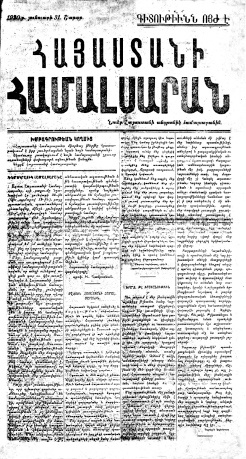
The newspaper's editorial, "The Democratic University," was written by the university's first rector, Yuri Ghambaryan. In it, he outlined the principles guiding the organization of the newly established university and its educational objectives.
The article described the university as:
"...a free, secular and democratic university, called upon to cultivate science and virtue in equal measure..."
The newspaper also published speeches by founding faculty members, the first-semester timetable for the Faculty of History and Linguistics, and a message from Catholicos of All Armenians Gevorg V addressed to the university's rector, faculty members and students.
Another noteworthy fact about the publication is that proceeds from its sale were allocated to a fund supporting students in financial need.
Today, this one-day publication is a valuable source for studying the history of the university's founding. It preserves information about both the opening ceremony and the academic and organizational activities of the newly established institution.
In the decades that followed, the university's involvement in journalism expanded through the introduction of professional education in the field.
In the 1949-1950 academic year, the Department of Journalism was established within YSU's Faculty of Philology.
The department produced its first graduates in 1954. Among them were writers and commentators Vardges Petrosyan and Artashes Kalantaryan, as well as Lida Gevorgyan, a Doctor of Philology and researcher of Armenian press history.

In the following years, graduates of YSU's journalism program pursued careers in the press, literature, culture and various areas of public life.
One example of their work was "Garun" magazine, which played an important role in Armenian literary and cultural life from the 1960s through the 1980s. During those decades, graduates of YSU's Department of Journalism were the magazine's editors.
As journalism education developed, the department underwent structural changes and was closed and reopened at different periods.
On October 1, 1999, the YSU Academic Council established the Faculty of Journalism.
The history of the Armenian press dates back to October 16, 1794, when "Azdarar," the first Armenian periodical, founded by Harutyun Shmavonyan, was published in Madras, India.

Over the following centuries, Armenian-language periodicals were published in various countries, covering social, political, cultural and educational issues.
The methods of producing and disseminating news also changed over time. Alongside the print press, radio and television developed, followed by online news outlets and social media platforms.
Today, information can spread within seconds, while artificial intelligence tools present new opportunities and challenges for journalism.
Under these circumstances, verifying information, assessing the credibility of sources, distinguishing facts from opinions and upholding professional ethics are particularly important.
These changes are also influencing the content of journalism education. YSU's Faculty of Journalism continues to train professionals and conduct research into media history, theory and contemporary communication processes.
More than a century ago, the university's first newspaper reported on the activities of the newly established institution. Today, journalists work in an environment where information spreads at lightning speed and technology continually transforms how it is produced and disseminated.

Yet access to information does not guarantee its reliability. The ability to verify sources, cross-check facts, understand the context of events and report them accurately to the public is more important than ever.
These principles also underpin journalism education at YSU. Over the decades, curricula and professional tools have evolved, but the central objective has remained unchanged: to train professionals capable of handling information responsibly.
Armenian Press Day is an opportunity to recognize not only the historical legacy of Armenian journalism but also the professional work that ensures the public receives verified, reliable and comprehensive information.