November 13, 2025 | 11:25
Research
Publications and scientific journals
Competitions
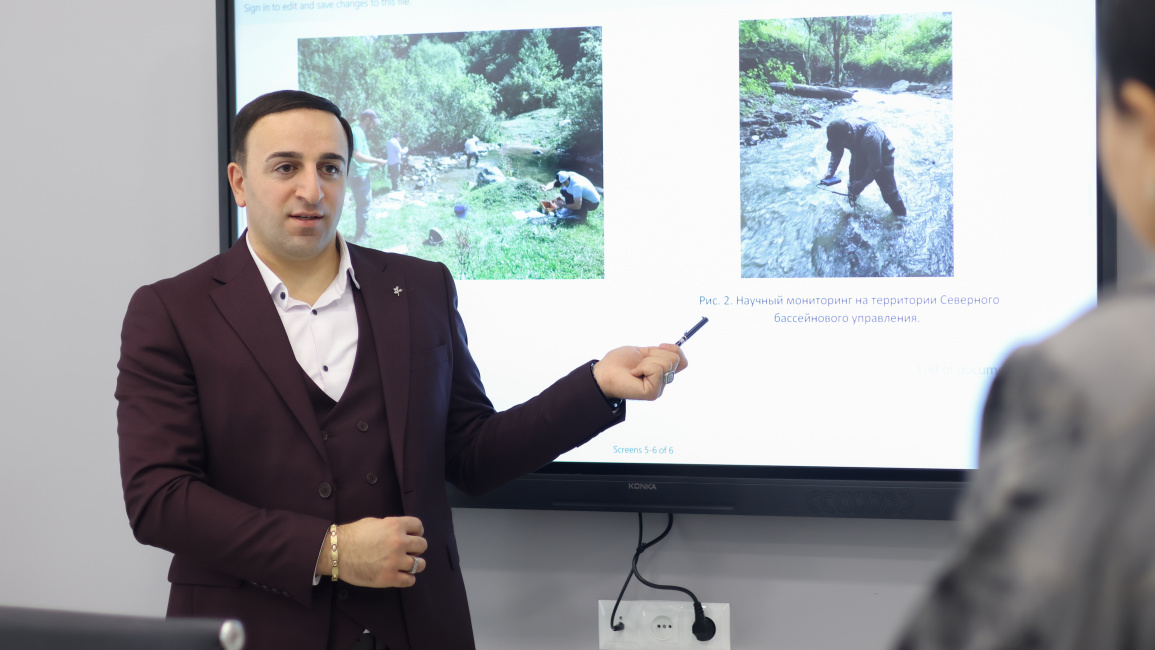
Hovakim Frunzikyan's scientific project, titled "Assessment of Ecological Condition of Surface Water Bodies. A Case-Study of The Northern Basin Management Area, Armenia", has been funded through the "Research Assistance Program for Young Applicants and PhD Students–2025", organized by the Higher Education and Science Committee of RA MoESCS.
The scientific supervisor of the project, Associate Professor Varduhi Margaryan from the YSU Chair of General Geography, emphasized the importance of the study, noting that it will examine the ecological issues of river basins in northeastern Armenia. Regarding the choice of the Debed River, she highlighted that it is one of the largest and most water-rich rivers in the country. Additionally, its status as a transboundary river basin was a key consideration: "Certain areas may be affected by rainfall, runoff, and water inflows originating upstream, which can influence the river's water quality. It is essential to study and analyze the ecological characteristics of such river basins, including the physical and chemical properties of the water, the impact of mining activities on water quality, its geographical distribution, and to determine the necessary measures to maintain ecologically favorable state."
We discussed the topic in greater detail with YSU PhD student Hovakim Frunzikyan.
– Hovakim, why did you choose this topic?
– From 2014 to 2023, I worked at Armenia's Hydromet under the Ministry of Environment of the Republic of Armenia and was involved in the EUWI+ program. Within this framework, we conducted monitoring of surface waters, including hydromorphological, hydrobiological, and hydrochemical studies. This experience inspired my current research topic, as the knowledge and skills I gained enabled me to deepen the study at the level of the Northern Basin Management Area, combining climate impact analysis with ecosystem assessment.

The Northern Basin Management Area is considered a highly sensitive zone, where climate and anthropogenic impacts—particularly mining and disruptions to water regimes—lead to deterioration of water ecosystem quality and a reduction in biodiversity.
The relevance of this topic stems from the fact that sustainable management of water resources and improvement of their quality are among Armenia's top environmental policy priorities. This research will allow the development of scientifically grounded recommendations for risk reduction and adaptive management strategies, closely linked to factors such as:
The growing impact of climate change on water quality and quantity;
The need to fill gaps in hydro-ecological data and monitoring;
Disruption of the ecological balance of surface waters; and
The requirement to develop sustainable management strategies in accordance with Armenian water legislation and the EU Water Framework Directive.
– You mentioned conducting preliminary studies on this topic. What were the findings, and where have they been published?
– Preliminary studies focused on surface water bodies in the Northern Basin Management Area, specifically the Debed, Agstev, and Pambak rivers and their tributaries. Field and laboratory work followed the EUWI+ methodology for surface water sampling (2019).
Analyses revealed ecological degradation in several river segments within the Northern Basin Management Area due to mining impacts, municipal pollution, and other factors. At the same time, a decrease in macroinvertebrate density and biodiversity was observed, indicating disruptions in ecosystem balance.
Based on these studies, methodological approaches for ecological assessment of water bodies were developed, forming the scientific foundation for further research under the grant program.
Related scientific work has been published in international journals such as Mining Informational and Analytical Bulletin (MIAB), 2024, No. 9, pp. 99–116 (Scopus indexed), and in conference proceedings, including Engineering Hydrology – 2025: International Conference Proceedings (St. Petersburg), pp. 104–111, and has been presented at international conferences.
– In the Northern Basin Management Area, there are approximately 2,388 rivers and streams across the Shirak, Lori, Tavush, and Gegharkunik provinces, as well as six reservoirs. Which resources are included in your study?
– The study focuses on water resources (the Debed and Aghstev rivers and some of their tributaries) for which monitoring data are available. The primary sources of data are monitoring stations operated by the Hydrometeorology and Monitoring Center. Some stations were selected as reference points or as points potentially impacted by pollution, even if they were not included in the Hydrometeorology and Monitoring Center's monitoring list. Additionally, results from our own monitoring in 2022 at 15 selected sites were used to evaluate potential pollution sources. Data from Hydromet's observations will also be incorporated.
Fieldwork includes hydromorphological, hydrobiological, and hydrochemical studies at the selected sites, enabling comprehensive ecological assessment in line with the EU Water Framework Directive.
– Regarding climate zones, what changes in ecological status have you observed, and what are their consequences?
– A formal assessment by climate zones has not yet been conducted. However, due to climate change, Armenia has experienced a reduction in surface water resources over the past decade, and this trend is expected to continue. Higher water temperatures and reduced flow worsen water quality by increasing microbial activity and pollution concentrations, leading to reduced aquatic biodiversity. These changes have direct consequences for agriculture, energy, and public health.
– How long is the study expected to take, and what will the final results contribute to?
– The research is planned for completion over three years. The final results will allow a preliminary comprehensive analysis of the environmental and economic status of the transboundary Debed River basin. They will highlight the need for further coordination between Armenia and Georgia, particularly between environmental and hydrochemical laboratories. The findings will enable the development of a detailed management plan for the studied river basins, offering solutions for previously stored and emerging hazardous waste, tailings management, and monitoring mechanisms. Ultimately, the results will support the restoration of significantly degraded river systems and provide a basis for improving community-level sewage and waste management infrastructure.