November 28, 2025 | 12:45
Science
Student

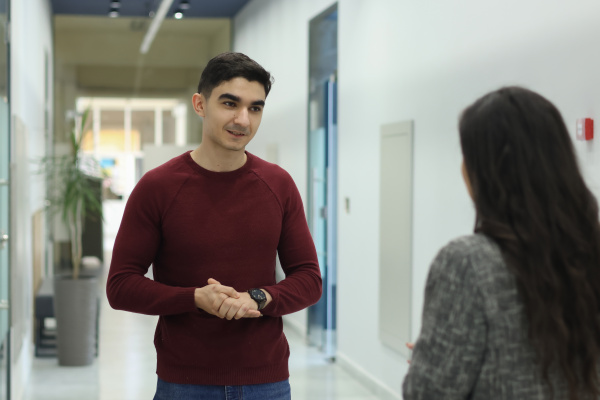
Areg Grigoryan, a PhD student at the YSU Institute of Physics, is conducting research within the framework of a scientific project titled "Some Quantum Phenomena in Curved Space with Applications in Cosmology". His work focuses on understanding the behavior of quantum fields in curved spaces and investigating the potential consequences of these fields.
"We aim to determine whether these consequences could affect cosmological evolution and whether it is theoretically possible to relate these effects to observable phenomena," he explains.
– Areg, could you explain why this topic is important and what significance it might have for understanding the structure of the universe and cosmology?
– Currently, humanity possesses several theories that describe nature, among which the most successful are Einstein's General Theory of Relativity (GR), which characterizes the influence of mass and energy on spacetime, and the Standard Model (SM), which explains how particles behave, interact, are created, and annihilated. Individually, these theories work exceptionally well, but complexity arises when we attempt to view them within a unified framework. GR describes gravity as the geometry of spacetime, whereas the SM relies on quantum mechanics and quantum field theory (QFT) to describe particle behavior. Our existing models become inconsistent in scenarios where spacetime curvature and quantum effects are comparable.
To investigate these issues, our research employs QFT to study certain quantum effects against a curved spacetime background. Modern cosmological theories suggest that the early universe was extremely dense, hot, and rapidly expanding. Under such conditions, interactions between GR and QFT are highly significant, and their nature is non-trivial. These interactions likely served as the "seeds" for the large-scale structure of today's universe.
Within the framework of this research, by applying our knowledge of GR and QFT, we aim to understand what kinds of quantum effects may emerge under specific spacetime curvatures and whether these effects could produce observable consequences. By understanding it, we may be able to explain certain unresolved phenomena and refine existing cosmological models to better align with the observable universe.
– At what stage is your research, and what expectations do you have from it?
– The research is currently in its initial, exploratory phase. I am working to deepen and refine my knowledge, while also continuing to familiarize myself with other ongoing work in this field.
The ultimate goal of the research is to determine how certain quantum fields behave under specific conditions of spacetime geometry and topology. We expect that this work will provide a clearer theoretical understanding and quantitative calculations regarding the behavior of quantum fields. Ultimately, we aim to publish at least five articles.
Although the results will not have immediate practical applications, they will advance our understanding of phenomena occurring at the intersection of General Relativity (GR) and Quantum Field Theory (QFT). We will gain a better understanding of the new mechanisms through which quantum fields may influence vacuum energy and the implications of this for the past and future of the universe. The research will also provide theoretical tools for studying quantum fields in non-trivial geometries, such as FRW (Friedmann–Robertson–Walker), AdS (Anti-de Sitter), and additional compact spaces.
The YSU student, who came to the university years ago seeking answers to many questions, notes that programs like this encourage students to formulate serious research problems and provide the necessary resources to take advantage of international collaboration opportunities and ensure the relevance of their research.
"I have been curious about the 'why' since I was little and wanted to find answers to my questions, and any meaningful 'why' eventually leads to physics. Therefore, choosing physics was a very natural decision," he emphasizes, adding that physics studies the laws of nature, which are the cause of all observable phenomena.
– Areg, what attracts you to your field, and what inspires you during your scientific research?
– I enjoy that I can explain most of the phenomena we encounter in everyday life using the fundamental laws of physics. It is very satisfying to simplify the causes of these phenomena to the point where I can also explain them to people who are not physicists. This also allows me to predict the outcomes of certain processes, which is highly inspiring.
I also see the applications of almost every branch of physics in daily life—from quantum physics used in computer technology, to the general theory of relativity applied in GPS systems, to solid-state physics necessary for the materials used in airplane engine blades (and such examples are endless).
The path of exploring the unknown is filled with fascinating and useful discoveries, which is the most rewarding aspect for anyone working in physics. I understand that physics is the cornerstone of everything.
– As a young researcher, what is your greatest challenge, and how do you overcome difficulties?
– Science is developing at a rapid pace, which continuously expands the body of knowledge required to work in the field. It is becoming increasingly difficult to master all the important areas within the known boundaries, especially when the goal is to extend those boundaries. During student years, it is difficult to fully understand everything you study. When you begin actual research, it often feels as though you do not have as firm a grasp of your knowledge as you would like. At the same time, there is also the necessity of earning money, which adds another layer of difficulty.

– If you could change any law of physics, which one would it be, and how would it change the universe?
– The world has reached its current stable state thanks to the existing laws of physics. Any change to them would inevitably lead to instability or disaster. In my view, the only change in the laws of physics that would not cause a catastrophe would be to reverse the signs of time and charge, or to enter a 'mirror world' (changing parity), because according to current understanding, charge-parity-time (CPT) symmetry is preserved. In that case, there should be no observable change in the universe.
– Every scientist has a desire to discover something new. What would you like to uncover?
– I think that modern cosmology has several incomplete aspects that need to be addressed. Its theoretical framework is not entirely compatible with other branches of physics. Therefore, I would like to propose a new, more coherent cosmological model. Perhaps this could be combined with an extended theory of gravitation, eliminating the need for a separate theory of quantum gravity.
– Areg, as a young physicist, what changes do you think are necessary for the development of science in Armenia?
– Above all, it is crucial to foster awareness of the importance of science at all levels of society. It must be understood that a country with strong science and high-level scientists simultaneously possesses a reliable foundation for applying scientific achievements in the economy and building solid pillars for its own development.
Armenia should actively participate in international scientific programs, as they not only help develop scientific potential but also ensure the continuous renewal of knowledge and technology. It is also important to understand that the results of investments in science are not always predictable, but in all cases, they hold significant potential for development.
I also think it is important to focus on in-depth study of specialized subjects.
The PhD student at the YSU Institute of Physics, alongside conducting research, seeks to fill gaps in his knowledge, strengthen his weaker areas, and learn to carry out research effectively. His goal is to become a highly skilled physicist capable of formulating precise and profound questions to push the boundaries of physics.
"Currently, alongside carrying out research, I am working on my PhD dissertation at the Chair of Theoretical Physics of the YSU Institute of Physics," Areg concludes.