Home
envelope
ՀայերենРусскийEnglish

Main Navigation (Eng)

  • Admission
    • Undergraduate admission
    • Master’s degree admission
    • Postgraduate admission
    • Foreign Students
    • Preparatory courses
    • Work Carried out with Applicants
    • YSU STEM High School
  • Education
    • Guide Book for First Year Students
    • Educational programs
    • Granting qualification of a pedagogue
    • Center for Academic Writing
    • Continuing education
    • Academic Calendar
    • Olympiad
  • Science
    • Open science
    • Conferences
    • Library
    • Grants
    • Publishing House
    • Doctoral Thesis Defence Councils
    • HRS4R
  • News and events
    • Events
    • Activities
    • News
    • Newsletter
    • Announcement
    • Photo gallery
    • Video gallery

Secondary Navigation (Eng)

  • About YSU
    • YSU Management
    • YSU Symbols
    • YSU International Cooperation
    • Quality assurance
    • YSU History Museum
    • Vacancies
    • FAQ
  • Structure
    • YSU Faculties and Educational Centers
      • Faculty of Geography and Geology
      • Faculty of Theology
      • Faculty of Oriental Studies
      • Faculty of European Languages and Communication
      • Faculty of Journalism
      • Faculty of Informatics and Applied Mathematics
      • Faculty of Law
      • Faculty of Biology
      • Faculty of Armenian Philology
      • Faculty of International Relations
      • Faculty of History
      • Institute of Physics
      • Faculty of Russian Philology
      • Faculty of Sociology
      • Faculty of Economics and Management
      • Faculty of Philosophy and Psychology
      • Faculty of Chemistry
      • Faculty of Mathematics and Mechanics
      • Pedagogy and Education Development Center
      • Center for European Studies
      • Institute of Pharmacy
      • Information Technologies Educational and Research Center
      • Chair of Civil Defense
      • Chair of Physical Education and Sports
    • Column Wrapper
      • YSU STEM High School
      • YSU Ijevan Branch
    • Scientific Centers and Laboratories
      • American Studies Center
      • Psychology Research Center
      • Research Laboratory of Applied Sociology
      • Center for Mathematical and Applied Research
      • Institute for Armenian Studies
      • Institute for Social and Humanitarian Studies
      • Research Center for Chemistry
      • Research Institute of Biology
      • Research Institute of Physics
      • Research Center for the Institute of Pharmacy
    • Scientific and Educational Centers
      • Observatory
      • Scientific and Educational Center for Control and Monitoring of the Quality of Medicines
      • Specialized cabinet-laboratory for the Design of Very Large Integrated Circuits (Synopsis)
      • Legal Clinic
      • Center for Applied Psychology
      • Research Center-Library of Greek Studies
      • Innovation Center for Microbial Biotechnology and Biofuels
      • Russian Center
      • Center for Russian Studies
      • Distance Learning Laboratory of Sociology
    • Column Wrapper
      • Banner
    • Administrative Divisions of YSU
      • Academic Secretary
      • Center for Doctoral Education
      • General Division
      • YSU History Museum
      • Department of Energy System Operation
      • Financial Analysis Department
      • Human Resources Department
      • Center for Admissions and Affairs with Applicants
      • Vehicle Fleet
      • Business Incubator
      • Byurakan Industrial Practice Base
      • Medical Center
      • Science Policy Department
      • Procurement Planning Department
      • Dilijan Sports and Health Center
      • YSU Archive
      • Publishing House
      • Legal Service
      • Marketing Department
      • International Cooperation Office
      • Tsaghkadzor training and production base
      • Cultural Center
      • Fire Safety Service
      • Alumni and Career Center
      • Hankavan Industrial Practice Base
      • Accounting Department
      • Center for Quality Assurance
      • Department for Special Affairs
      • Guest House
      • Student Dormitory
      • Educational-Methodological Department
      • Marie and Sarkis Izmirlian Library
      • Center for Strategic Planning
      • Rectorate
      • Rector's Office
      • Department of Territory Improvement and Landscape Design
      • Information Technology Department
      • Department of Organization and Control of Economic Activities
  • Structure
  • Alumni and Career
    • Alumni Community
    • Career Center
    • Friends of YSU
  • Student life
    • YSU Student Scientific Society
    • YSU Student Council
    • Art and Culture
ՀայերենРусскийEnglish
envelope

Main Navigation (Eng)

  • Admission
    • Undergraduate admission
    • Master’s degree admission
    • Postgraduate admission
    • Foreign Students
    • Preparatory courses
    • Work Carried out with Applicants
    • YSU STEM High School
  • Education
    • Guide Book for First Year Students
    • Educational programs
    • Granting qualification of a pedagogue
    • Center for Academic Writing
    • Continuing education
    • Academic Calendar
    • Olympiad
  • Science
    • Open science
    • Conferences
    • Library
    • Grants
    • Publishing House
    • Doctoral Thesis Defence Councils
    • HRS4R
  • News and events
    • Events
    • Activities
    • News
    • Newsletter
    • Announcement
    • Photo gallery
    • Video gallery

Secondary Navigation (Eng)

  • About YSU
    • YSU Management
    • YSU Symbols
    • YSU International Cooperation
    • Quality assurance
    • YSU History Museum
    • Vacancies
    • FAQ
  • Structure
    • YSU Faculties and Educational Centers
      • Faculty of Geography and Geology
      • Faculty of Theology
      • Faculty of Oriental Studies
      • Faculty of European Languages and Communication
      • Faculty of Journalism
      • Faculty of Informatics and Applied Mathematics
      • Faculty of Law
      • Faculty of Biology
      • Faculty of Armenian Philology
      • Faculty of International Relations
      • Faculty of History
      • Institute of Physics
      • Faculty of Russian Philology
      • Faculty of Sociology
      • Faculty of Economics and Management
      • Faculty of Philosophy and Psychology
      • Faculty of Chemistry
      • Faculty of Mathematics and Mechanics
      • Pedagogy and Education Development Center
      • Center for European Studies
      • Institute of Pharmacy
      • Information Technologies Educational and Research Center
      • Chair of Civil Defense
      • Chair of Physical Education and Sports
    • Column Wrapper
      • YSU STEM High School
      • YSU Ijevan Branch
    • Scientific Centers and Laboratories
      • American Studies Center
      • Psychology Research Center
      • Research Laboratory of Applied Sociology
      • Center for Mathematical and Applied Research
      • Institute for Armenian Studies
      • Institute for Social and Humanitarian Studies
      • Research Center for Chemistry
      • Research Institute of Biology
      • Research Institute of Physics
      • Research Center for the Institute of Pharmacy
    • Scientific and Educational Centers
      • Observatory
      • Scientific and Educational Center for Control and Monitoring of the Quality of Medicines
      • Specialized cabinet-laboratory for the Design of Very Large Integrated Circuits (Synopsis)
      • Legal Clinic
      • Center for Applied Psychology
      • Research Center-Library of Greek Studies
      • Innovation Center for Microbial Biotechnology and Biofuels
      • Russian Center
      • Center for Russian Studies
      • Distance Learning Laboratory of Sociology
    • Column Wrapper
      • Banner
    • Administrative Divisions of YSU
      • Academic Secretary
      • Center for Doctoral Education
      • General Division
      • YSU History Museum
      • Department of Energy System Operation
      • Financial Analysis Department
      • Human Resources Department
      • Center for Admissions and Affairs with Applicants
      • Vehicle Fleet
      • Business Incubator
      • Byurakan Industrial Practice Base
      • Medical Center
      • Science Policy Department
      • Procurement Planning Department
      • Dilijan Sports and Health Center
      • YSU Archive
      • Publishing House
      • Legal Service
      • Marketing Department
      • International Cooperation Office
      • Tsaghkadzor training and production base
      • Cultural Center
      • Fire Safety Service
      • Alumni and Career Center
      • Hankavan Industrial Practice Base
      • Accounting Department
      • Center for Quality Assurance
      • Department for Special Affairs
      • Guest House
      • Student Dormitory
      • Educational-Methodological Department
      • Marie and Sarkis Izmirlian Library
      • Center for Strategic Planning
      • Rectorate
      • Rector's Office
      • Department of Territory Improvement and Landscape Design
      • Information Technology Department
      • Department of Organization and Control of Economic Activities
  • Structure
  • Alumni and Career
    • Alumni Community
    • Career Center
    • Friends of YSU
  • Student life
    • YSU Student Scientific Society
    • YSU Student Council
    • Art and Culture
  1. Main
  2. News
  3. Armenia is no longer only being shaped by history, but is also helping shape it — YSU professor
May 18, 2026 | 10:50
Education
International cooperation
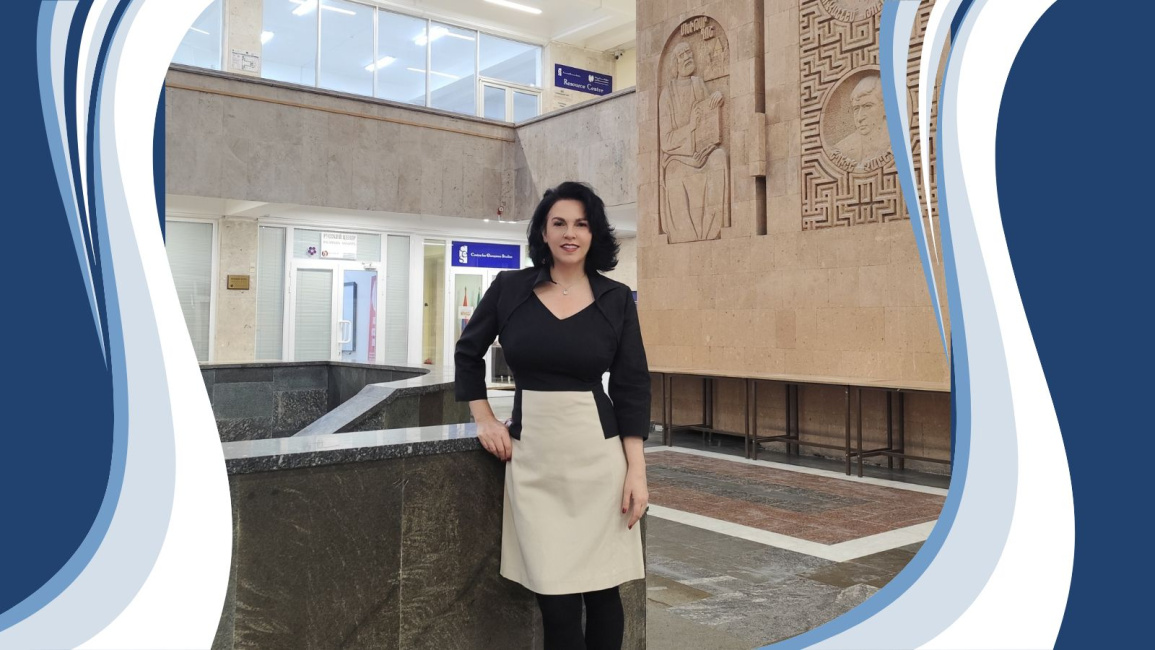
Armenia is no longer only being shaped by history, but is also helping shape it — YSU professor

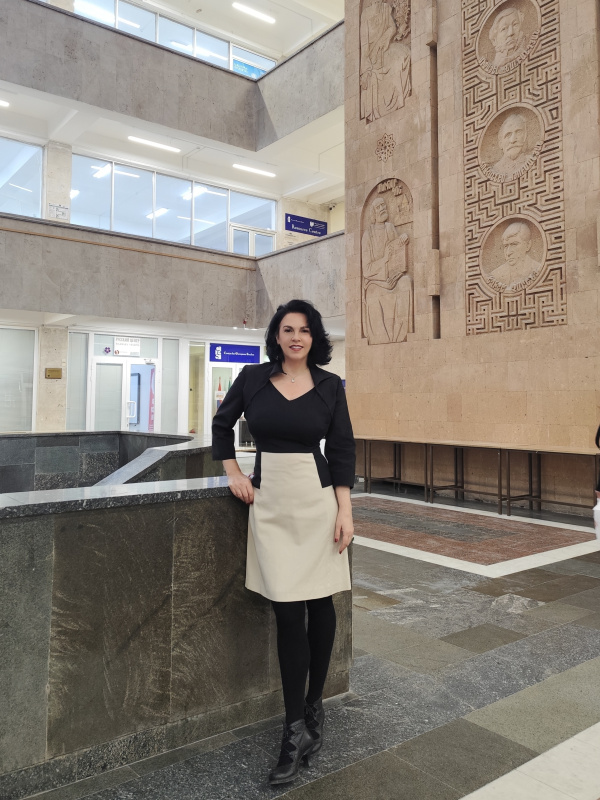
Professor Cristina Vanberghen has been teaching at the Faculty of International Relations at Yerevan State University for the past academic year. She delivers the course Artificial Intelligence and Non-State Actors in Global Politics, which is part of the faculty's academic curriculum. Before joining YSU, Professor Vanberghen lectured at the Free University of Brussels and the European University Institute in Florence.

According to Professor Vanberghen, there is a growing awareness in Armenia that national resilience cannot always rely on external guarantees. 

– Ms. Vanberghen, why did you choose YSU, and what led you to continue your academic career in Armenia? 

– I chose Yerevan State University because I have always believed that intellectual work is most meaningful when it is close to change rather than merely observing it.

Throughout my professional career, whether in diplomacy, European institutions, or academia, I have consistently sought environments where complexity is real, where theory is tested by events, and where ideas can have practical significance.  

There was no single turning point that brought me here. Rather, it was the result of long reflection shaped by years of work and teaching in the European Union, India, Japan, and Southeast Asia. Across those regions, the European Union has steadily deepened its strategic and digital partnerships. Over time, I became increasingly interested not only in observing these transformations, but also in contributing to them through education and dialogue.

Coming to Armenia felt like a natural continuation of that path — an opportunity to share my experience of global digital and geopolitical transformations and, in my own way, contribute to the work being carried out in this region.

I wanted to be in a place where many of the defining issues of our time converge: technological governance, digital sovereignty, geopolitical adaptation, and regional connectivity. Armenia is precisely such a place.

For someone teaching artificial intelligence, non-state actors, and digital diplomacy, this region is particularly instructive from a strategic standpoint.

– You describe challenges as a source of motivation. What has been the most difficult yet the most rewarding aspect of teaching at YSU?

– The greatest challenge has been helping students move from strong academic performance to genuine intellectual confidence. Many students possess impressive analytical skills, yet they often hesitate when it comes to fully trusting their own strategic judgment.

This transformation takes time. It requires creating an environment that encourages questioning the foundations of certain assumptions. The most rewarding aspect has been witnessing that shift. 

When a student begins not only to provide correct answers, but also to question existing frameworks, build connections across disciplines, and develop independent positions, that is when real education begins. 

– How do Armenian students engage with your course? Is their perspective different from that of students in Europe or Asia? 

– In some ways, yes and no. My students approach discussions on cybersecurity, artificial intelligence, and non-state actors with a pragmatic mindset and a strong sense of immediacy.

In some contexts, these topics may remain relatively abstract or confined to the policy level. However, as Europe itself increasingly faces cyberattacks and new forms of geopolitical pressure, many questions are emerging. In Armenia in particular, students clearly understand that issues related to security, institutional resilience, or technological dependence can have immediate consequences for both the state and society.

There is a stronger awareness that national resilience cannot always rely on automatic external guarantees or immediate support mechanisms, as is often the case in the European Union, where a kind of collective security network exists in the background. Naturally, this reality shapes a unique intellectual atmosphere in the classroom.

– You describe yourself not only as a professor, but also as a mentor. Which discussions with students have left the strongest impression on you?

– The most memorable discussions have centered on responsibility. Students reflected on whether to build careers abroad or return to contribute to Armenia's development. These were not simply conversations about careers, but discussions about national development, belonging, and long-term purpose.

I was particularly impressed by the seriousness with which many students approach these questions. It reflects a generation that is aware of its role in shaping Armenia's future.

International experience is extremely important. It broadens perspectives, builds discipline, and creates connections. However, I have often seen in both Europe and Asia that countries progress when knowledge "returns home."

I encourage students to go abroad because Armenia needs globally prepared minds. I encourage them to return because Armenia needs those minds here. There is no contradiction between international ambition and national contribution.

– As a professor, what strengths do you see that could enable Armenia to play a greater role on international platforms?

– Armenia's strategic potential lies at the crossroads of three key components: geography, human capital, and what I would call civilizational depth.
Geographically, Armenia is located in a region where different regional dynamics inevitably intersect, not always in a comfortable way, but unavoidably. This in itself does not create influence, but it creates relevance. And relevance is the starting point of strategy. However, geography only becomes a power when it is accompanied by another component: purpose and vision.

Armenia has a strong tradition of education, a powerful diaspora operating across various sectors and continents, an historically shaped capacity for adaptability, and a gradually maturing institutional environment. Together, these form the foundations of connectivity.

In that sense, Armenia is, in a deeper way, a connecting node not only between regions, but also between different forms of capital — diplomatic, technological, and intellectual.

That is why I often use the word "crossroads." It refers to places where routes intersect. These are places where choices multiply. And in today's world, the ability to multiply choices — rather than remain confined within them — is itself a form of strategic value.

Alongside my academic work at Yerevan State University, I have also had the opportunity to participate in a number of international events in a personal capacity, whether in the United States, France, Belgium, China, or the United Kingdom.

Each of these environments became for me more than just professional engagement. They were moments when I naturally began to bring Armenia into the center of discussions — sometimes through formal debates, sometimes through informal conversations — simply because I felt that Armenia should be part of a broader international dialogue.

– Why was it important for you to move beyond classroom teaching and engage in various projects?

– For me, a university should function as an ecosystem in which ideas circulate, collaborations are formed, and students gradually become familiar with the real structure of international life.

That is why I tried to move beyond classroom-only teaching. At the YSU Faculty of International Relations, I have worked on initiating academic collaborations, including cooperation with Sciences Po, the development of an important training initiative on the Global Gateway, as well as supporting the preliminary design process of a research center.

I have also explored more applied opportunities for students, including internships and practical experiences through organizations such as the TUMO Center for Creative Technologies.

At the same time, I have introduced research approaches aimed at strengthening intellectual independence, encouraging students not simply to reproduce existing frameworks, but to question them, test them, and develop their own analytical voice.

And as far as I have heard, this was the first time a professor from another university was allowed to supervise students. In my view, this reflects more the openness of the academic model than a personal achievement.

None of this would have been possible without the support and trust of my colleagues, especially the dean of the Faculty of International Relations.

– Has Armenia surprised you intellectually or culturally?

– There is a quiet discipline here, embedded in the way people think, work, and create.
I remember the European Political Community Summit in Yerevan, when something simple yet very powerful took place at the center of the diplomatic setting: the names of prominent Armenians were displayed — composers, scientists, writers, philosophers, historical figures, and members of the diaspora. It conveyed something without stating it directly: this is a country defined by resilience, but also one with a long-standing intellectual and cultural heritage — people who have contributed to the world through ideas, beauty, and thought far beyond what its geographic size would suggest. It subtly shifted the perspective from a "small and vulnerable state" to a "civilizational contributor." It was very powerful — simply allowing recognition to emerge on its own.

In that sense, Armenian culture has always seemed slightly larger than its geography within the history of modern Europe, even when it sits at the edges of the map. And in a world where small states often feel they must amplify everything to be heard, this felt like the opposite: soft power in its purest form — calm, self-assured, and almost restrained to the point of elegance. This is Armenian diplomacy.

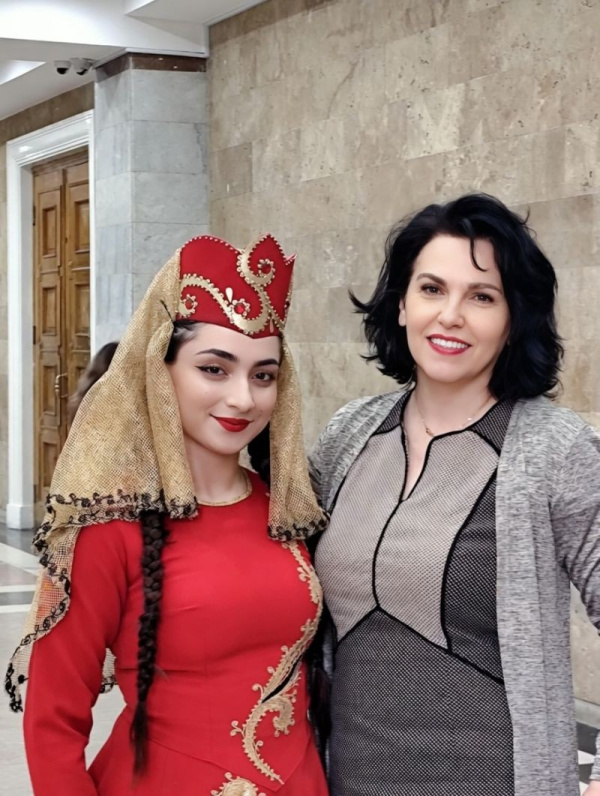
What I did not expect was how quickly Yerevan would draw me out of my office. During celebrations of International Dance Day at YSU, or in Republic Square when the entire city seemed to come alive with music and people in the streets, it was impossible not to join that energy.

Armenians carry history within them, but also a sense of collective strength and joy. I often listened in the evenings to the symphonic folk piece Sasuntsi Davit, and I began regularly attending concerts in Yerevan. Those moments, perhaps, taught me as much about Armenia as many political discussions.

– How would you describe Armenia to someone who has never visited?

– I would tell them to be prepared to encounter a country distinguished by exceptional beauty, resilience, seriousness, and strategic depth.

For me, diplomatic engagements, as well as the European Political Community Summit in Yerevan, were a political affirmation of Armenia's sovereign trajectory and growing connectivity. The agreements reached — including the Connectivity Partnership and expanded cooperation frameworks — are important signals.

However, Armenia's long-term future will depend primarily on strategic independence: institutional resilience, democratic consolidation, technological development, energy diversification, and confidence in its own path.

Armenia may be in one of those rare phases in which it is no longer only being shaped by history, but is also quietly helping shape it.


Nara Martirosyan
ShareFacebookTelegram

Latest News

Armenia is no longer only being shaped by history, but is also helping shape it — YSU professor

18.05.2026

Հանդիպում մեկ տանիքի տակ․ կայացավ ԵՊՀ շրջանավարտների ֆորումը

16.05.2026

Three-day teacher training at Yerevan State University

15.05.2026
Show All

Announcement

Invitation to Online Conference: American Research Institute of the South Caucasus

09.17.2026 - 09.19.2026

Invitation to Participate in International Conference "Armenia: Crossroads of Centuries and Worlds"

06.18.2026 - 06.19.2026

Erasmus+ International Credit Mobility: WSB University, Poland

05.15.2026 - 05.27.2026
Show All

Արագ հասանելիություն

  • Intranet
  • E-learning
  • Mulberry
  • Online applications
  • Phone book
  • Registrar
  • Documentation

Footer(ENG)

  • Main pages
    • Admission
    • Education
    • Science
    • News
  • Information
    • Frequently asked Questions
    • Vacancies
    • Search for educational programs
    • For the applicants
    • For the students
  • About YSU
    • YSU management
    • YSU symbols
© Yerevan state university 2026
Address: Republic of Armenia, Yerevan, 0025, 1 Alex Manoogian (+37460) 710000 info@ysu.am