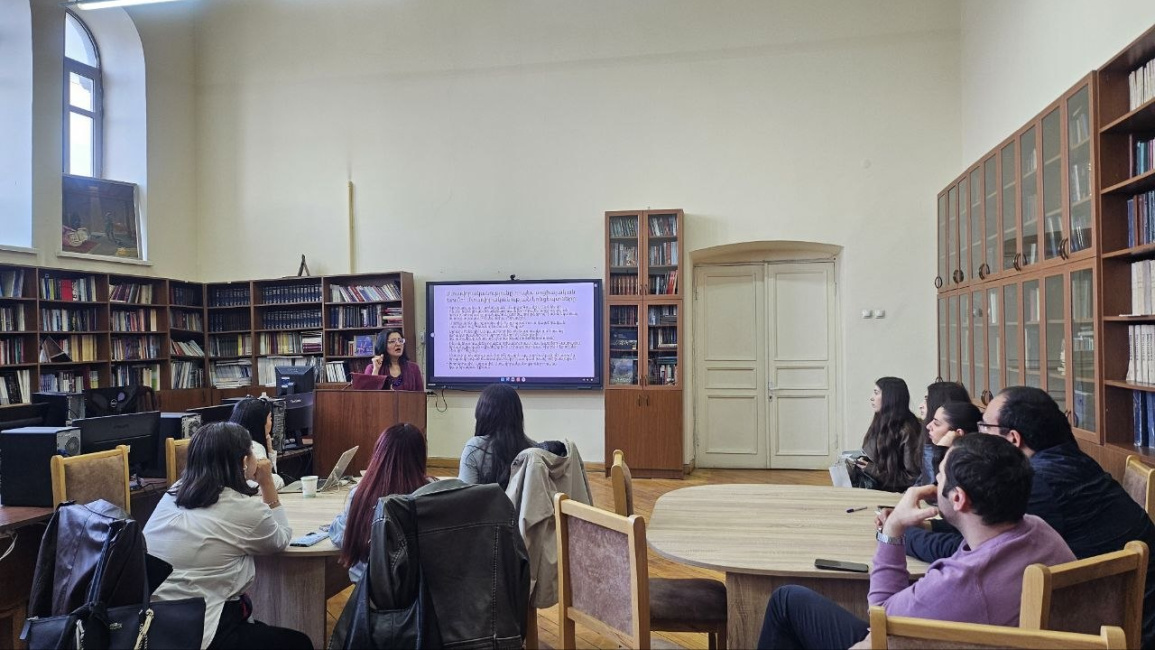
On April 7, within the framework of the annual seminar on scientific results at Yerevan State University, a seminar titled "Soviet Intelligentsia as Discursive Group and Its Transformations" was held at the Faculty of History. Associate Professor of the Chair of Culturology, PhD in History Yulia Antonyan presented the results of a study conducted under the Higher Education and Science Committee of the RA Ministry of Education, Science, Culture and Sports program "Research in the Fields of Social Sciences, Armenian Studies, and Humanities–2024."
The research focuses on the analysis of the formation mechanisms, developmental processes, and post-Soviet transformations of the Soviet intelligentsia as a distinct social stratum. Within this framework, Antonyan identifies several subgroups of the intelligentsia that demonstrated differentiated patterns of behavior and social roles within the Soviet ideological system.
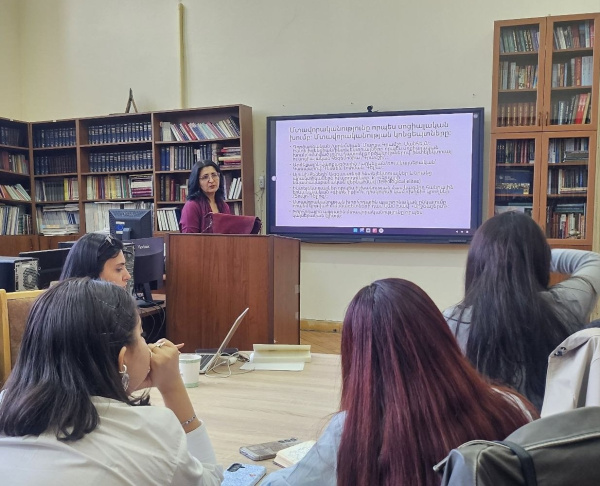
The speaker addressed the characteristics of official and public perceptions of the intelligentsia during the Soviet period, noting that despite ambivalent attitudes, the concept of the intelligentsia was fully integrated into the logic of Stalin-era "social engineering." According to the researcher, this process was largely formal in nature, as a new category—the "Soviet socialist intelligentsia"—was being constructed as a specific intermediary social layer.
Antonyan emphasized that this structure was not homogeneous and was clearly divided into two main poles: the humanities and the technical intelligentsia. This division was determined not only by professional orientation but also by a clearly defined distribution of socio-political functions, as the defining characteristics of the intelligentsia were primarily functional, grounded in occupation and public role.
In the case of the technical intelligentsia, the situation was significantly different. Engineers, physicists, and architects were engaged in the technological modernization of the country and the provision of material foundations for socialist development. The speaker noted that while the humanities sector was subject to strict ideological control, the technical intelligentsia enjoyed a certain limited but real degree of autonomy, driven by the imperatives of technological progress.
Particular attention was given to the existence of "closed enclaves," where the technical intelligentsia was able to carry out professional activities under relatively autonomous conditions. This phenomenon was discussed in the context of the well-known Soviet intellectual debate between "physicists and lyricists," highlighting the relative dominance of technical intellectualism. As a practical example, the research examined the experience of the Mergelyan Institute as an organized and systematized manifestation of the technical intelligentsia.
In conclusion, Associate Professor Antonyan noted that the systemic collapse of the post-Soviet period had a profound impact on the technical intelligentsia, dismantling imperial scientific-industrial structures. As a result, part of the technical intelligentsia was transformed and integrated into new communities of digital technologies, while another segment was reconfigured or shifted into other social and professional spheres.