Home
envelope
ՀայերենРусскийEnglish

Main Navigation (Eng)

  • Admission
    • Undergraduate admission
    • Master’s degree admission
    • Postgraduate admission
    • Foreign Students
    • Preparatory courses
    • Work Carried out with Applicants
    • YSU STEM High School
  • Education
    • Guide Book for First Year Students
    • Educational programs
    • Granting qualification of a pedagogue
    • Center for Academic Writing
    • Continuing education
    • Academic Calendar
    • Olympiad
  • Science
    • Open science
    • Conferences
    • Library
    • Grants
    • Publishing House
    • Doctoral Thesis Defence Councils
    • HRS4R
  • News and events
    • Events
    • Activities
    • News
    • Newsletter
    • Announcement
    • Photo gallery
    • Video gallery

Secondary Navigation (Eng)

  • About YSU
    • YSU Management
    • YSU Symbols
    • YSU International Cooperation
    • Quality assurance
    • YSU History Museum
    • Vacancies
    • FAQ
  • Structure
    • YSU Faculties and Educational Centers
      • Faculty of Geography and Geology
      • Faculty of Theology
      • Faculty of Oriental Studies
      • Faculty of European Languages and Communication
      • Faculty of Journalism
      • Faculty of Informatics and Applied Mathematics
      • Faculty of Law
      • Faculty of Biology
      • Faculty of Armenian Philology
      • Faculty of International Relations
      • Faculty of History
      • Institute of Physics
      • Faculty of Russian Philology
      • Faculty of Sociology
      • Faculty of Economics and Management
      • Faculty of Philosophy and Psychology
      • Faculty of Chemistry
      • Faculty of Mathematics and Mechanics
      • Pedagogy and Education Development Center
      • Center for European Studies
      • Institute of Pharmacy
      • Information Technologies Educational and Research Center
      • Chair of Civil Defense
      • Chair of Physical Education and Sports
    • Column Wrapper
      • YSU STEM High School
      • YSU Ijevan Branch
    • Scientific Centers and Laboratories
      • American Studies Center
      • Psychology Research Center
      • Research Laboratory of Applied Sociology
      • Center for Mathematical and Applied Research
      • Institute for Armenian Studies
      • Institute for Social and Humanitarian Studies
      • Research Center for Chemistry
      • Research Institute of Biology
      • Research Institute of Physics
      • Research Center for the Institute of Pharmacy
    • Scientific and Educational Centers
      • Observatory
      • Scientific and Educational Center for Control and Monitoring of the Quality of Medicines
      • Specialized cabinet-laboratory for the Design of Very Large Integrated Circuits (Synopsis)
      • Legal Clinic
      • Center for Applied Psychology
      • Research Center-Library of Greek Studies
      • Innovation Center for Microbial Biotechnology and Biofuels
      • Russian Center
      • Center for Russian Studies
      • Distance Learning Laboratory of Sociology
    • Column Wrapper
      • Banner
    • Administrative Divisions of YSU
      • Academic Secretary
      • Center for Doctoral Education
      • General Division
      • YSU History Museum
      • Department of Energy System Operation
      • Financial Analysis Department
      • Human Resources Department
      • Center for Admissions and Affairs with Applicants
      • Vehicle Fleet
      • Business Incubator
      • Byurakan Industrial Practice Base
      • Medical Center
      • Science Policy Department
      • Procurement Planning Department
      • Dilijan Sports and Health Center
      • YSU Archive
      • Publishing House
      • Legal Service
      • Marketing Department
      • International Cooperation Office
      • Tsaghkadzor training and production base
      • Cultural Center
      • Fire Safety Service
      • Alumni and Career Center
      • Hankavan Industrial Practice Base
      • Accounting Department
      • Center for Quality Assurance
      • Department for Special Affairs
      • Guest House
      • Student Dormitory
      • Educational-Methodological Department
      • Marie and Sarkis Izmirlian Library
      • Center for Strategic Planning
      • Rectorate
      • Rector's Office
      • Department of Territory Improvement and Landscape Design
      • Information Technology Department
      • Department of Organization and Control of Economic Activities
  • Structure
  • Alumni and Career
    • Alumni Community
    • Career Center
    • Friends of YSU
  • Student life
    • YSU Student Scientific Society
    • YSU Student Council
    • Art and Culture
ՀայերենРусскийEnglish
envelope

Main Navigation (Eng)

  • Admission
    • Undergraduate admission
    • Master’s degree admission
    • Postgraduate admission
    • Foreign Students
    • Preparatory courses
    • Work Carried out with Applicants
    • YSU STEM High School
  • Education
    • Guide Book for First Year Students
    • Educational programs
    • Granting qualification of a pedagogue
    • Center for Academic Writing
    • Continuing education
    • Academic Calendar
    • Olympiad
  • Science
    • Open science
    • Conferences
    • Library
    • Grants
    • Publishing House
    • Doctoral Thesis Defence Councils
    • HRS4R
  • News and events
    • Events
    • Activities
    • News
    • Newsletter
    • Announcement
    • Photo gallery
    • Video gallery

Secondary Navigation (Eng)

  • About YSU
    • YSU Management
    • YSU Symbols
    • YSU International Cooperation
    • Quality assurance
    • YSU History Museum
    • Vacancies
    • FAQ
  • Structure
    • YSU Faculties and Educational Centers
      • Faculty of Geography and Geology
      • Faculty of Theology
      • Faculty of Oriental Studies
      • Faculty of European Languages and Communication
      • Faculty of Journalism
      • Faculty of Informatics and Applied Mathematics
      • Faculty of Law
      • Faculty of Biology
      • Faculty of Armenian Philology
      • Faculty of International Relations
      • Faculty of History
      • Institute of Physics
      • Faculty of Russian Philology
      • Faculty of Sociology
      • Faculty of Economics and Management
      • Faculty of Philosophy and Psychology
      • Faculty of Chemistry
      • Faculty of Mathematics and Mechanics
      • Pedagogy and Education Development Center
      • Center for European Studies
      • Institute of Pharmacy
      • Information Technologies Educational and Research Center
      • Chair of Civil Defense
      • Chair of Physical Education and Sports
    • Column Wrapper
      • YSU STEM High School
      • YSU Ijevan Branch
    • Scientific Centers and Laboratories
      • American Studies Center
      • Psychology Research Center
      • Research Laboratory of Applied Sociology
      • Center for Mathematical and Applied Research
      • Institute for Armenian Studies
      • Institute for Social and Humanitarian Studies
      • Research Center for Chemistry
      • Research Institute of Biology
      • Research Institute of Physics
      • Research Center for the Institute of Pharmacy
    • Scientific and Educational Centers
      • Observatory
      • Scientific and Educational Center for Control and Monitoring of the Quality of Medicines
      • Specialized cabinet-laboratory for the Design of Very Large Integrated Circuits (Synopsis)
      • Legal Clinic
      • Center for Applied Psychology
      • Research Center-Library of Greek Studies
      • Innovation Center for Microbial Biotechnology and Biofuels
      • Russian Center
      • Center for Russian Studies
      • Distance Learning Laboratory of Sociology
    • Column Wrapper
      • Banner
    • Administrative Divisions of YSU
      • Academic Secretary
      • Center for Doctoral Education
      • General Division
      • YSU History Museum
      • Department of Energy System Operation
      • Financial Analysis Department
      • Human Resources Department
      • Center for Admissions and Affairs with Applicants
      • Vehicle Fleet
      • Business Incubator
      • Byurakan Industrial Practice Base
      • Medical Center
      • Science Policy Department
      • Procurement Planning Department
      • Dilijan Sports and Health Center
      • YSU Archive
      • Publishing House
      • Legal Service
      • Marketing Department
      • International Cooperation Office
      • Tsaghkadzor training and production base
      • Cultural Center
      • Fire Safety Service
      • Alumni and Career Center
      • Hankavan Industrial Practice Base
      • Accounting Department
      • Center for Quality Assurance
      • Department for Special Affairs
      • Guest House
      • Student Dormitory
      • Educational-Methodological Department
      • Marie and Sarkis Izmirlian Library
      • Center for Strategic Planning
      • Rectorate
      • Rector's Office
      • Department of Territory Improvement and Landscape Design
      • Information Technology Department
      • Department of Organization and Control of Economic Activities
  • Structure
  • Alumni and Career
    • Alumni Community
    • Career Center
    • Friends of YSU
  • Student life
    • YSU Student Scientific Society
    • YSU Student Council
    • Art and Culture
  1. Main
  2. News
  3. Religious terms in Classical Armenian: Article by YSU associate professors published in Scopus-indexed journal
February 06, 2026 | 12:00
Research
Publications and scientific journals
Culture

Religious terms in Classical Armenian: Article by YSU associate professors published in Scopus-indexed journal

In pagan belief, which, according to Yeznik Koghbatsi, is a combination of different sects, the worship of the sky is paralleled with the glorification of the four sacred terrestrial elements—water, earth, soil, and air. This is noted by YSU Associate Professor Gayane Mkhitaryan, who emphasizes that in his work "Eghts Aghandots" ("Refutation of the Sects"), Yeznik argues that the aforementioned elements are results of God's creation—visible and material—and therefore unworthy of worship.

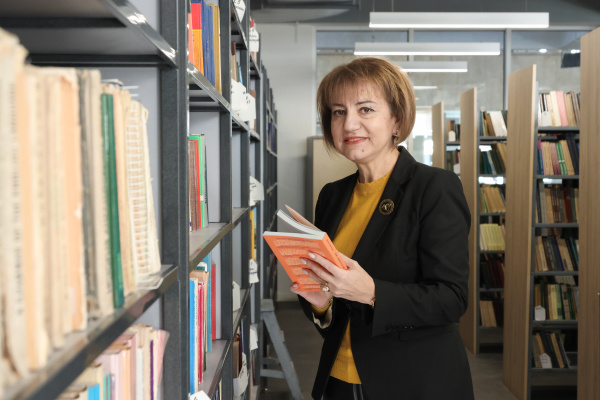
The scholarly article "Religious Terms in Classical Armenian Based on the Book 'Refutation of the Sects' by Yeznik Koghbatsi", authored by Gayane Mkrtchyan, Associate Professor at the YSU Chair of Armenian History, and Narine Dilbaryan, Associate Professor at the Chair of the Armenian Language History and General Linguistics, has been published in the highly ranked journal Forum for Linguistic Studies, which is indexed in the Scopus scientific database. 

According to Gayane Mkrtchyan, the purpose of the research is to present the manifestations of early medieval Armenian philosophical thought to the international scholarly community.

"In the 5th century, the Armenian language still lacked a fully developed terminology. Yeznik Koghbatsi succeeded in expressing many scientific concepts using ordinary words, endowing them with new meanings, while simultaneously introducing entirely new scientific terms into circulation," Gayane Mkrtchyan noted.  

According to her, in "Refutation of the Sects", Yeznik Koghbatsi primarily examines the issues of individual and collective human freedom and salvation from theological, philosophical, and political perspectives. 

"The philosophical approach to these issues leads to an analysis of free will, human activity, and the problems of good and evil," emphasized the YSU associate professor.

Commenting on the work, Gayane Mkrtchyan noted that in "Refutation of the Sects", Yeznik Koghbatsi refuted Zoroastrianism, paganism, and ancient philosophy from the standpoint of Christian monotheism. 

"Yeznik argued that evil is the result of free will, and that responsibility for all evils in the world lies with humanity rather than with God. According to him, God created a good world, and evil arose as a consequence of the misuse of human free will, not as a flaw in creation," said the co-author of the article, adding that Yeznik Koghbatsi also criticized astrology and pagan survivals, considering them superstitions contrary to reason. 

"He also rejected philosophy, subjected Greek polytheism and Epicurean atheism to criticism, and defended the Christian doctrine of creation," she emphasized.

Through this study, the YSU associate professors conducted a substantive analysis of religious and belief-related lexical units in the vocabulary of Yeznik's work, revealing semantic shifts and the vitality of religious terms.

According to Gayane Mkrtchyan, the semantic field of religion and beliefs comprises nuclear words that date back to ancient times. They are generally native in origin and represent root lexical units, from which new concepts and words later arise through affixation and compounding.

"The analysis of the lexical items belonging to the belief-related semantic field of Classical Armenian makes it possible to restore equivalent layers of the proto-language. Alongside their linguistic value, these layers possess great cultural value, as they reveal specificities of Indo-European worldviews and the relationships between spiritual and material cultures," she stressed.

According to the associate professor, the proto-Armenians, breaking away from the European unity, inherited a distinct system of the cultic world with ritual practices, which shaped the semantic field of terms expressing religious concepts.

"That is, certain words in the semantic field we are studying are not ancient in origin but serve as evidence of very early times," stated the YSU associate professor. 

According to Gayane Mkrtchyan, the divine, in its primary sense, refers to that which is endowed with God’s creative power and might—that is, the sacred—as well as to everything beyond the reach of mortals. Speaking on this topic, she noted: "People expect from divine powers either the performance of rituals for the benefit or protection of their actions, or the prevention of actions directed against them. These goals can be accomplished in two ways– by means of words, i.e., a prayer, and by means of some material things, for instance, sacrifice, 'մատաղ' (animal sacrifice), lighting a candle, incensing, bowing before totem statues or icons, crossing oneself."

Addressing words related to the semantic field of religion, Gayane Mkrtchyan emphasized: "Some words in the semantic field of religion were closely connected with the semantic field of law and rights in ancient times. Evidence of this is found in Yeznik Koghbatsi's work, since the primary law was the divine principle—the Word of God—which was indisputable. The word 'կրոն' itself derives from the root of the verb 'կրեմ' and is explained in the New Dictionary of the Haykazian Language as law and order."   

She added that the semantic field of religion is closely associated with the nuclear words of the semantic field of time, since time is a divine order itself, with periods of birth and death that parallel the notions of morning, daytime, evening, and night, beginning with a bright day, then gradually changing into sunset, and finally reaching resurrection.

The study also established that Yeznik Koghbatsi created distinctive word pairs using the negative prefixes "ան-" and "չ-", which linguistically represent the divine and non-divine, the sacred and the profane. Examples include "ասուն" and "անասուն" (man and animal), "խոսուն" and "անխոսուն" (speaking and non-speaking), "մտավոր" and "անմտավոր" (smart and stupid), "բանավոր" and "անբանավոր" (oral and non-oral), "էականք" and "չէականք" (essential ones and non-essential ones), "մշտնջենավորք" and "չմշտնջենավորք" (eternal and non-eternal, transient), "արարածք" and "չարարածք" (creatures and non-creatures). 

"Refutation of the Sects" consists of four chapters. Gayane Mkrtchyan noted that in the fourth chapter, "Refutation of the Heretic Marcion", the adjective "արդար" becomes synonymous with the word God. In the modern Armenian translation of the work, linguist Ashot Abrahamyan retains the word "արդար", adding "God" in parentheses for clarity, since the religious meaning of this word has become significantly obscured in contemporary Eastern Armenian. 
The YSU associate professors also examined beautiful multi-component Classical Armenian expressions belonging to the semantic field of religion, such as "ամենագետ գիտություն" (all-knowing science), "անպակաս իմաստնություն" (endless wisdom), "ամենարվեստ իմաստնություն" (richest wisdom), "աղբյուր բարության" (a source of kindness). Gayane Mkrtchyan emphasized that these expressions serve as phraseological equivalents of the word "God", while Yeznik Koghbatsi uses the expression "խոպանացյալ որդ" to refer to the sinful human being. 

"As humanity developed, the semantic structure of ancient words related to religion and beliefs underwent significant changes, as a result of which the supernatural gradually gave way to naturalness. Many words that originally carried religious meanings slowly became units of the general vocabulary and, having lost their purely ritual content, came to denote moral and legal values and qualities, such as 'բախտավորություն' (luck), 'բարերարություն' (benevolence), 'բարկություն' (anger), 'իմաստնություն' (wisdom), 'ողորմություն' (mercy), 'պատիժ' (punishment), 'չար' (evil), 'բարի' (kind), 'կենարար' (life-giving), and others," the associate professor added. 

According to Gayane Mkrtchyan, the contemporary relevance of "Refutation of the Sects" is manifested in several respects.

"First, it upholds human free will: according to Koghbatsi, existing evil is not of divine origin but is the result of human free will, which underscores the importance of moral responsibility. Second, superstition is rejected: Koghbatsi fundamentally refutes astrology, fatalism, and pagan survivals. Third, a struggle is waged against false ideologies," she stated, adding that the work promotes active resistance against negative influences and false values—such as superstition, pagan survivals, and astrology—and is therefore of exceptional significance even today.


Nara Martirosyan
ShareFacebookTelegram

Latest News

YSU hosts specialized training for history teachers on teaching "sensitive" topics

27.02.2026

Why institutional policies promoting equal participation of women and girls in science are essential: discussion at YSU

27.02.2026

YSU confirms results of chair head elections, regular session of Academic Council held

26.02.2026
Show All

Announcement

Առցանց գիտաժողովի հրավեր. Հարավային Կովկասի ամերիկյան հետազոտությունների ինստիտուտ

09.17.2026 - 09.19.2026

«Հայաստանը՝ դարերի ու աշխարհների խաչմերուկ» խորագրով միջազգային գիտաժողովի մասնակցության հրավեր

06.18.2026 - 06.19.2026

Դասընթացների մշակման մրցույթ

02.27.2026 - 03.25.2026
Show All

Quick access

  • Intranet
  • E-learning
  • Mulberry
  • Online applications
  • Phone book
  • Registrar
  • Documentation

Footer(ENG)

  • Main pages
    • Admission
    • Education
    • Science
    • News
  • Information
    • Frequently asked Questions
    • Vacancies
    • Search for educational programs
    • For the applicants
    • For the students
  • About YSU
    • YSU management
    • YSU symbols
© Yerevan state university 2026
Address: Republic of Armenia, Yerevan, 0025, 1 Alex Manoogian (+37460) 710000 info@ysu.am