Home
envelope
ՀայերենРусскийEnglish

Main Navigation (Eng)

  • Admission
    • Undergraduate admission
    • Master’s degree admission
    • Postgraduate admission
    • Foreign Students
    • Preparatory courses
    • Work Carried out with Applicants
    • YSU STEM High School
  • Education
    • Guide Book for First Year Students
    • Educational programs
    • Granting qualification of a pedagogue
    • Center for Academic Writing
    • Continuing education
    • Academic Calendar
    • Olympiad
  • Science
    • Open science
    • Conferences
    • Library
    • Grants
    • Publishing House
    • Doctoral Thesis Defence Councils
    • HRS4R
  • News and events
    • Events
    • Activities
    • News
    • Newsletter
    • Announcement
    • Photo gallery
    • Video gallery

Secondary Navigation (Eng)

  • About YSU
    • YSU Management
    • YSU Symbols
    • YSU International Cooperation
    • Quality assurance
    • YSU History Museum
    • Vacancies
    • FAQ
  • Structure
    • YSU Faculties and Educational Centers
      • Faculty of Geography and Geology
      • Faculty of Theology
      • Faculty of Oriental Studies
      • Faculty of European Languages and Communication
      • Faculty of Journalism
      • Faculty of Informatics and Applied Mathematics
      • Faculty of Law
      • Faculty of Biology
      • Faculty of Armenian Philology
      • Faculty of International Relations
      • Faculty of History
      • Institute of Physics
      • Faculty of Russian Philology
      • Faculty of Sociology
      • Faculty of Economics and Management
      • Faculty of Philosophy and Psychology
      • Faculty of Chemistry
      • Faculty of Mathematics and Mechanics
      • Pedagogy and Education Development Center
      • Center for European Studies
      • Institute of Pharmacy
      • Information Technologies Educational and Research Center
      • Chair of Civil Defense
      • Chair of Physical Education and Sports
    • Column Wrapper
      • YSU STEM High School
      • YSU Ijevan Branch
    • Scientific Centers and Laboratories
      • American Studies Center
      • Psychology Research Center
      • Research Laboratory of Applied Sociology
      • Center for Mathematical and Applied Research
      • Institute for Armenian Studies
      • Institute for Social and Humanitarian Studies
      • Research Center for Chemistry
      • Research Institute of Biology
      • Research Institute of Physics
      • Research Center for the Institute of Pharmacy
    • Scientific and Educational Centers
      • Observatory
      • Scientific and Educational Center for Control and Monitoring of the Quality of Medicines
      • Specialized cabinet-laboratory for the Design of Very Large Integrated Circuits (Synopsis)
      • Legal Clinic
      • Center for Applied Psychology
      • Research Center-Library of Greek Studies
      • Innovation Center for Microbial Biotechnology and Biofuels
      • Russian Center
      • Center for Russian Studies
      • Distance Learning Laboratory of Sociology
    • Column Wrapper
      • Banner
    • Administrative Divisions of YSU
      • Academic Secretary
      • Center for Doctoral Education
      • General Division
      • YSU History Museum
      • Department of Energy System Operation
      • Financial Analysis Department
      • Human Resources Department
      • Center for Admissions and Affairs with Applicants
      • Vehicle Fleet
      • Business Incubator
      • Byurakan Industrial Practice Base
      • Medical Center
      • Science Policy Department
      • Procurement Planning Department
      • Dilijan Sports and Health Center
      • YSU Archive
      • Publishing House
      • Legal Service
      • Marketing Department
      • International Cooperation Office
      • Tsaghkadzor training and production base
      • Cultural Center
      • Fire Safety Service
      • Alumni and Career Center
      • Hankavan Industrial Practice Base
      • Accounting Department
      • Center for Quality Assurance
      • Department for Special Affairs
      • Guest House
      • Student Dormitory
      • Educational-Methodological Department
      • Marie and Sarkis Izmirlian Library
      • Center for Strategic Planning
      • Rectorate
      • Rector's Office
      • Department of Territory Improvement and Landscape Design
      • Information Technology Department
      • Department of Organization and Control of Economic Activities
  • Structure
  • Alumni and Career
    • Alumni Community
    • Career Center
    • Friends of YSU
  • Student life
    • YSU Student Scientific Society
    • YSU Student Council
    • Art and Culture
ՀայերենРусскийEnglish
envelope

Main Navigation (Eng)

  • Admission
    • Undergraduate admission
    • Master’s degree admission
    • Postgraduate admission
    • Foreign Students
    • Preparatory courses
    • Work Carried out with Applicants
    • YSU STEM High School
  • Education
    • Guide Book for First Year Students
    • Educational programs
    • Granting qualification of a pedagogue
    • Center for Academic Writing
    • Continuing education
    • Academic Calendar
    • Olympiad
  • Science
    • Open science
    • Conferences
    • Library
    • Grants
    • Publishing House
    • Doctoral Thesis Defence Councils
    • HRS4R
  • News and events
    • Events
    • Activities
    • News
    • Newsletter
    • Announcement
    • Photo gallery
    • Video gallery

Secondary Navigation (Eng)

  • About YSU
    • YSU Management
    • YSU Symbols
    • YSU International Cooperation
    • Quality assurance
    • YSU History Museum
    • Vacancies
    • FAQ
  • Structure
    • YSU Faculties and Educational Centers
      • Faculty of Geography and Geology
      • Faculty of Theology
      • Faculty of Oriental Studies
      • Faculty of European Languages and Communication
      • Faculty of Journalism
      • Faculty of Informatics and Applied Mathematics
      • Faculty of Law
      • Faculty of Biology
      • Faculty of Armenian Philology
      • Faculty of International Relations
      • Faculty of History
      • Institute of Physics
      • Faculty of Russian Philology
      • Faculty of Sociology
      • Faculty of Economics and Management
      • Faculty of Philosophy and Psychology
      • Faculty of Chemistry
      • Faculty of Mathematics and Mechanics
      • Pedagogy and Education Development Center
      • Center for European Studies
      • Institute of Pharmacy
      • Information Technologies Educational and Research Center
      • Chair of Civil Defense
      • Chair of Physical Education and Sports
    • Column Wrapper
      • YSU STEM High School
      • YSU Ijevan Branch
    • Scientific Centers and Laboratories
      • American Studies Center
      • Psychology Research Center
      • Research Laboratory of Applied Sociology
      • Center for Mathematical and Applied Research
      • Institute for Armenian Studies
      • Institute for Social and Humanitarian Studies
      • Research Center for Chemistry
      • Research Institute of Biology
      • Research Institute of Physics
      • Research Center for the Institute of Pharmacy
    • Scientific and Educational Centers
      • Observatory
      • Scientific and Educational Center for Control and Monitoring of the Quality of Medicines
      • Specialized cabinet-laboratory for the Design of Very Large Integrated Circuits (Synopsis)
      • Legal Clinic
      • Center for Applied Psychology
      • Research Center-Library of Greek Studies
      • Innovation Center for Microbial Biotechnology and Biofuels
      • Russian Center
      • Center for Russian Studies
      • Distance Learning Laboratory of Sociology
    • Column Wrapper
      • Banner
    • Administrative Divisions of YSU
      • Academic Secretary
      • Center for Doctoral Education
      • General Division
      • YSU History Museum
      • Department of Energy System Operation
      • Financial Analysis Department
      • Human Resources Department
      • Center for Admissions and Affairs with Applicants
      • Vehicle Fleet
      • Business Incubator
      • Byurakan Industrial Practice Base
      • Medical Center
      • Science Policy Department
      • Procurement Planning Department
      • Dilijan Sports and Health Center
      • YSU Archive
      • Publishing House
      • Legal Service
      • Marketing Department
      • International Cooperation Office
      • Tsaghkadzor training and production base
      • Cultural Center
      • Fire Safety Service
      • Alumni and Career Center
      • Hankavan Industrial Practice Base
      • Accounting Department
      • Center for Quality Assurance
      • Department for Special Affairs
      • Guest House
      • Student Dormitory
      • Educational-Methodological Department
      • Marie and Sarkis Izmirlian Library
      • Center for Strategic Planning
      • Rectorate
      • Rector's Office
      • Department of Territory Improvement and Landscape Design
      • Information Technology Department
      • Department of Organization and Control of Economic Activities
  • Structure
  • Alumni and Career
    • Alumni Community
    • Career Center
    • Friends of YSU
  • Student life
    • YSU Student Scientific Society
    • YSU Student Council
    • Art and Culture
  1. Main
  2. News
  3. Why institutional policies promoting equal participation of women and girls in science are essential: discussion at YSU
February 27, 2026 | 11:22
Science
Research
International cooperation
Why institutional policies promoting equal participation of women and girls in science are essential: discussion at YSU

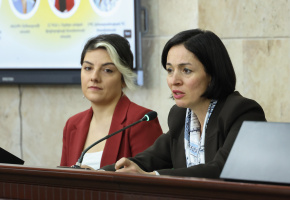
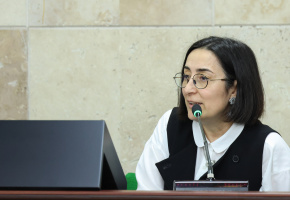
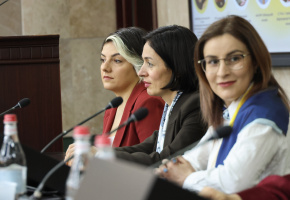
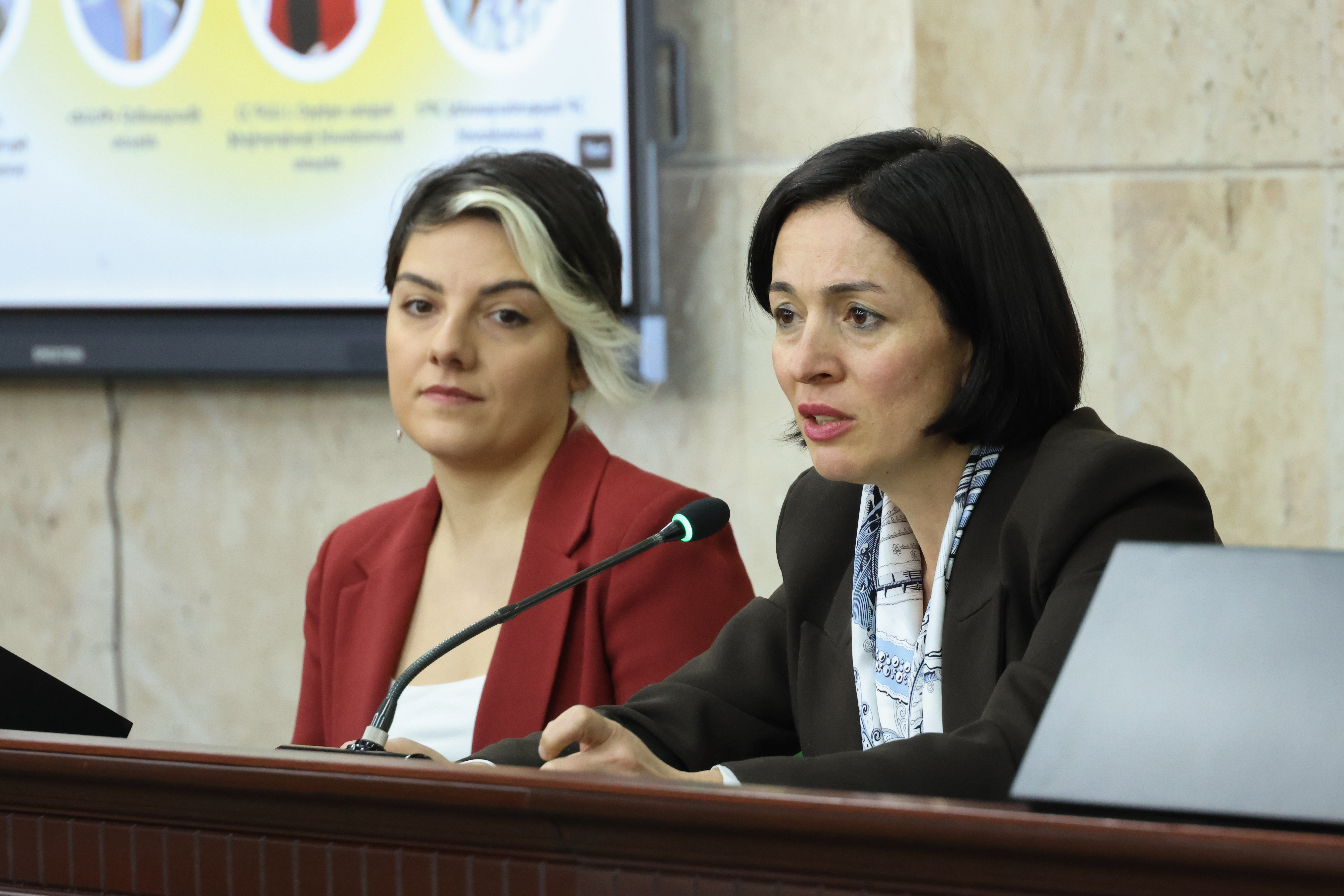
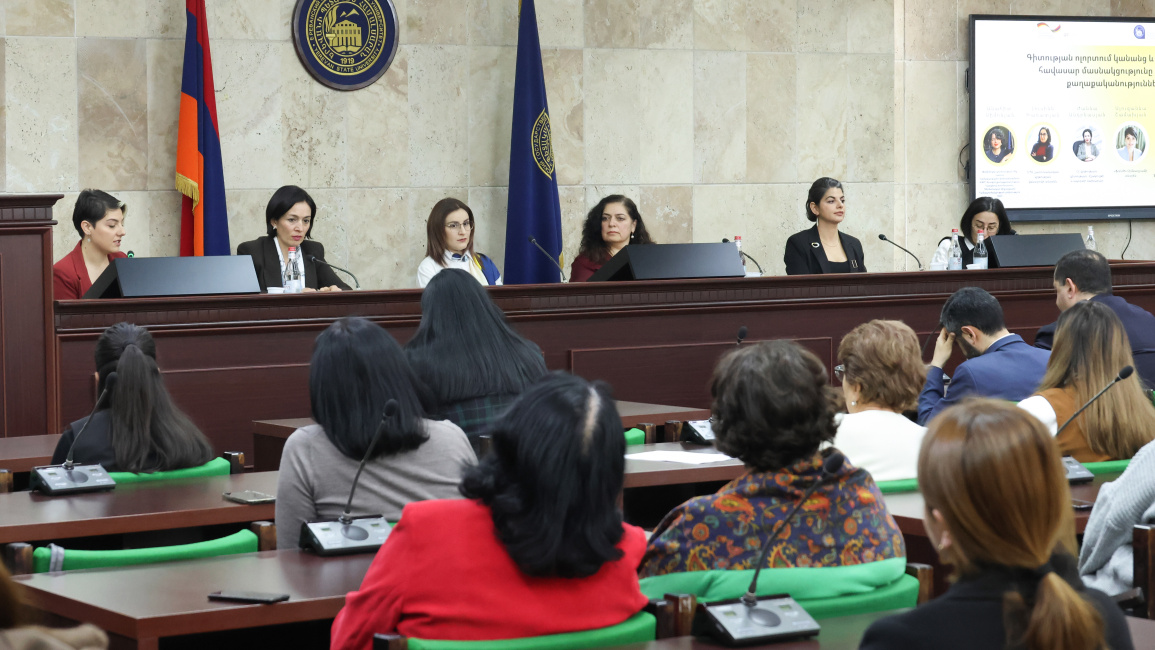
From laboratory and field research to publications in high-ranking international peer-reviewed journals, the statistical indicators for women and girls in Armenia's scientific sector appear optimistic. However, in substantive terms, they continue to face significant challenges. This was highlighted by speakers during a panel discussion held at Yerevan State University titled "Policies Promoting Equal Participation of Women and Girls in Science". By evaluating targeted programs currently underway, participants highlighted the persistent obstacles facing women in the field, while also proposing solutions and strategies to address them.

According to the Minister of Education, Science, Culture, and Sports of the Republic of Armenia, Zhanna Andreasyan, funding for science has increased by approximately 180 percent compared to 2018. Women currently account for 53.6 percent of the 3,761 researchers receiving baseline funding — a figure approximately 1.7 times higher than the global average. 

From supportive policies to a change in mindset

To enhance the participation of women and girls in science, clear and actionable policies are essential; however, without a corresponding shift in societal mindsets, such policies cannot achieve their full potential. Zhanna Andreasyan highlighted this point in response to a question from the panel moderator, Lusine Kharatyan, Director of the YSU Continuous Education Center, regarding the influence of social environments and entrenched gender stereotypes.
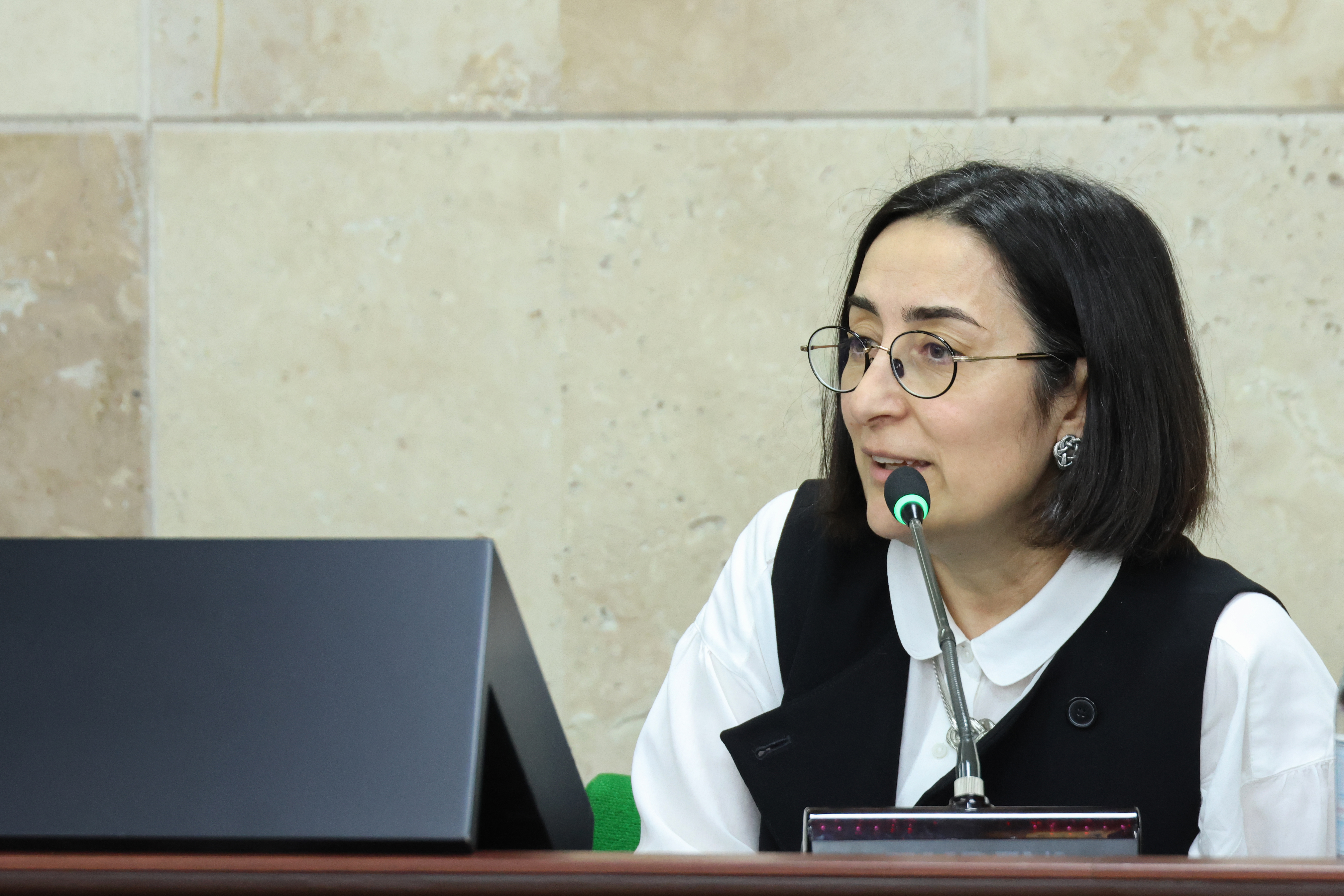
"Undoubtedly, there is a necessity for supportive policies. Such policies facilitate the increased involvement of women and girls in scientific domains. In the absence of these policies—or if they fail to be effectively implemented—I am confident that the statistical outcomes we observe today would not exist, and the situation would be even worse. This is because we are not yet in conditions where the existing environment inherently encourages women to pursue a scientific career," the minister noted, emphasizing that the broader environment does not sufficiently support women, particularly in mathematical and technical sciences.

Pointing out that stereotypes formed during school years often subtly demotivate girls, she observed, "Even unintentionally, girls are sometimes discouraged from pursuing certain types of activities… How often do we hear in schools that boys excel more in mathematics, and how many girls are thereby demotivated?" 

She further highlighted another statistical trend: female researchers are predominantly concentrated in biology and chemistry, whereas their representation in mathematical sciences remains low. According to her, this is not coincidental but reflects a systemic issue.  

Disproportionate burdens and structural barriers for women

Another critical factor underscored by the minister is the disproportionate allocation of familial and domestic responsibilities to women. Data indicates that women spend approximately five times more hours on household obligations than men, which, in turn, constrains their professional competitiveness, especially in scientific disciplines where working hours are often unregulated and require additional dedication. She stressed that the state must analyze existing challenges and establish mechanisms—also with the support of partners—to ensure that women's competitiveness in science continuously evolves in alignment with current developments.
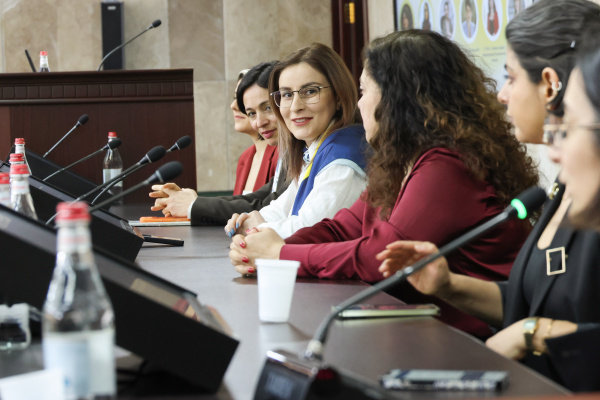
Heghine Gevorgyan, a researcher at the YSU Research Institute of Biology and one of the panel speakers, added that the adoption of policies will only yield tangible results if societal and educational mindsets change, starting from teachers and early childhood educators and extending to the family unit."

"It is all well and good to speak of policy—to organize, describe, and draft everything on paper—but substantial results depend on a change in mindset," she emphasized, noting that existing social environments shape primary difficulties, and unless that foundation changes, even current policies will fail to reach their full effectiveness.

Experiences and proposals discussed

Naira Ayvazyan, Director of the L. A. Orbeli Institute of Physiology at the National Academy of Sciences of Armenia, addressed the practical dimension of the issue, stressing that increasing women's participation in science is not solely a matter of motivation or special incentive policies. 

"The challenge is not to motivate young women to become scientists; that spark exists in many. The difficulties emerge at a later stage of their careers when a young mother also has a family, and this is precisely where obstacles arise," she stated.
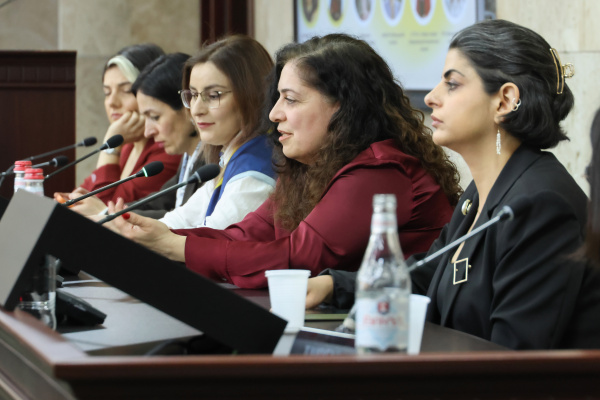
According to Naira Ayvazyan, at this stage, the issue extends beyond educational policy; institutions addressing social concerns play a substantial role. She highlighted the importance of supportive mechanisms, citing the example of preschool operating hours. For researchers with young children, this often presents a significant challenge, as public preschools generally operate until 6:00 p.m., and alternative solutions entail additional financial burdens. She emphasized that such matters must be addressed systemically to enhance women's position in science. 

International expertise, observations, and comparisons 

Suzanna Shamakhyan, Director of the Foundation for Armenian Science and Technology (FAST) and a panel speaker, contextualized the issue internationally, asserting that Armenia's situation should not be evaluated in isolation. In comparison with other countries, Armenia's statistical indicators are not unfavorable.

According to S. Shamakhyan, Armenia ranks reasonably well both in terms of girls pursuing STEM education and the number of active female scientists.
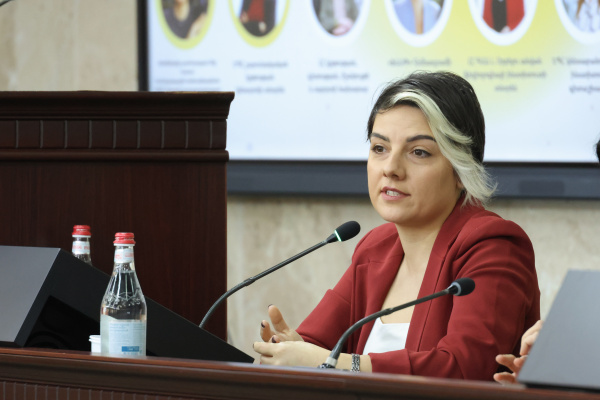
"If we look at the issue only in terms of statistics, we are in quite a favorable position — we could congratulate one another and go home," she remarked. However, in her view, the problem arises when the focus shifts from the numbers to substantive outcomes. 

She noted that the barriers in science often reflect the structural features of society at large. The work environment is historically modeled around men, with a '9-to-6' factory logic that persists through inertia. At the same time, she highlighted certain advantages in Armenia, such as social protection mechanisms that allow women to retain employment during maternity—a provision that is inaccessible to young female researchers in many countries.

S. Shamakhyan emphasized that the primary objective is to establish an environment in which both women and men have realistic opportunities to advance their careers. She added that, although interest and ideas are often present, significant gaps remain in progressing to subsequent career stages, and systemic support along this path remains insufficient. 

The role of the school environment

Anahit Simonyan, Policy Advisor for the Feminism in Action for Structural Transformation (FAST) program under GIZ, and the panel moderator, questioned participants regarding new standards in general education and their methodological and value-based components. She inquired about measures ensuring that teaching approaches and school environments are gender-sensitive and facilitate the dismantling of obstructive stereotypes.

Minister Zhanna Andreasyan responded that the process will take time, as schools are not isolated from society and the issue requires consistent efforts.

"Schools do not exist in a 'vacuum'; they are part of our society. The teachers entering classrooms are also members of the broader social environment, and it is unrealistic to expect entirely different behavior from them without systemic societal change," she remarked, adding that the social conduct of educators must also be perceived within the context of pedagogical activity. 
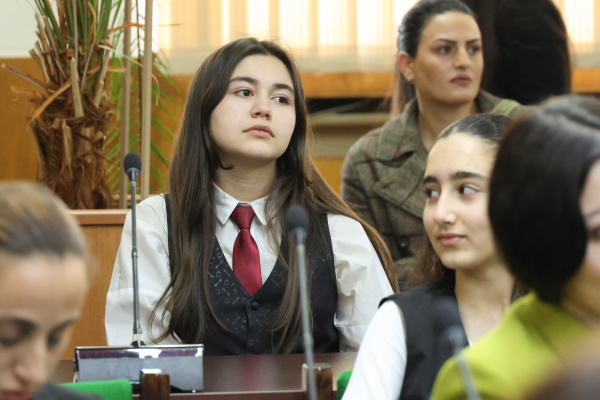
According to the minister, the state is implementing various programs, including teacher training, curriculum revision and monitoring, yet the anticipated transformation will only occur if societal attitudes toward schools and education evolve in parallel.

During the discussion, participants also addressed a range of issues related to the participation of women and girls in science—from fostering scientific interest among girls at school age to labor rights and legal frameworks.

Nurturing scientific interest from school

In response to the moderator's question whether there are special approaches to nurturing interest in science from an early school age, the minister shared an initiative she had recently launched to advance that objective. 

"I recently proposed that our students visit research institutes together to explore ongoing projects, meet scientists, and understand their work. Student interest has been significant, and each institute is willing to host them, providing explanations and demonstrations. This is a small step, yet it already makes an impact. Imagine the opportunities that can emerge through broader programs," she noted, emphasizing that similar initiatives have already achieved success, including on an international scale.

"Thus, we can be confident that properly organized, innovative approaches can yield effective solutions," the minister concluded.

The discussion was held within the framework of the event "Women in Science: Equal Rights, Equal Opportunities", organized on the occasion of the International Day of Women and Girls in Science. The event was organized by Yerevan State University with financial support from the Government of Germany and carried out within the framework of the Feminism in Action for Structural Transformation (FAST) and Women's Empowerment for Wellbeing (WoW) programs, implemented by the German Agency for International Cooperation (GIZ).


  • Download
  • Download
  • Download
    ShareFacebookTelegram

    Latest News

    ԵՊՀ կենսաբանության ֆակուլտետում ամփոփվում են գիտական արդյունքները և ուրվագծվում նոր ուղիներ

    19.03.2026

    Prospects for Armenian–Swiss academic cooperation discussed at YSU

    19.03.2026

    From YSU to Varna University of Management: student's international experience in tourism

    19.03.2026
    Show All

    Announcement

    Invitation to Online Conference: American Research Institute of the South Caucasus

    09.17.2026 - 09.19.2026

    Invitation to Participate in International Conference "Armenia: Crossroads of Centuries and Worlds"

    06.18.2026 - 06.19.2026

    Grant Competition for Invited Professorship at Yerevan State University

    04.10.2026 - 05.20.2026
    Show All

    Quick access

    • Intranet
    • E-learning
    • Mulberry
    • Online applications
    • Phone book
    • Registrar
    • Documentation

    Footer(ENG)

    • Main pages
      • Admission
      • Education
      • Science
      • News
    • Information
      • Frequently asked Questions
      • Vacancies
      • Search for educational programs
      • For the applicants
      • For the students
    • About YSU
      • YSU management
      • YSU symbols
    © Yerevan state university 2026
    Address: Republic of Armenia, Yerevan, 0025, 1 Alex Manoogian (+37460) 710000 info@ysu.am