May 22, 2026 | 14:14
Education
International cooperation
Policy
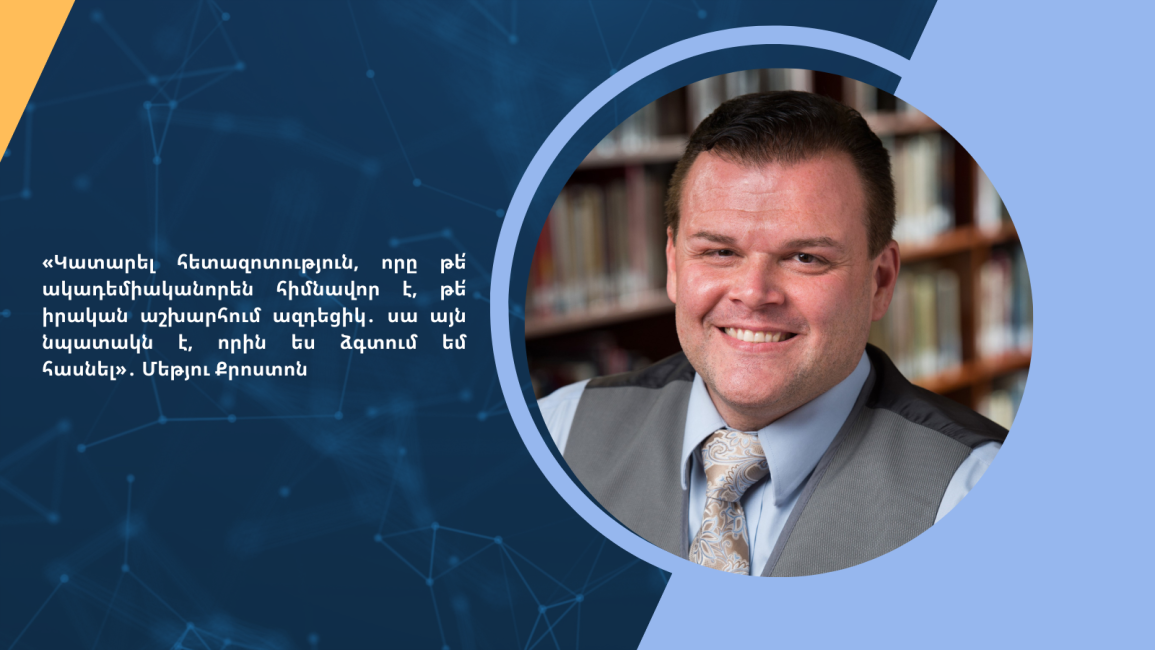
In an interview with us, Professor Crosston discussed his approaches to remote teaching, the role of lobbying, notable Armenian lobbying initiatives, and his joint research projects with YSU scholars.
– Mr. Crosston, what modern methods do you use in remote lecturing with YSU students?
– My approaches and strategies primarily aim to increase YSU students' interest in the course. Ultimately, the greatest challenge of remote learning is whether the professor is willing to "entertain" them with different learning styles and engagement opportunities while also ensuring that everyone shares the same expectations regarding conduct and performance.
I do this in several ways: using breakout rooms for group work and peer discussions; encouraging the use of chat functions on online platforms (such as Zoom) for Q&A and real-time interaction; developing a digital code of conduct; clearly communicating grading criteria and response timelines; using visual materials and infographics to make guidelines easier to remember; assigning rotating student moderators for online discussions; regularly holding one-on-one check-ins with students; sharing curated YouTube playlists or TED Talks relevant to the subject; allowing multiple formats for assignments (video, audio, essay, slides); and organizing regular Q&A sessions or virtual coffee hours.
Of course, all of this is not a "magic formula" for a successful course. But taken together, these methods communicate to YSU students that the professor cares about their success and is committed to helping that success happen.
– What role does lobbying play in global politics today?
– In fact, while most people assume lobbying is more about domestic politics and/or economic issues, the reality is that lobbying is a critical secret backbone of peacemaking and conflict de-escalation. In the view of some analysts, the failure of lobbying efforts is one of the main reasons why conflicts in Israel, Ukraine, and now Iran have continued—and in some cases intensified. Even now, with President Trump currently visiting China, President Xi Jinping is making it clear how relevant lobbying is: his initial statements during the presidential visit indicated that China's primary concern is to lobby Trump not to think there can be connections made between American actions in Iran and possibilities for future action in Taiwan.
These high-level negotiations are, in fact, nothing more than one side lobbying the other, using dedicated long-established techniques made famous many decades ago by lobbyists.
– Do you encourage YSU students to get involved in international lobbying processes?
– It is not so much about encouraging them to get involved in international lobbying processes but exposing them to the range of opportunities that exist and the channels through which they can become involved later if they wish. Today's reality is that global Generation Z—which is what all current students are—tends to be very narrowly focused, largely a consequence of their loyalty to social media and victims of their own search algorithms. Trying to help students realize how expansive and fascinating the world is beyond those algorithms is what is most important, regardless of the subject being taught in a given semester.
– In terms of lobbying initiatives, this is especially relevant, as there are literally tens of thousands of lobbying groups and projects worldwide, all of them with an active online presence and all of them interested in enlarging their reach and scope and gaining followers willing to "engage the cause." We did this with the YSU students to expose them to what is possible for their futures. These are truly exciting times.
– Could you highlight successful or notable Armenian lobbying initiatives in recent years?
– Since it is highly important that students believe in the instructor's ability to provide information that is both unfamiliar to them and still credible and relevant, I focused on Armenian lobbying initiatives in the United States, where I reside. I felt this would be doubly relevant for YSU students, as I correctly assumed they were not aware that Armenia has any lobbying influence in the United States, nor did they have substantial background knowledge of the current affairs and priorities of the Armenian global diaspora. The areas highlighted included:
For decades, Armenian-American organizations such as the Armenian National Committee of America (ANCA) and the Armenian Assembly of America (AAA) have pushed for U.S. recognition of the Armenian Genocide. These efforts culminated in bipartisan congressional recognition and President Biden's acknowledgment, a major diplomatic win for the Armenian cause.
Through grassroots mobilization and targeted lobbying, Armenian groups successfully lobbied to maintain Section 907 of the Freedom Support Act, which restricts U.S. military aid to Azerbaijan.
In 2026, ANCA-backed lawmakers sent letters to Congress demanding $30 million for defense cooperation with Armenia, $100 million for Armenians in Karabakh, a ban on military aid to Azerbaijan, and sanctions against Azerbaijani officials under the Global Magnitsky Act.
The Armenian government has hired firms such as First Channel America, Inc. to run U.S.-based advertising and cultural programming, aiming to shape public perception and strengthen Armenia's soft power in general.
– You are conducting a joint research project with Zhak Manukyan, Head of the Chair of International Relations and Diplomacy at YSU, titled "Transformations of Post-Soviet Integration Models in the Context of Three Crises." Why did you choose this topic, what makes it relevant, what sources are you using, and how do you plan to publicize the results?
– This is an exciting and hugely impactful project. While not getting too lost in the weeds, our findings indicate that the analyzed crises have exerted a profound influence on integration models, occasionally resulting in structural deformations that have not previously been considered in academia or the real-world policy community.
Under crisis conditions, the Commonwealth of Independent States (CIS) has demonstrated a surprising degree of viability. It should be regarded as a foundational framework for Greater Eurasian Integration while continuing to serve as a platform for diplomatic dialogue. Bringing this evidence forward helps shed a more positive light on states that have so far been largely disregarded or little considered.
Ultimately, we would like to see the research published in a leading Scopus-indexed academic journal. However, more importantly, I would like to see this work reach practicing diplomats around the world and become a regular read for policy practitioners. Being able to produce research that is both academically rigorous and real-world impactful is always the goal I aim to achieve.