July 08, 2026 | 16:00
Science
Education
Society
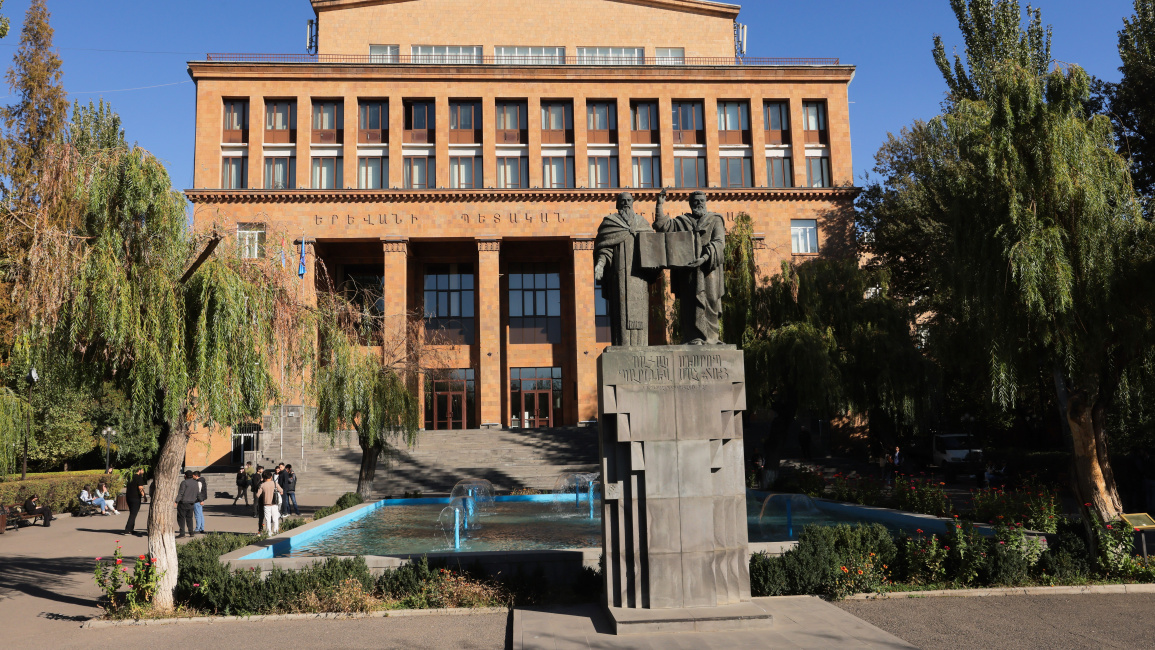
9 / 9 Indicators showing growth in 2024-2027 | 75th YSU's global ranking by employment outcomes | 601–620 In Physics and Astronomy |
|---|
Since 2022, YSU has entered the QS international rankings to receive an independent, methodologically grounded assessment of the progress and effectiveness of the university's reforms, integrating into the global higher education community, becoming familiar with international evaluation standards, and applying them in internal quality assurance endeavors.
At the initial stage, the evaluation process revealed a number of shortcomings, including the absence of documents regulating certain areas and the need for data collection tools. Addressing these issues enabled YSU to initiate many important internal reforms. QS evaluation is based on criteria related to education, research, internationalization, sustainability and links with the labour market.
In 2023, QS substantially revised its evaluation methodology, adding new criteria, including sustainability, international research networks and employment outcomes. For this reason, a full chronological comparison is possible only for 2024-2027. During this period, YSU recorded steady, tangible growth in almost all areas.
Key results • The comparison for 2024-2027 shows progress across all 9 areas of evaluation. • The comparison for 2026-2027 shows growth in 5 out of 9 areas. • The most significant increases were recorded in employment outcomes, up 59.4 points, and sustainability, up 16.2 points. |
|---|
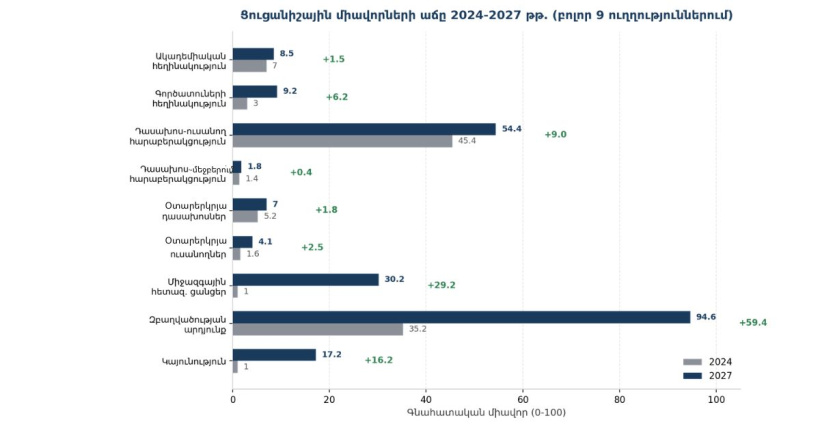
As shown in the chart above, the 2027 score exceeds the 2024 score in all nine indicators. This is direct evidence of the university's real and consistent progress, regardless of its overall ranking position.
| Indicator | 2024 | 2025 | 2026 | 2027 |
|---|---|---|---|---|
Academic reputation | 7,0 (601+) | 7,0 (601+) | 8,7 (701+) | 8,5 (701+) |
Employer reputation | 3,0 (601+) | 2,9 (601+) | 6,0 (701+) | 9,2 (701+) |
Faculty-student ratio | 45,4 (347) | 51,4 (295) | 64,8 (271) | 54,4 (349) |
Citations per faculty | 1,4 (701+) | 1,3 (701+) | 1,9 (801+) | 1,8 (801+) |
International faculty ratio | 5,2 (701+) | 5,1 (701+) | 8,7 (801+) | 7,0 (801+) |
International student ratio | 1,6 (701+) | 1,7 (701+) | 3,0 (801+) | 4,1 (801+) |
International research network | 1,0 (701+) | 20 (701+) | 21,2 (801+) | 30,2 (801+) |
Employment outcomes | 35,2 (215) | 87,4 (92) | 90 (106) | 94,6 (75) |
Sustainability | 1,0 (701+) | 1,0 (701+) | 13,3 (801+) | 17,2 (801+) |
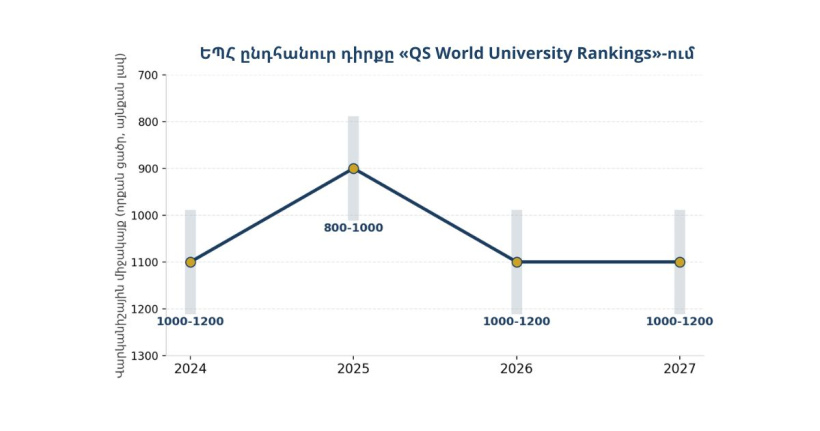
Despite steady score growth across almost all indicators, YSU's overall ranking position, namely its ranking band, has not improved linearly over the years. This is due to two objective external factors that are independent of YSU's actual performance:
Methodology change in 2023: QS changed the weighting of its evaluation criteria and added new indicators, reshaping the relative positions of all participating universities and making direct comparison with data before 2024 more difficult.
Sharp increase in participating universities: Over the past two to three years, the number of universities applying to be included in the ranking system has doubled, especially from the Asian region, including China, Indonesia, Kazakhstan, Uzbekistan, Azerbaijan and other countries. This increases competition for every ranking position, even when a university's own score rises.
In other words, YSU has recorded visible progress compared with its previous results. However, amid the sharp increase in global competition, this progress has not been fully reflected in an improved overall ranking position. This is a widely observed trend in the region and globally among many universities in mid- and high-ranking positions.
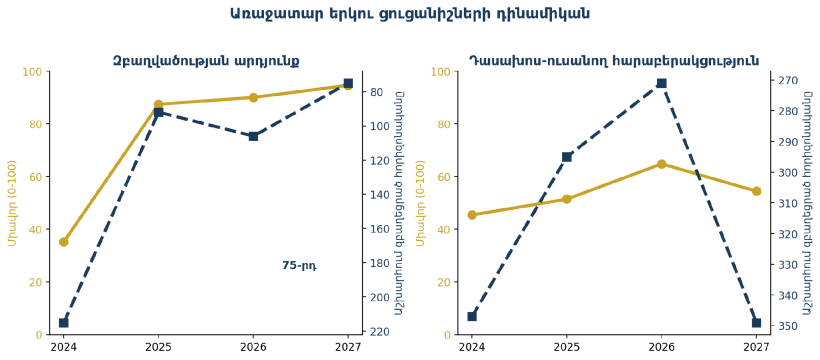
YSU's progress in two areas is particularly significant and deserves special attention.
Employment outcomes: The score increased from 35.2 to 94.6, while the university's global ranking improved from 215th to 75th.
Faculty-student ratio: The score reached 64.8 in 2026, indicating an improvement in the quality of the educational process.
At the same time, YSU recorded its best result in the subject rankings in Physics and Astronomy, placing 601-620. In the QS Europe Region Rankings, the university is ranked 487th, strengthening its position in the European higher education system.
The weakest results were recorded in the international student ratio and citations per faculty indicators, for which there are clear, objective reasons.
The low number of international students and faculty has largely been due to previously existing legislative restrictions, which limited opportunities to attract foreign students and faculty.
The low citation score compared with the global average reflects both past and current levels of research funding. Nevertheless, this indicator shows continuous positive dynamics, rising from 1.4 to 1.9, and this growth is expected not only to continue but also to accelerate in the coming years.
In both cases, the hindering factors are external and historically conditioned, while the current trend shows consistent improvement, demonstrating the effectiveness of the reforms implemented.
The analysis of YSU's 2024-2027 indicators in the QS international rankings shows consistent and multidimensional progress across all evaluation areas. The stability of the overall ranking position is due to objective external factors, namely the revision of the methodology and the sharp increase in global competition, rather than a decline in YSU's actual performance. The continuity of ongoing reforms and the trends already recorded provide grounds for expecting further improvement in the next ranking cycle.